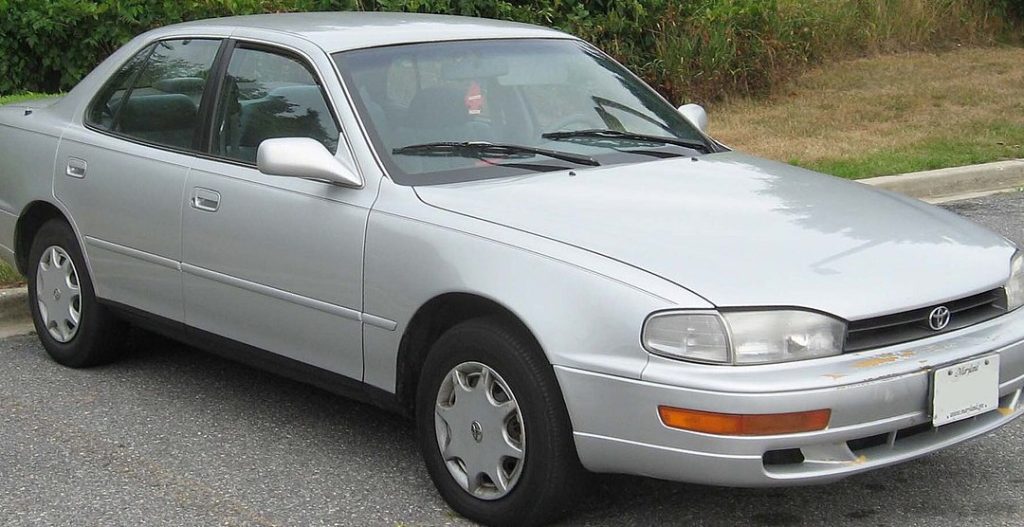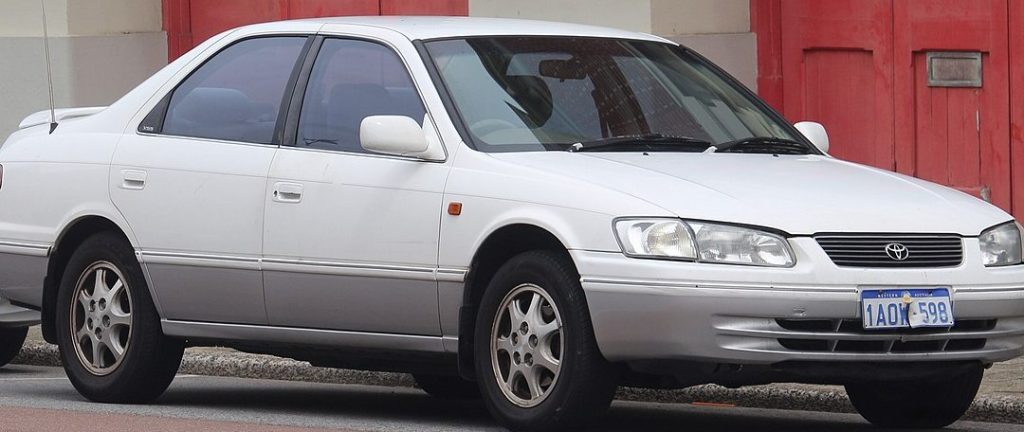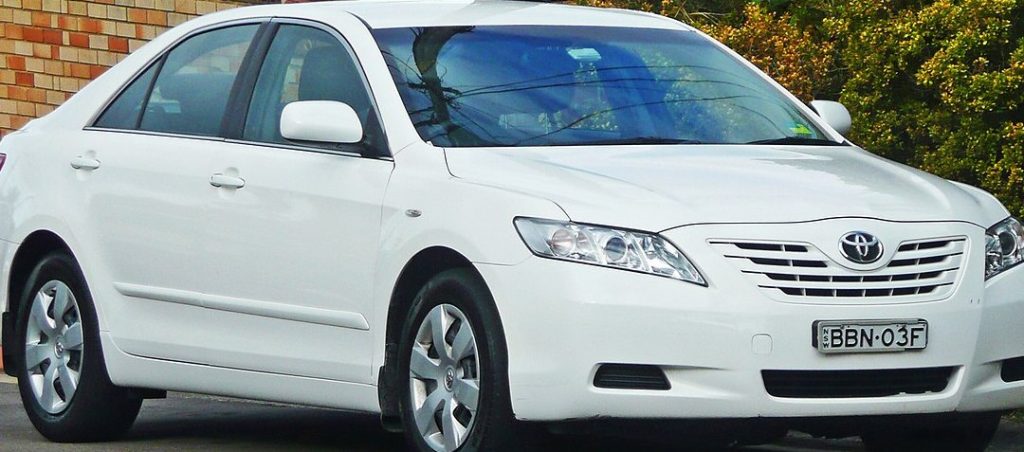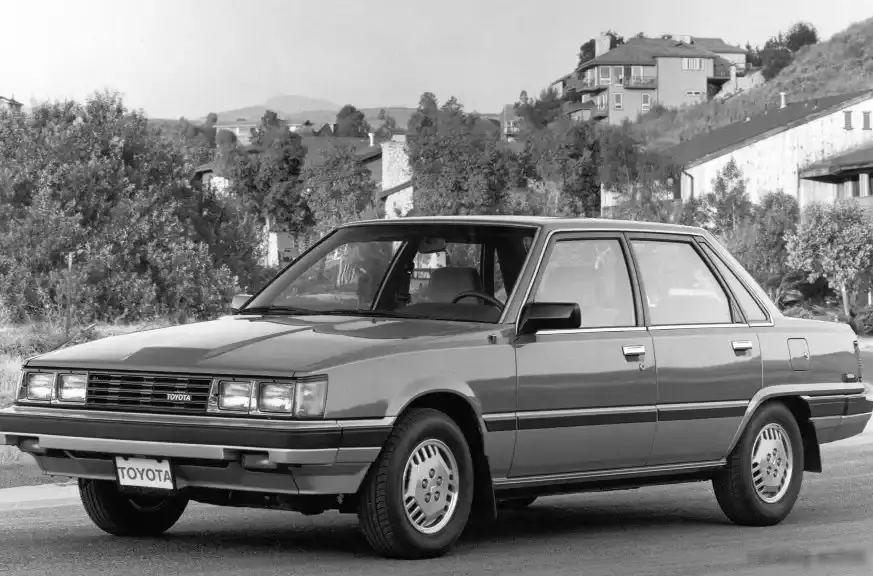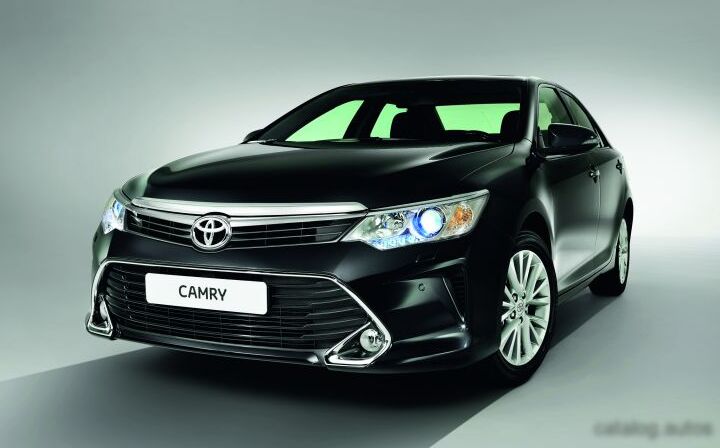
The Toyota Camry VII, specifically the facelifted version produced from 2014 to 2017, represented a significant evolution of Toyota’s best-selling mid-size sedan. Among the various trims offered, the 2.5-liter Hybrid model with the e-CVT transmission held a prominent position, appealing to buyers seeking fuel efficiency without sacrificing mainstream comfort and practicality. This variant, positioned as a mid-to-upper trim level, offered a compelling blend of performance and economy within the XV50 generation Camry lineup. It was a key player in Toyota’s push towards greater hybridization in the American market, where fuel costs and environmental concerns were increasingly influencing consumer choices.
Technical Specifications
| Brand | Toyota |
| Model | Camry |
| Generation | Camry VII (XV50, facelift 2014) |
| Type (Engine) | 2.5 (200 Hp) Hybrid e-CVT |
| Start of production | 2014 |
| End of production | 2017 |
| Powertrain Architecture | FHEV (Full Hybrid Electric Vehicle) |
| Body type | Sedan |
| Seats | 5 |
| Doors | 4 |
| Fuel consumption (urban) | 5.7 l/100 km (41.3 US mpg, 49.6 UK mpg, 17.5 km/l) |
| Fuel consumption (extra urban) | 6 l/100 km (39.2 US mpg, 47.1 UK mpg, 16.7 km/l) |
| Fuel consumption (combined) | 5.7 l/100 km (41.3 US mpg, 49.6 UK mpg, 17.5 km/l) |
| Fuel Type | Petrol (Gasoline) |
| Weight-to-power ratio | 7.9 kg/Hp, 126.5 Hp/tonne |
| Weight-to-torque ratio | 7.4 kg/Nm, 134.7 Nm/tonne |
| Battery voltage | 244.8 V |
| Battery technology | Nickel-metal hydride (NiMH) |
| Battery location | Behind the back wall of the passenger cabin |
| Electric motor power | 143 Hp |
| Electric motor torque | 270 Nm (199.14 lb.-ft.) |
| Electric motor location | Integrated into the transmission |
| Electric motor type | Synchronous |
| System power | 200 Hp @ 5700 rpm |
| System torque | 213 Nm @ 4500 rpm (157.1 lb.-ft. @ 4500 rpm) |
| Internal combustion engine power | 156 Hp @ 5700 rpm |
| Power per litre | 62.6 Hp/l |
| Internal combustion engine torque | 212 Nm @ 4500 rpm (156.36 lb.-ft. @ 4500 rpm) |
| Engine layout | Front, Transverse |
| Engine Model/Code | 2AR-FXE |
| Engine displacement | 2494 cm3 (152.19 cu. in.) |
| Number of cylinders | 4 |
| Engine configuration | Inline |
| Cylinder Bore | 90 mm (3.54 in.) |
| Piston Stroke | 98 mm (3.86 in.) |
| Compression ratio | 10.4:1 |
| Number of valves per cylinder | 4 |
| Fuel injection system | Multi-port manifold injection |
| Engine aspiration | Naturally aspirated engine |
| Valvetrain | DOHC. Dual VVT-i |
| Engine oil capacity | 4.4 l (4.65 US qt | 3.87 UK qt) |
| Coolant capacity | 7.2 l (7.61 US qt | 6.34 UK qt) |
| Kerb Weight | 1581 kg (3485.51 lbs.) |
| Trunk (boot) space (minimum) | 370 l (13.07 cu. ft.) |
| Fuel tank capacity | 64 l (16.91 US gal | 14.08 UK gal) |
| Length | 4849 mm (190.91 in.) |
| Width | 1821 mm (71.69 in.) |
| Height | 1470 mm (57.87 in.) |
| Wheelbase | 2776 mm (109.29 in.) |
| Front track | 1595 mm (62.8 in.) |
| Rear track | 1585 mm (62.4 in.) |
| Ride height (ground clearance) | 155 mm (6.1 in.) |
| Drag coefficient (Cd) | 0.27 |
| Minimum turning circle | 11.1 m (36.42 ft.) |
| Drivetrain Architecture | The Internal combustion engine (ICE) and electric motor drive the front wheels of the car with the ability to work in full electric or mixed mode. |
| Drive wheel | Front wheel drive |
| Number of gears and type of gearbox | automatic transmission e-CVT |
| Front suspension | Independent, type McPherson with coil spring and anti-roll bar |
| Rear suspension | Independent multi-link spring suspension with stabilizer |
| Front brakes | Ventilated discs |
| Rear brakes | Disc |
| Assisting systems | ABS (Anti-lock braking system) |
| Steering type | Steering rack and pinion |
| Power steering | Electric Steering |
| Tires size | 205/65 R16; 215/55 R17 |
| Wheel rims size | 7J x 16; 7J x 17 |
Powertrain & Engine Architecture
The heart of the 2014-2017 Camry Hybrid is the 2AR-FXE 2.5-liter inline-four engine. This engine utilizes a multi-port fuel injection system and Toyota’s Dual VVT-i (Variable Valve Timing-intelligence) technology for both intake and exhaust valves, optimizing efficiency and power delivery. The engine produces 156 horsepower and 156 lb-ft of torque. However, the system’s total output is 200 horsepower, thanks to the addition of a 143-horsepower electric motor. The electric motor draws power from a 244.8V nickel-metal hydride (NiMH) battery pack located behind the rear seats. The e-CVT (electronically controlled Continuously Variable Transmission) is a key component, seamlessly blending power from the gasoline engine and electric motor. Unlike traditional CVTs with belts, Toyota’s e-CVT uses a planetary gearset to achieve a continuously variable ratio, resulting in smooth, linear acceleration. This system allows the engine to operate at its most efficient RPM, maximizing fuel economy.
Driving Characteristics
The 2.5-liter Hybrid Camry offers a noticeably different driving experience compared to the standard 2.5-liter gasoline-only model, or the available V6. Acceleration is adequate for everyday driving, with the electric motor providing instant torque that compensates for the engine’s relatively modest output. The e-CVT contributes to a smooth, almost seamless acceleration feel, lacking the stepped gear changes of a conventional automatic. While not sporty, the hybrid Camry provides sufficient power for merging onto highways and passing other vehicles. The focus is clearly on efficiency; the car excels in city driving, where the electric motor can operate frequently, resulting in exceptional fuel economy. The hybrid system’s regenerative braking also contributes to efficiency, capturing energy during deceleration and storing it in the battery.
Equipment & Trim Levels
The 2.5-liter Hybrid Camry typically came well-equipped, often including features like automatic climate control, a touchscreen infotainment system, Bluetooth connectivity, and a rearview camera. Higher trim levels added features such as leather upholstery, a sunroof, upgraded audio systems, and advanced safety technologies like lane departure alert and adaptive cruise control. The interior design was generally conservative and focused on comfort and practicality, with ample space for passengers and cargo. Optional extras included navigation systems, premium sound systems, and various appearance packages.
Chassis & Braking
The Camry Hybrid utilizes an independent McPherson strut front suspension and an independent multi-link rear suspension, providing a comfortable and controlled ride. The suspension tuning is geared towards comfort rather than sporty handling. Braking duties are handled by ventilated front discs and solid rear discs, with ABS (Anti-lock Braking System) standard. The regenerative braking system works in conjunction with the conventional brakes to maximize efficiency and reduce wear on the brake pads.
Market Reception & Comparison
The Camry Hybrid was generally well-received by critics and consumers alike. It was praised for its exceptional fuel economy, comfortable ride, and reliability. Compared to the standard Camry, the Hybrid offered significantly better fuel efficiency, although it came at a slightly higher price. Compared to other hybrid options in its class, such as the Ford Fusion Hybrid, the Camry Hybrid was often cited as being more reliable and offering a more refined driving experience. The Hybrid’s fuel economy consistently outperformed the V6-powered Camry, making it an attractive option for buyers prioritizing efficiency.
Legacy
The 2014-2017 Toyota Camry Hybrid, particularly the 2.5-liter variant, has proven to be a reliable and durable vehicle. The hybrid powertrain has demonstrated long-term dependability, with many examples exceeding 200,000 miles with minimal issues. The NiMH battery pack, while requiring eventual replacement, typically lasts for 8-10 years or 100,000-150,000 miles. On the used car market, these Camrys hold their value well due to their reputation for reliability and fuel efficiency, making them a popular choice for budget-conscious buyers seeking a dependable and economical mid-size sedan.