
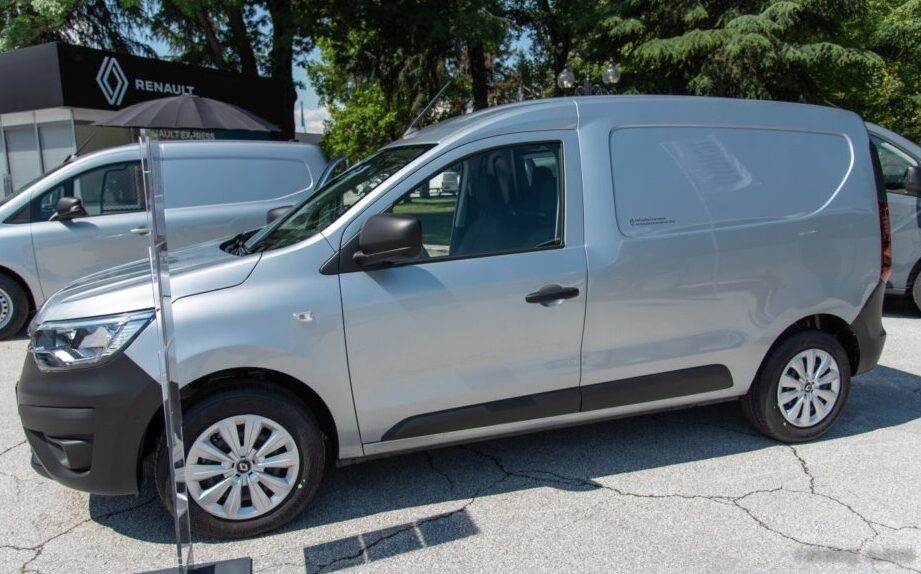
The Renault Express II Van 1.5 Blue dCi (75 hp) is a commercial vehicle produced by Renault since 2021. Representing a key variant within the second generation of the Express line, this model is geared towards businesses and tradespeople requiring a practical and economical light commercial vehicle. It slots into the lineup as an entry-level offering, prioritizing fuel efficiency and affordability over outright performance. The Express II Van builds upon the shared platform with the Nissan Townstar and the Mercedes-Benz Citan, offering a versatile solution in the compact van segment.
Technical Specifications
| Brand | Renault |
| Model | Express |
| Generation | Express II Van |
| Type (Engine) | 1.5 Blue dCi (75 Hp) |
| Start of production | 2021 |
| Powertrain Architecture | Internal Combustion engine |
| Body type | Minivan |
| Seats | 2 |
| Doors | 4 |
| Combined fuel consumption (WLTP) | 5.1-5.4 l/100 km (46.1 – 43.6 US mpg, 55.4 – 52.3 UK mpg, 19.6 – 18.5 km/l) |
| CO2 emissions (WLTP) | 133-141 g/km |
| Fuel Type | Diesel |
| Acceleration 0 – 100 km/h | 16.3 sec |
| Acceleration 0 – 62 mph | 16.3 sec |
| Acceleration 0 – 60 mph | 15.5 sec |
| Maximum speed | 148 km/h (91.96 mph) |
| Emission standard | Euro 6D-Temp |
| Power | 75 Hp @ 3000-3750 rpm |
| Power per litre | 51.3 Hp/l |
| Torque | 220 Nm @ 1750-2000 rpm (162.26 lb.-ft. @ 1750-2000 rpm) |
| Engine layout | Front, Transverse |
| Engine Model/Code | K9K 872 |
| Engine displacement | 1461 cm3 (89.16 cu. in.) |
| Number of cylinders | 4 |
| Engine configuration | Inline |
| Number of valves per cylinder | 2 |
| Fuel injection system | Diesel Commonrail |
| Engine aspiration | Turbocharger, Intercooler |
| Trunk (boot) space – minimum | 3300 l (116.54 cu. ft.) |
| Trunk (boot) space – maximum | 3700 l (130.66 cu. ft.) |
| Fuel tank capacity | 50 l (13.21 US gal | 11 UK gal) |
| AdBlue tank | 17 l (4.49 US gal | 3.74 UK gal) |
| Length | 4393 mm (172.95 in.) |
| Width | 1775 mm (69.88 in.) |
| Width including mirrors | 2079 mm (81.85 in.) |
| Height | 1811-1893 mm (71.3 – 74.53 in.) |
| Wheelbase | 2812 mm (110.71 in.) |
| Front track | 1488 mm (58.58 in.) |
| Rear (Back) track | 1478 mm (58.19 in.) |
| Front overhang | 851 mm (33.5 in.) |
| Rear overhang | 730 mm (28.74 in.) |
| Ride height (ground clearance) | 160 mm (6.3 in.) |
| Minimum turning circle (turning diameter) | 11.1 m (36.42 ft.) |
| Drivetrain Architecture | The Internal combustion engine (ICE) drives the front wheels of the vehicle. |
| Drive wheel | Front wheel drive |
| Number of gears and type of gearbox | 6 gears, manual transmission |
| Front suspension | Independent, type McPherson with coil spring and anti-roll bar |
| Rear suspension | Torsion |
| Front brakes | Ventilated discs, 280×24 mm |
| Rear brakes | Drum, 229 mm |
| Assisting systems | ABS (Anti-lock braking system) |
| Steering type | Steering rack and pinion |
| Power steering | Electric Steering |
| Tires size | 185/65 R15 |
| Wheel rims size | 15 |
INTRODUCTION
The Renault Express II Van 1.5 Blue dCi (75 hp) represents Renault’s offering in the compact van segment, designed for urban delivery and tradesperson use. Introduced in 2021, it’s the latest iteration of a van lineage dating back to the original Renault Express. This particular variant, powered by the 1.5-liter Blue dCi engine and equipped with a six-speed manual transmission, is positioned as the entry point to the Express II Van range, emphasizing fuel economy and practicality. It shares its platform and many components with the Nissan Townstar and Mercedes-Benz Citan, a result of the Renault-Nissan-Mercedes-Benz alliance.
Powertrain & Engine Architecture
At the heart of the Express II Van 1.5 Blue dCi (75 hp) lies the K9K 872 engine, a 1.5-liter inline four-cylinder diesel engine. This engine is part of Renault’s Blue dCi family, known for its efficiency and reduced emissions. It utilizes a turbocharger with an intercooler to boost power output while maintaining reasonable fuel consumption. The engine employs a diesel commonrail direct injection system, delivering fuel directly into the combustion chamber at high pressure for optimized combustion. The engine produces 75 horsepower at 3000-3750 rpm and 220 Nm (162.26 lb.-ft.) of torque between 1750-2000 rpm. The six-speed manual transmission is the sole gearbox option for this variant, providing a balance between fuel efficiency and drivability. The transmission’s gear ratios are tuned for maximizing fuel economy and providing adequate acceleration for urban and highway driving.
Driving Characteristics
The 75 hp output and manual transmission combination results in a driving experience focused on practicality rather than performance. Acceleration is modest, with a 0-100 km/h (0-62 mph) time of 16.3 seconds. The engine delivers its peak torque at relatively low revs, providing sufficient pulling power for typical commercial tasks. The six-speed gearbox allows for efficient cruising on highways, while the lower gears provide adequate power for navigating city streets and carrying loads. Compared to higher-powered versions of the Express II Van, this variant feels less responsive, particularly when fully loaded. However, the trade-off is significantly improved fuel economy, making it an attractive option for businesses prioritizing operating costs.
Equipment & Trim Levels
The Renault Express II Van 1.5 Blue dCi (75 hp) typically comes with a functional, no-frills interior focused on durability and practicality. Standard equipment generally includes a driver’s airbag, ABS brakes, a basic audio system, and power steering. The cabin features durable plastic trim and hard-wearing seat upholstery. The van offers a generous cargo space, ranging from 3300 to 3700 liters (116.54 to 130.66 cu. ft.), depending on the seating configuration. Optional extras, depending on the market and specific trim level, could include air conditioning, a rear parking sensor, a touchscreen infotainment system with navigation, and various cargo area enhancements like shelving and load securing systems.
Chassis & Braking
The Express II Van utilizes a front-wheel-drive layout. The front suspension consists of an independent McPherson strut setup with a coil spring and anti-roll bar, providing a comfortable ride and stable handling. The rear suspension employs a torsion beam axle, a cost-effective and space-saving solution suitable for light commercial vehicle applications. The braking system features ventilated discs on the front wheels (280×24 mm) and drum brakes on the rear wheels (229 mm). ABS (Anti-lock Braking System) is standard, enhancing braking performance and safety. The steering is rack and pinion with electric power assistance, providing light and precise steering feel.
Market Reception & Comparison
The Renault Express II Van 1.5 Blue dCi (75 hp) has been generally well-received as a practical and economical light commercial vehicle. Critics have praised its fuel efficiency and competitive pricing. However, some have noted its modest performance, particularly when compared to more powerful van alternatives. Compared to other trims in the Express II Van lineup, such as those with higher-output engines, this variant offers a lower purchase price and improved fuel economy, but at the expense of acceleration and load-carrying capacity. Its fuel consumption of 5.1-5.4 l/100 km (46.1 – 43.6 US mpg) is a key selling point, making it an attractive option for businesses focused on minimizing operating costs.
Legacy
The Renault Express II Van 1.5 Blue dCi (75 hp) represents a modern take on a classic commercial vehicle formula. While not the most powerful or feature-rich van in its class, its focus on fuel efficiency, practicality, and affordability has secured its place in the market. The K9K engine has a proven track record for reliability, and the relatively simple mechanical design of this variant suggests it should be reasonably durable and easy to maintain. In the used car market, these vans are expected to hold their value as dependable and economical workhorses, particularly for businesses and tradespeople seeking a cost-effective transportation solution.
