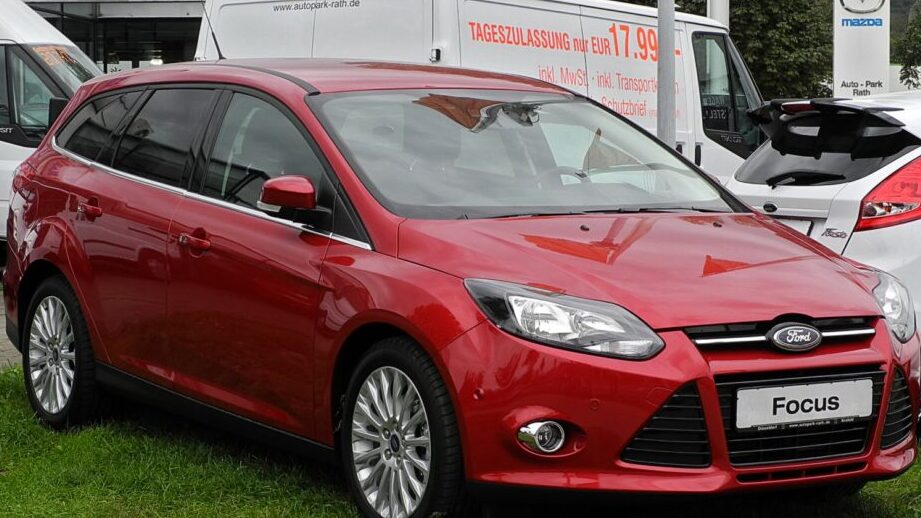
The Ford Focus III Wagon 1.6 Ti-VCT (125 hp) was a popular variant of Ford’s globally successful Focus model, produced between 2010 and 2014. Positioned as a mid-range offering within the third-generation Focus (Mk3) lineup, this wagon combined a fuel-efficient 1.6-liter gasoline engine with a five-speed manual transmission. It catered to buyers seeking a practical, affordable, and reasonably equipped family vehicle. The Focus Mk3, built on the C-segment platform shared with other Ford and Mazda vehicles, represented a significant step forward in terms of driving dynamics, interior quality, and technology compared to its predecessors. This particular wagon body style was primarily marketed in Europe, where demand for estate cars remained strong, offering a compelling alternative to hatchbacks and sedans.
Technical Specifications
| Brand | Ford |
| Model | Focus |
| Generation | Focus III Wagon |
| Type (Engine) | 1.6 Ti-VCT (125 Hp) |
| Start of production | 2010 |
| End of production | 2014 |
| Powertrain Architecture | Internal Combustion engine |
| Body type | Station wagon (estate) |
| Seats | 5 |
| Doors | 5 |
| Fuel consumption (urban) | 8.1 l/100 km (29 US mpg, 34.9 UK mpg, 12.3 km/l) |
| Fuel consumption (extra urban) | 4.8 l/100 km (49 US mpg, 58.9 UK mpg, 20.8 km/l) |
| Fuel consumption (combined) | 6 l/100 km (39.2 US mpg, 47.1 UK mpg, 16.7 km/l) |
| CO2 emissions | 139 g/km |
| Fuel Type | Petrol (Gasoline) |
| Acceleration 0 – 100 km/h | 11.1 sec |
| Acceleration 0 – 62 mph | 11.1 sec |
| Acceleration 0 – 60 mph | 10.5 sec |
| Maximum speed | 196 km/h (121.79 mph) |
| Emission standard | Euro 5 |
| Weight-to-power ratio | 10.5 kg/Hp, 95.3 Hp/tonne |
| Weight-to-torque ratio | 8.3 kg/Nm, 121.2 Nm/tonne |
| Power | 125 Hp @ 6000 rpm |
| Power per litre | 78.3 Hp/l |
| Torque | 159 Nm @ 4000 rpm (117.27 lb.-ft. @ 4000 rpm) |
| Engine layout | Front, Transverse |
| Engine Model/Code | PNDA |
| Engine displacement | 1596 cm3 (97.39 cu. in.) |
| Number of cylinders | 4 |
| Engine configuration | Inline |
| Cylinder Bore | 79 mm (3.11 in.) |
| Piston Stroke | 81.4 mm (3.2 in.) |
| Compression ratio | 11:1 |
| Number of valves per cylinder | 4 |
| Fuel injection system | Multi-port manifold injection |
| Engine aspiration | Naturally aspirated engine |
| Valvetrain | DOHC |
| Engine oil capacity | 4.1 l (4.33 US qt | 3.61 UK qt) |
| Coolant | 5.8 l (6.13 US qt | 5.1 UK qt) |
| Kerb Weight | 1312 kg (2892.46 lbs.) |
| Max. weight | 1825 kg (4023.44 lbs.) |
| Max load | 513 kg (1130.97 lbs.) |
| Trunk (boot) space – minimum | 490 l (17.3 cu. ft.) |
| Trunk (boot) space – maximum | 1516 l (53.54 cu. ft.) |
| Fuel tank capacity | 55 l (14.53 US gal | 12.1 UK gal) |
| Length | 4556 mm (179.37 in.) |
| Width | 1823 mm (71.77 in.) |
| Height | 1505 mm (59.25 in.) |
| Wheelbase | 2648 mm (104.25 in.) |
| Front track | 1544/1559 mm (60.79 in.) |
| Rear (Back) track | 1534/1549 mm (60.39 in.) |
| Minimum turning circle | 11 m (36.09 ft.) |
| Drivetrain Architecture | Front wheel drive |
| Number of gears | 5 gears, manual transmission |
| Assisting systems | ABS (Anti-lock braking system) |
| Steering type | Steering rack and pinion |
| Tires size | 205/55 R16; 205/55 R16; 215/55 R16; 215/50 R17; 235/40 R18 |
| Wheel rims size | 6.5J x 16; 7.0J x 16; 7.0J x 17; 8.0J x 18 |
Powertrain & Engine Architecture
The heart of the Focus III Wagon 1.6 Ti-VCT was the PNDA engine, a 1.6-liter inline-four cylinder gasoline engine. “Ti-VCT” stands for Twin Independent Variable Camshaft Timing, a technology that optimizes valve timing for improved performance and fuel efficiency. The engine utilized multi-point fuel injection and a relatively high compression ratio of 11:1. The PNDA engine was known for its smooth operation and reasonable power output for its displacement. The five-speed manual transmission was a standard offering, providing a direct and engaging driving experience. Gear ratios were tuned for a balance between acceleration and fuel economy, with a relatively long fifth gear for highway cruising. While not a particularly powerful engine, the 1.6 Ti-VCT offered adequate performance for everyday driving and was generally considered reliable.
Driving Characteristics
The 125 hp 1.6 Ti-VCT engine in the Focus Wagon delivered a practical, if not exhilarating, driving experience. Acceleration from 0-60 mph took around 10.5 seconds, making it suitable for commuting and general family use. The manual transmission allowed for good control over the engine’s power band, and the Ti-VCT technology helped to maintain a decent level of responsiveness throughout the rev range. Compared to higher-output versions of the Focus, such as those equipped with the 1.5L EcoBoost or 2.0L engines, this variant felt noticeably less powerful. However, it offered a more economical and affordable option. The wagon’s suspension provided a comfortable ride, absorbing bumps and imperfections in the road well. Steering was precise and well-weighted, contributing to a confident feel behind the wheel.
Equipment & Trim Levels
The 1.6 Ti-VCT variant of the Focus Wagon typically came with a respectable level of standard equipment. This included air conditioning, power windows, power mirrors, a basic audio system with USB connectivity, and ABS brakes. Higher trim levels, such as the Titanium, offered additional features like alloy wheels, automatic climate control, a more advanced audio system, and parking sensors. Interior upholstery was typically cloth, with options for upgraded materials on higher trims. The dashboard layout was functional and well-designed, with easy-to-read gauges and intuitive controls.
Chassis & Braking
The Focus III Wagon featured a MacPherson strut front suspension and a multi-link rear suspension, providing a good balance of ride comfort and handling. The braking system consisted of disc brakes on the front wheels and drum brakes on the rear wheels. ABS (Anti-lock Braking System) was standard, enhancing safety during emergency braking situations. Stabilizer bars were fitted to both the front and rear axles to reduce body roll during cornering. The chassis was designed to be lightweight yet rigid, contributing to the car’s overall agility.
Market Reception & Comparison
The Ford Focus III Wagon 1.6 Ti-VCT was generally well-received by automotive critics. It was praised for its fuel efficiency, comfortable ride, and practical interior space. However, some reviewers noted that the engine lacked outright power, particularly when the car was fully loaded. Compared to the diesel-powered variants, such as the 1.6 TDCi, the 1.6 Ti-VCT offered less torque but a smoother and quieter driving experience. In terms of reliability, the PNDA engine proved to be generally dependable, although regular maintenance was essential to prevent issues. Fuel economy was a strong point, with combined figures averaging around 39.2 US mpg.
Legacy
The Ford Focus III Wagon 1.6 Ti-VCT remains a popular choice in the used car market, particularly for buyers seeking an affordable and practical family vehicle. The PNDA engine, while not known for its performance, has proven to be relatively durable and easy to maintain. Parts availability is generally good, and repair costs are reasonable. The Focus III Wagon’s combination of practicality, fuel efficiency, and comfortable ride continues to appeal to a wide range of buyers, ensuring its continued presence on roads today. It represents a solid and dependable option in the C-segment wagon class.