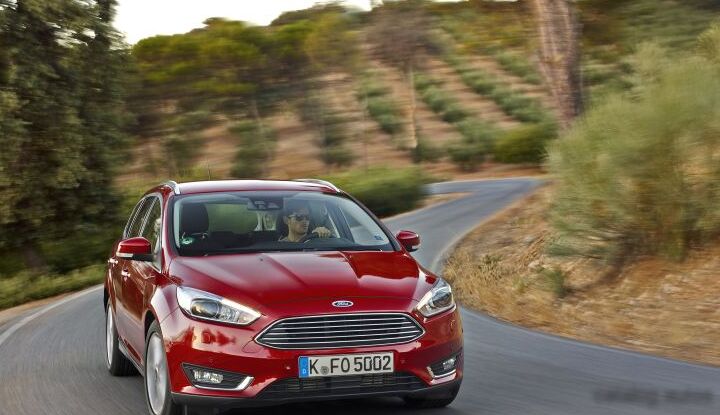
The Ford Focus III Wagon, specifically the facelifted version introduced in 2014, represented a significant evolution of Ford’s globally successful compact family car. The 1.0 EcoBoost 100 horsepower variant, produced from 2014 to 2018, occupied an important position in the lineup as an entry-level option focused on fuel efficiency and affordability. This model was primarily aimed at the European market, where compact wagons are highly popular, but also saw limited sales in other regions. It was built on the C346 platform, also known as the 1HX0/A3 platform, shared with other Ford models like the C-Max and Kuga.
Technical Specifications
| Brand | Ford |
| Model | Focus |
| Generation | Focus III Wagon (facelift 2014) |
| Type (Engine) | 1.0 EcoBoost (100 Hp) |
| Start of production | 2014 |
| End of production | 2018 |
| Powertrain Architecture | Internal Combustion engine |
| Body type | Station wagon (estate) |
| Seats | 5 |
| Doors | 5 |
| Fuel consumption (urban) | 6.5 l/100 km (36.2 US mpg, 43.5 UK mpg, 15.4 km/l) |
| Fuel consumption (extra urban) | 4.2 l/100 km (56 US mpg, 67.3 UK mpg, 23.8 km/l) |
| Fuel consumption (combined) | 5 l/100 km (47 US mpg, 56.5 UK mpg, 20 km/l) |
| CO2 emissions | 115 g/km |
| Fuel Type | Petrol (Gasoline) |
| Acceleration 0 – 100 km/h | 12.7 sec |
| Acceleration 0 – 62 mph | 12.7 sec |
| Acceleration 0 – 60 mph | 12.1 sec |
| Maximum speed | 185 km/h (114.95 mph) |
| Emission standard | Euro 6 |
| Weight-to-power ratio | 14.9 kg/Hp, 67.3 Hp/tonne |
| Weight-to-torque ratio | 8.7 kg/Nm, 114.5 Nm/tonne |
| Power | 100 Hp @ 6000 rpm |
| Power per litre | 100.2 Hp/l |
| Torque | 170 Nm @ 1400-4000 rpm (125.39 lb.-ft. @ 1400-4000 rpm) |
| Engine layout | Front, Transverse |
| Engine Model/Code | M2DB, M2DC, SFDB |
| Engine displacement | 998 cm3 (60.9 cu. in.) |
| Number of cylinders | 3 |
| Engine configuration | Inline |
| Cylinder Bore | 71.9 mm (2.83 in.) |
| Piston Stroke | 82 mm (3.23 in.) |
| Compression ratio | 10:1 |
| Number of valves per cylinder | 4 |
| Fuel injection system | Direct injection |
| Engine aspiration | Turbocharger, Intercooler |
| Valvetrain | DOHC |
| Engine oil capacity | 4.1 l (4.33 US qt | 3.61 UK qt) |
| Coolant | 5.8 l (6.13 US qt | 5.1 UK qt) |
| Kerb Weight | 1485 kg (3273.86 lbs.) |
| Max. weight | 1900 kg (4188.78 lbs.) |
| Max load | 415 kg (914.92 lbs.) |
| Trunk (boot) space – minimum | 476 l (16.81 cu. ft.) |
| Trunk (boot) space – maximum | 1502 l (53.04 cu. ft.) |
| Fuel tank capacity | 55 l (14.53 US gal | 12.1 UK gal) |
| Length | 4556 mm (179.37 in.) |
| Width | 1823 mm (71.77 in.) |
| Height | 1505 mm (59.25 in.) |
| Wheelbase | 2648 mm (104.25 in.) |
| Front track | 1544 mm (60.79 in.) |
| Rear (Back) track | 1559 mm (61.38 in.) |
| Minimum turning circle | 11 m (36.09 ft.) |
| Drivetrain Architecture | ICE, Front wheel drive |
| Number of gears and type of gearbox | 5 gears, manual transmission |
| Front suspension | Independent, McPherson with coil spring and anti-roll bar |
| Rear suspension | Independent multi-link suspension |
| Front brakes | Disc |
| Rear brakes | Disc |
| Assisting systems | ABS (Anti-lock braking system) |
| Steering type | Steering rack and pinion |
| Tires size | 205/55 R16; 215/50 R17 |
| Wheel rims size | 6.5J x 16; 7.0J x 17 |
INTRODUCTION
The 1.0 EcoBoost engine in the 2014-2018 Ford Focus III Wagon was a key component of Ford’s strategy to offer fuel-efficient and affordable vehicles. This variant was positioned as the entry point into the Focus Wagon range, appealing to buyers prioritizing economy over outright performance. The facelifted Focus III, launched in 2014, brought with it revised styling, updated technology, and improvements to the driving experience. The 1.0 EcoBoost engine was a central part of this update, offering a modern, turbocharged powerplant in a traditionally sensible package. It was a direct response to growing demand for smaller, more efficient engines in the European market.
Powertrain & Engine Architecture
The heart of this Focus variant is the 1.0-liter EcoBoost three-cylinder engine, specifically the M2DB, M2DC, or SFDB engine codes. This engine is a marvel of engineering, packing a turbocharger and direct fuel injection into a remarkably small package. The direct injection system, operating at pressures up to 200 bar, ensures precise fuel delivery for optimal combustion. The engine utilizes a single scroll turbocharger, designed to minimize turbo lag and provide a responsive driving experience. The valvetrain is a double overhead camshaft (DOHC) design with four valves per cylinder, maximizing airflow and contributing to the engine’s power output. The engine’s block is made of aluminum, contributing to its lightweight design. This particular trim level was exclusively offered with a 5-speed manual transmission, chosen for its efficiency and cost-effectiveness. The transmission’s gear ratios were tuned to prioritize fuel economy, with a relatively long final drive.
Driving Characteristics
The 1.0 EcoBoost 100 hp Focus Wagon delivers a driving experience focused on practicality and efficiency. Acceleration from 0-60 mph takes around 12.1 seconds, and top speed is around 115 mph. While not particularly quick, the engine provides adequate power for everyday driving situations. The turbocharger provides a noticeable boost in power at higher RPMs, but the engine feels somewhat strained when pushed hard. The 5-speed manual transmission is smooth and precise, but the gear ratios can feel a bit spaced apart, requiring frequent shifting. Compared to the higher-output 1.5 EcoBoost or diesel variants, this engine feels significantly less powerful, but it offers a more engaging driving experience than the automatic transmissions available with those engines. The lighter engine weight contributes to nimble handling, making the car enjoyable to drive on winding roads.
Equipment & Trim Levels
The 1.0 EcoBoost 100 hp model typically came with a base level of equipment, focusing on essential features. Standard equipment generally included air conditioning, power windows, power door locks, a basic audio system with USB connectivity, and steel wheels with wheel covers. Higher trim levels, such as Zetec or Titanium, added features like alloy wheels, a more advanced infotainment system, cruise control, and automatic headlights. Optional extras included a panoramic sunroof, leather upholstery, and a rear parking sensor system. Interior upholstery was typically cloth, with a functional and durable design. The dashboard layout was straightforward and easy to use, with a focus on ergonomics.
Chassis & Braking
The Focus Wagon’s chassis features independent suspension at all four wheels. The front suspension utilizes a McPherson strut design with a coil spring and anti-roll bar, while the rear suspension employs a multi-link setup. This configuration provides a good balance between ride comfort and handling. Brakes are disc brakes on all four wheels, providing adequate stopping power for the vehicle’s weight and performance. Anti-lock Braking System (ABS) is standard, enhancing safety during emergency braking situations. The steering is a rack and pinion system, offering precise and responsive steering feel. The 1.0 EcoBoost models typically featured smaller diameter tires (205/55 R16 or 215/50 R17) compared to higher-performance variants, prioritizing fuel efficiency and ride comfort.
Market Reception & Comparison
The 1.0 EcoBoost Focus Wagon was generally well-received by critics for its fuel efficiency and affordability. It was praised for its surprisingly refined engine and its nimble handling. However, some reviewers noted its lack of outright performance and its somewhat noisy engine. Compared to the 1.6-liter Ti-VCT petrol engine, the 1.0 EcoBoost offered significantly better fuel economy but less power. The diesel variants, such as the 1.6 TDCi, provided even better fuel economy but were more expensive to purchase. In terms of reliability, the 1.0 EcoBoost engine has proven to be generally reliable, although some owners have reported issues with the timing belt system. Fuel economy figures consistently averaged around 5 liters per 100 kilometers (47 US mpg), making it one of the most efficient wagons in its class.
Legacy
The 1.0 EcoBoost engine has become a mainstay in Ford’s lineup, and the Focus Wagon variant remains a popular choice in the used car market. Its combination of fuel efficiency, affordability, and practicality makes it an attractive option for buyers seeking a sensible family car. The engine’s relatively simple design and readily available parts contribute to its long-term reliability. While not a performance icon, the 1.0 EcoBoost Focus Wagon represents a significant step forward in terms of fuel efficiency and demonstrates Ford’s commitment to developing innovative and environmentally friendly technologies. Today, well-maintained examples can be found for reasonable prices, offering a cost-effective and practical transportation solution.