
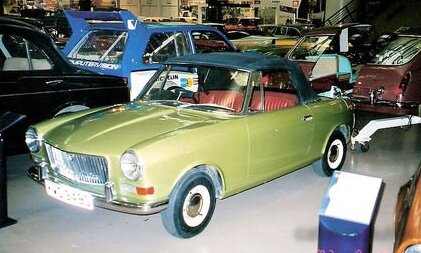
The MG Midget 1.5, produced between 1974 and 1980, represents a significant iteration of the iconic British sports car. Falling within the latter stages of the Midget’s long production run (spanning from 1961 to 1980), this 1.5-liter variant aimed to offer a balance of affordability, spirited driving, and classic open-top motoring. It occupied a key position in the Midget lineup, serving as the standard engine option during its production years, positioned below the more potent (and later introduced) 1600cc versions. The 1.5-liter Midget was primarily marketed in the United Kingdom and export markets, including North America, appealing to enthusiasts seeking a compact, nimble roadster.
Technical Specifications
| Brand | MG |
| Model | Midget |
| Generation | Midget |
| Type (Engine) | 1.5 (66 Hp) |
| Start of production | 1974 |
| End of production | 1980 |
| Powertrain Architecture | Internal Combustion engine |
| Body type | Cabriolet |
| Seats | 2 |
| Doors | 2 |
| Fuel Type | Petrol (Gasoline) |
| Weight-to-power ratio | 12.7 kg/Hp, 78.7 Hp/tonne |
| Power | 66 Hp |
| Power per litre | 44.2 Hp/l |
| Engine layout | Front, Longitudinal |
| Engine Model/Code | Standard SC |
| Engine displacement | 1493 cm3 |
| Engine displacement (cu. in.) | 91.11 cu. in. |
| Number of cylinders | 4 |
| Engine configuration | Inline |
| Cylinder Bore | 73.7 mm |
| Cylinder Bore (in.) | 2.9 in. |
| Piston Stroke | 87.5 mm |
| Piston Stroke (in.) | 3.44 in. |
| Compression ratio | 7.5:1 |
| Number of valves per cylinder | 2 |
| Fuel injection system | Carburettor |
| Engine aspiration | Naturally aspirated engine |
| Valvetrain | OHV |
| Engine oil capacity | 4.5 l |
| Engine oil capacity (US qt) | 4.76 US qt |
| Engine oil capacity (UK qt) | 3.96 UK qt |
| Coolant capacity | 4.25 l |
| Coolant capacity (US qt) | 4.49 US qt |
| Coolant capacity (UK qt) | 3.74 UK qt |
| Kerb Weight | 839 kg |
| Kerb Weight (lbs) | 1849.68 lbs. |
| Length | 3632 mm |
| Length (in.) | 142.99 in. |
| Width | 1411 mm |
| Width (in.) | 55.55 in. |
| Height | 1226 mm |
| Height (in.) | 48.27 in. |
| Wheelbase | 2032 mm |
| Wheelbase (in.) | 80 in. |
| Front track | 1183 mm |
| Front track (in.) | 46.57 in. |
| Rear track | 1143 mm |
| Rear track (in.) | 45 in. |
| Ride height (ground clearance) | 83 mm |
| Ride height (ground clearance) (in.) | 3.27 in. |
| Drivetrain Architecture | The Internal combustion engine (ICE) drives the rear wheels of the vehicle. |
| Drive wheel | Rear wheel drive |
| Number of gears | 4 |
| Gearbox type | Manual transmission |
| Front suspension | Wishbone, Transverse stabilizer |
| Rear suspension | Leaf spring |
| Front brakes | Disc, 209.55 mm |
| Rear brakes | Drum, 177.8 mm |
| Steering type | Steering rack and pinion |
Powertrain & Engine Architecture
The heart of the Midget 1.5 is its 1493cc inline-four cylinder engine, designated as the Standard SC. This engine utilized a traditional overhead valve (OHV) valvetrain, with two valves per cylinder. Fuel delivery was managed by a single carburetor, a common setup for the era, prioritizing simplicity and affordability. The engine’s 7.5:1 compression ratio was a compromise between performance and the fuel quality available in various markets. The engine was mounted longitudinally in the front of the vehicle, driving the rear wheels. The four-speed manual transmission was the standard offering, providing a direct connection between the engine and the drivetrain. This configuration, while not particularly sophisticated, was robust and relatively easy to maintain.
Driving Characteristics
The 1.5-liter Midget offered a classic British roadster driving experience. With 66 horsepower on tap, acceleration was modest by modern standards, but the car’s light weight (approximately 1850 lbs) contributed to a lively feel. The four-speed manual gearbox required deliberate shifts, and the engine needed to be revved to extract its full potential. Compared to the later 1600cc versions, the 1.5 felt less urgent in acceleration and had a slightly lower top speed. However, the 1.5’s lower power output also meant it was less stressed, potentially contributing to greater long-term reliability. The rear-wheel drive layout and relatively short wheelbase made the Midget responsive and engaging to drive on winding roads, though it also demanded respect and careful handling.
Equipment & Trim Levels
The Midget 1.5 was generally sparsely equipped, reflecting its position as an affordable sports car. Standard features typically included basic instrumentation (speedometer, fuel gauge, temperature gauge), vinyl upholstery, and a folding soft top. Chrome bumpers and brightwork were common, adding to the car’s classic aesthetic. Optional extras included wire wheels, a tonneau cover (a partial cover for the passenger seat), and upgraded interior trim. Trim levels were relatively limited; the focus was on providing a basic, enjoyable driving experience rather than luxurious appointments. The interior was functional and compact, prioritizing driver engagement over passenger comfort.
Chassis & Braking
The Midget 1.5 utilized a body-on-frame construction, a traditional design that contributed to its relatively low weight. Front suspension consisted of independent wishbones with a transverse stabilizer bar, providing reasonable handling characteristics. The rear suspension employed leaf springs, a simpler and more cost-effective design. Braking was accomplished via disc brakes at the front and drum brakes at the rear. While adequate for the car’s performance, the braking system was not particularly powerful by modern standards. Steering was via a rack and pinion system, offering precise and responsive control.
Market Reception & Comparison
The MG Midget 1.5 was generally well-received by automotive critics as an affordable and fun-to-drive sports car. It was praised for its nimble handling, classic styling, and relatively low running costs. However, it was also criticized for its modest performance, basic interior, and limited weather protection. Compared to the later 1600cc Midgets, the 1.5 offered a more economical option, appealing to buyers who prioritized fuel efficiency and affordability over outright speed. Against competitors like the Triumph Spitfire and Austin-Healey Sprite, the Midget 1.5 offered a similar blend of affordability and driving enjoyment.
Legacy
The MG Midget 1.5 remains a popular choice among classic car enthusiasts today. Its simple mechanical design and readily available parts make it relatively easy to maintain and restore. While not the fastest or most luxurious sports car of its era, the Midget 1.5 offers a unique and engaging driving experience that captures the spirit of classic British motoring. The 1.5-liter engine, while not known for exceptional power, proved to be reasonably reliable, and well-maintained examples continue to provide years of enjoyment. In the used car market, the Midget 1.5 typically commands a lower price than the 1600cc versions, making it an accessible entry point into the world of classic sports cars.
