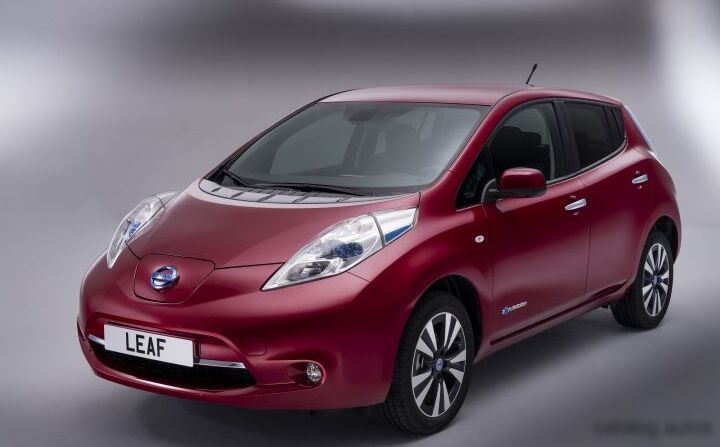
The Nissan Leaf, launched in December 2010, marked Nissan’s significant entry into the rapidly growing electric vehicle (EV) market. The first generation, internally designated the ZE0, was manufactured from 2010 through 2017, undergoing several notable revisions throughout its production run. The 24 kWh variant, delivering 109 horsepower, was a cornerstone model in the early years of Leaf production, specifically from November 2012 to December 2017. This version served as the entry-level option in the Leaf lineup, providing a more accessible and budget-friendly EV choice for consumers. It was strategically positioned as a practical, everyday commuter vehicle, prioritizing efficiency and affordability over outright performance. The 24 kWh Leaf was instrumental in establishing the Leaf as a mainstream EV and showcasing Nissan’s commitment to electric mobility.
Technical Specifications
| Brand | Nissan |
| Model | Leaf |
| Generation | Leaf I (ZE0) |
| Type (Engine) | 24 kWh (109 Hp) |
| Start of production | November, 2012 |
| End of production | December, 2017 |
| Powertrain Architecture | BEV (Electric Vehicle) |
| Body type | Hatchback |
| Seats | 5 |
| Doors | 5 |
| Fuel Type | Electricity |
| Acceleration 0 – 100 km/h | 11.5 sec |
| Acceleration 0 – 62 mph | 11.5 sec |
| Acceleration 0 – 60 mph | 10.9 sec |
| Maximum speed | 144 km/h (89.48 mph) |
| Emission standard | ZEV |
| Weight-to-power ratio | 13.8 kg/Hp, 72.4 Hp/tonne |
| Weight-to-torque ratio | 5.9 kg/Nm, 168.8 Nm/tonne |
| Gross battery capacity | 24 kWh |
| Net (usable) battery capacity | 22 kWh |
| Battery voltage | 360 V |
| Battery technology | Lithium-ion (Li-Ion) |
| Battery weight | 294 kg (648.16 lbs) |
| Battery location | Below the floor |
| All-electric range (NEDC) | 199 km (123.65 mi) |
| Average Energy consumption (NEDC) | 15 kWh/100 km (24.14 kWh/100 mi) |
| Electric motor power | 109 Hp @ 3008-10000 rpm |
| Electric motor Torque | 254 Nm @ 0-3008 rpm (187.34 lb.-ft. @ 0-3008 rpm) |
| Electric motor model/code | EM57 |
| Maximum revolutions of the electric motor | 10500 rpm |
| Electric motor location | Front axle, Transverse |
| System power | 109 Hp @ 3008-10000 rpm |
| System torque | 254 Nm @ 0-3008 rpm (187.34 lb.-ft. @ 0-3008 rpm) |
| Kerb Weight | 1505 kg (3317.96 lbs) |
| Max. weight | 1945 kg (4287.99 lbs) |
| Max load | 440 kg (970.03 lbs) |
| Trunk (boot) space – minimum | 370 l (13.07 cu. ft) |
| Trunk (boot) space – maximum | 720 l (25.43 cu. ft) |
| Length | 4445 mm (175 in) |
| Width | 1770 mm (69.69 in) |
| Width including mirrors | 1967 mm (77.44 in) |
| Height | 1550 mm (61.02 in) |
| Wheelbase | 2700 mm (106.3 in) |
| Front track | 1540 mm (60.63 in) |
| Rear (Back) track | 1535 mm (60.43 in) |
| Front overhang | 960 mm (37.8 in) |
| Rear overhang | 785 mm (30.91 in) |
| Ride height (ground clearance) | 160 mm (6.3 in) |
| Drag coefficient (Cd) | 0.28 |
| Minimum turning circle (turning diameter) | 10.4 m (34.12 ft) |
| Drivetrain Architecture | One electric motor drives the front wheels |
| Drive wheel | Front wheel drive |
| Number of gears and type of gearbox | 1 gears, automatic transmission |
| Front suspension | Coil spring, Independent type McPherson, Transverse stabilizer |
| Rear suspension | Transverse stabilizer, Coil spring, Torsion |
| Front brakes | Ventilated discs |
| Rear brakes | Ventilated discs |
| Assisting systems | ABS (Anti-lock braking system) |
| Steering type | Steering rack and pinion |
| Power steering | Electric Steering |
| Tires size | 205/55 R16; 215/50 R17 |
| Wheel rims size | 6.5J x 16; 6.5J x 17 |
Powertrain & Engine Architecture
The Nissan Leaf 24 kWh employs a fully electric powertrain, revolving around the EM57 AC synchronous electric motor. This motor generates 109 horsepower and 254 Nm (187 lb-ft) of torque, available instantaneously from 0 rpm. The motor draws power from a 24 kWh lithium-ion battery pack, consisting of 96 cells configured to deliver a nominal voltage of 360V. The battery pack is strategically positioned under the vehicle floor, contributing to a lower center of gravity and enhanced handling characteristics. The Leaf utilizes a single-speed automatic transmission, simplifying the driving experience and maximizing efficiency. Integrated into the vehicle’s powertrain control system are the power electronics, including the inverter and charger. The Leaf also incorporates regenerative braking, capturing kinetic energy during deceleration and converting it back into electricity to recharge the battery, further improving overall efficiency.
Driving Characteristics
The 24 kWh Leaf delivers a smooth and remarkably quiet driving experience, a hallmark of electric vehicles. Acceleration is sufficient for both city and highway driving, achieving a 0-60 mph time of approximately 10.9 seconds. The instant torque delivery provides responsive acceleration from a standstill. However, when compared to later Leaf models equipped with larger battery packs and more potent motors, or even the higher trim levels of the first-generation Leaf, the 24 kWh version feels comparatively less responsive at higher speeds. The single-speed transmission offers seamless acceleration, but lacks the multiple gear ratios found in conventional automatic transmissions. The low center of gravity contributes to stable handling, although the Leaf’s suspension is tuned primarily for comfort rather than sporty performance. In essence, the driving experience is tailored towards practicality and efficiency, making it ideally suited for daily commuting.
Equipment & Trim Levels
The 24 kWh Leaf typically came standard with features such as air conditioning, power windows and locks, a basic audio system, and the aforementioned regenerative braking system. Higher trim levels, including the SV and SL, added enhancements like a touchscreen infotainment system, Bluetooth connectivity, a rearview camera, and alloy wheels. Optional extras included a quick charging port, enabling faster charging times at compatible charging stations. Interior upholstery was generally cloth, with higher trims offering leather options. The dashboard layout was functional and user-friendly, prioritizing ease of operation. Safety features included ABS, traction control, and multiple airbags.
Chassis & Braking
The Leaf’s chassis features a McPherson strut front suspension and a torsion beam rear suspension. This configuration provides a comfortable ride, but isn’t particularly focused on sporty handling. The front brakes are ventilated discs, and the rear brakes are also ventilated discs. The Leaf is equipped with an electric power steering system, offering light and responsive steering feel. Tire sizes typically ranged from 205/55 R16 to 215/50 R17, depending on the specific trim level. The relatively low vehicle weight, thanks to the battery pack’s low placement within the chassis, contributes to stable handling.
Market Reception & Comparison
The Nissan Leaf 24 kWh was generally well-received by automotive critics as an affordable and practical EV. However, its limited range – approximately 84 miles in real-world driving conditions – was a frequent point of criticism. In comparison to the later-introduced 30 kWh Leaf, the 24 kWh version offered significantly less range. Fuel economy, measured in MPGe, averaged around 140 MPGe, making it considerably more efficient than gasoline-powered vehicles. Reliability was generally considered good, although some owners reported instances of battery degradation over time. The 24 kWh Leaf competed with other early EVs, such as the Mitsubishi i-MiEV and the Fiat 500e.
Legacy
The Nissan Leaf 24 kWh played a crucial role in popularizing electric vehicles and demonstrating their viability as a mainstream transportation option. While its range is limited by contemporary standards, it remains a relatively affordable and reliable EV in the used car market. The Leaf’s battery technology has undergone substantial advancements since 2012, but the 24 kWh version still presents a viable option for those seeking a short-range commuter vehicle. The valuable lessons learned from the development and production of the Leaf have informed Nissan’s subsequent EV offerings, contributing to the ongoing evolution of electric mobility.