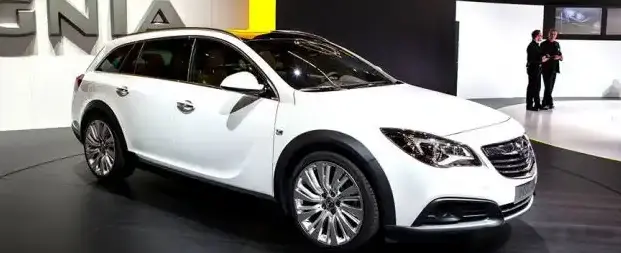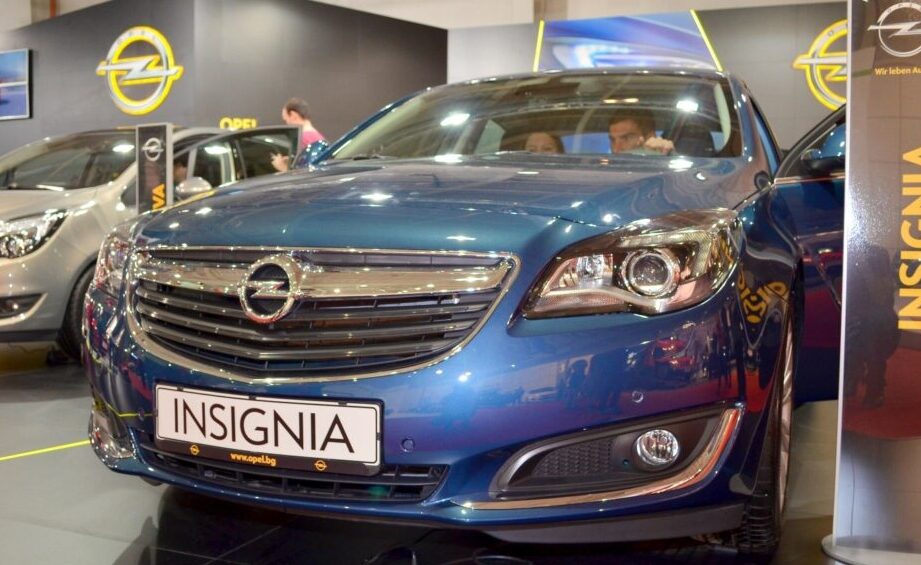
The Opel Insignia Sedan (A, facelift 2013) 2.0 (250 Hp) AWD Turbo Ecotec Start/Stop represents a performance-oriented variant of Opel’s flagship D-segment sedan. Introduced in July 2013 and continuing through January 2017, this model aimed to provide a blend of practicality, comfort, and spirited driving dynamics within the Insignia range. It was positioned as a premium offering, sitting at the top of the performance hierarchy for the Insignia sedan, appealing to buyers seeking a more engaging driving experience than the base engine options provided. This facelifted version of the original Insignia (introduced in 2008) brought revised styling and updated technology, solidifying its position as a competitor to established players like the Ford Mondeo, Volkswagen Passat, and Mazda 6.
Technical Specifications
| Brand | Opel |
| Model | Insignia |
| Generation | Insignia Sedan (A, facelift 2013) |
| Type (Engine) | 2.0 (250 Hp) AWD Turbo Ecotec Start/Stop |
| Start of production | July, 2013 |
| End of production | January, 2017 |
| Powertrain Architecture | Internal Combustion engine |
| Body type | Sedan |
| Seats | 5 |
| Doors | 4 |
| Fuel consumption (urban) | 10.6 l/100 km (22.2 US mpg, 26.6 UK mpg, 9.4 km/l) |
| Fuel consumption (extra urban) | 6.3 l/100 km (37.3 US mpg, 44.8 UK mpg, 15.9 km/l) |
| Fuel consumption (combined) | 7.8 l/100 km (30.2 US mpg, 36.2 UK mpg, 12.8 km/l) |
| CO2 emissions | 184 g/km |
| Fuel Type | Petrol (Gasoline) |
| Acceleration 0 – 100 km/h | 7.5 sec |
| Acceleration 0 – 62 mph | 7.5 sec |
| Acceleration 0 – 60 mph | 7.1 sec |
| Maximum speed | 250 km/h (155.34 mph) |
| Emission standard | Euro 5 |
| Power | 250 Hp @ 5300 rpm |
| Power per litre | 125.1 Hp/l |
| Torque | 400 Nm @ 2500-4000 rpm (295.02 lb.-ft. @ 2500-4000 rpm) |
| Engine layout | Front, Transverse |
| Engine Model/Code | A20NHT, B20NHT |
| Engine displacement | 1998 cm3 (121.93 cu. in.) |
| Number of cylinders | 4 |
| Engine configuration | Inline |
| Cylinder Bore | 86 mm (3.39 in.) |
| Piston Stroke | 86 mm (3.39 in.) |
| Number of valves per cylinder | 4 |
| Fuel injection system | Direct injection |
| Engine aspiration | Turbocharger, Intercooler |
| Engine oil capacity | 6 l (6.34 US qt | 5.28 UK qt) |
| Coolant | 8 l (8.45 US qt | 7.04 UK qt) |
| Trunk (boot) space – minimum | 500 l (17.66 cu. ft.) |
| Trunk (boot) space – maximum | 1015 l (35.84 cu. ft.) |
| Fuel tank capacity | 70 l (18.49 US gal | 15.4 UK gal) |
| Length | 4842 mm (190.63 in.) |
| Width | 1856 mm (73.07 in.) |
| Width including mirrors | 2084 mm (82.05 in.) |
| Height | 1498 mm (58.98 in.) |
| Wheelbase | 2737 mm (107.76 in.) |
| Front track | 1587 mm (62.48 in.) |
| Rear (Back) track | 1590 mm (62.6 in.) |
| Minimum turning circle | 11.4 m (37.4 ft.) |
| Drive wheel | All wheel drive (4×4) |
| Number of gears | 6 |
| Gearbox type | Manual transmission |
| Assisting systems | ABS (Anti-lock braking system) |
| Steering type | Steering rack and pinion |
Powertrain & Engine Architecture
At the heart of the Insignia 2.0 AWD Turbo Ecotec lies the A20NHT (or B20NHT) 2.0-liter inline-four cylinder gasoline engine. This engine is a member of Opel’s Ecotec family, known for its focus on efficiency and performance. The engine utilizes direct fuel injection, a technology that improves combustion efficiency and power output. A single turbocharger with an intercooler provides forced induction, boosting power to 250 horsepower at 5300 rpm and 400 Nm (295 lb-ft) of torque between 2500 and 4000 rpm. The engine features a dual overhead camshaft (DOHC) valvetrain with four valves per cylinder, optimizing airflow for enhanced performance. The six-speed manual transmission was standard, providing drivers with full control over gear selection. The Start/Stop system, a key feature for fuel economy, automatically shuts off the engine when the vehicle is stationary, restarting it instantly when the driver depresses the clutch pedal.
Driving Characteristics
The 250 hp AWD Insignia Sedan delivers a noticeably more engaging driving experience compared to lower-powered variants. Acceleration from 0-60 mph takes approximately 7.1 seconds, and the car feels responsive in most driving situations. The all-wheel-drive system provides excellent traction, particularly in inclement weather, enhancing stability and confidence. The manual transmission allows for precise gear changes, enabling drivers to maximize the engine’s power output. While not a dedicated sports sedan, the Insignia 2.0 AWD offers a good balance between comfort and performance, making it suitable for both daily commuting and spirited weekend drives. The gear ratios are tuned to provide strong acceleration in the mid-range, making overtaking maneuvers effortless.
Equipment & Trim Levels
The 2.0 AWD Turbo Ecotec Start/Stop typically came with a generous level of standard equipment. This included features like automatic climate control, a touchscreen infotainment system with navigation, Bluetooth connectivity, and a premium sound system. Interior upholstery was typically cloth or leather, with higher trims offering more luxurious materials. Standard safety features included ABS, traction control, stability control, and multiple airbags. Optional extras included a panoramic sunroof, adaptive cruise control, and advanced parking assist systems. The trim level often dictated the exterior styling details, such as alloy wheel designs and chrome accents.
Chassis & Braking
The Insignia Sedan’s chassis is comprised of a MacPherson strut front suspension and a multi-link rear suspension. This setup provides a comfortable ride while maintaining good handling characteristics. The all-wheel-drive system adds to the car’s stability, particularly during cornering. Braking duties are handled by ventilated disc brakes on all four wheels, providing ample stopping power. ABS (Anti-lock Braking System) is standard, preventing wheel lockup during hard braking. Stabilizer bars are fitted to both the front and rear axles to reduce body roll.
Market Reception & Comparison
The Opel Insignia 2.0 AWD Turbo Ecotec Start/Stop was generally well-received by automotive critics. It was praised for its strong performance, comfortable ride, and spacious interior. However, some reviewers noted that the styling was somewhat conservative compared to rivals. Compared to the base 1.6-liter engine, the 2.0-liter offered a significant performance upgrade, but at the cost of slightly higher fuel consumption. The 2.0-liter diesel variants offered comparable fuel economy but lacked the same level of outright performance. The Insignia’s all-wheel-drive system was a key selling point, providing a competitive advantage over front-wheel-drive rivals.
Legacy
The Opel Insignia 2.0 AWD Turbo Ecotec Start/Stop has proven to be a relatively reliable powertrain. The 2.0-liter engine is known for its durability, and the six-speed manual transmission is generally robust. Common maintenance items include regular oil changes, spark plug replacements, and air filter replacements. On the used car market, these Insignias hold their value reasonably well, particularly those in good condition with a full service history. The combination of performance, practicality, and all-wheel-drive capability continues to make this variant an attractive option for buyers seeking a well-rounded D-segment sedan.