Technical Specifications
| Brand | Renault |
| Model | Kangoo |
| Generation | Grand Kangoo II |
| Type (Engine) | 1.5 dCi (110 Hp) |
| Start of production | 2012 |
| End of production | 2013 |
| Powertrain Architecture | Internal Combustion engine |
| Body type | Minivan |
| Seats | 7 |
| Doors | 5 |
| Fuel consumption (urban) | 6.4 l/100 km (36.8 US mpg, 44.1 UK mpg, 15.6 km/l) |
| Fuel consumption (extra urban) | 5 l/100 km (47 US mpg, 56.5 UK mpg, 20 km/l) |
| Fuel consumption (combined) | 5.5 l/100 km (42.8 US mpg, 51.4 UK mpg, 18.2 km/l) |
| CO2 emissions | 143 g/km |
| Fuel Type | Diesel |
| Acceleration 0 – 100 km/h | 15 sec |
| Acceleration 0 – 62 mph | 15 sec |
| Acceleration 0 – 60 mph | 14.3 sec |
| Maximum speed | 160 km/h (99.42 mph) |
| Emission standard | Euro 5 |
| Weight-to-power ratio | 13 kg/Hp, 76.9 Hp/tonne |
| Weight-to-torque ratio | 6 kg/Nm, 167.8 Nm/tonne |
| Power | 110 Hp @ 4000 rpm |
| Power per litre | 75.3 Hp/l |
| Torque | 240 Nm @ 1750 rpm (177.01 lb.-ft. @ 1750 rpm) |
| Engine layout | Front, Transverse |
| Engine Model/Code | K9K |
| Engine displacement | 1461 cm3 (89.16 cu. in.) |
| Number of cylinders | 4 |
| Engine configuration | Inline |
| Number of valves per cylinder | 2 |
| Fuel injection system | Diesel Commonrail |
| Engine aspiration | Turbocharger, Intercooler |
| Engine oil capacity | 4.5 l (4.76 US qt | 3.96 UK qt) |
| Coolant capacity | 7.2 l (7.61 US qt | 6.34 UK qt) |
| Kerb Weight | 1430 kg (3152.61 lbs.) |
| Max. weight | 2193 kg (4834.74 lbs.) |
| Max load | 763 kg (1682.13 lbs.) |
| Trunk (boot) space – minimum | 300 l (10.59 cu. ft.) |
| Fuel tank capacity | 60 l (15.85 US gal | 13.2 UK gal) |
| Permitted trailer load with brakes (12%) | 1050 kg (2314.85 lbs.) |
| Permitted trailer load without brakes | 715 kg (1576.31 lbs.) |
| Length | 4597 mm (180.98 in.) |
| Width | 1829 mm (72.01 in.) |
| Width including mirrors | 2133 mm (83.98 in.) |
| Height | 1802 mm (70.94 in.) |
| Wheelbase | 3081 mm (121.3 in.) |
| Front track | 1521 mm (59.88 in.) |
| Rear track | 1533 mm (60.35 in.) |
| Front overhang | 807 mm (31.77 in.) |
| Rear overhang | 709 mm (27.91 in.) |
| Ride height (ground clearance) | 177-142 mm (6.97 – 5.59 in.) |
| Minimum turning circle | 11.9 m (39.04 ft.) |
| Drivetrain Architecture | Front wheel drive |
| Number of gears | 6 |
| Gearbox type | Manual transmission |
| Front suspension | Independent type McPherson |
| Rear suspension | Torsion |
| Front brakes | Ventilated discs |
| Rear brakes | Disc |
| Assisting systems | ABS (Anti-lock braking system) |
| Steering type | Steering rack and pinion |
| Tires size | 195/65 R15 95T |
| Wheel rims size | 15 |
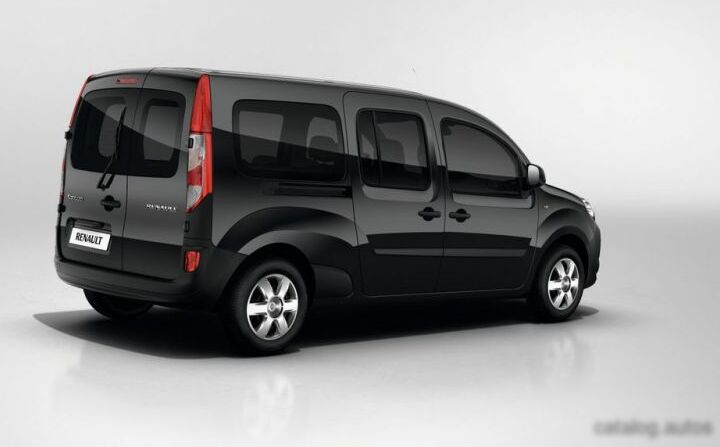
The Renault Grand Kangoo II 1.5 dCi, producing 110 horsepower, was a popular configuration of Renault’s versatile compact MPV, sold primarily in Europe from 2012 to 2013. Positioned as a mid-range offering within the Grand Kangoo II lineup, it aimed to balance fuel efficiency with adequate performance for family transport and light commercial duties. This variant occupied a space between the base-level engine options and the more powerful, though less economical, versions. The Grand Kangoo II itself, built on the X0/B0 platform, represented a significant evolution of the original Kangoo, offering increased space, improved refinement, and a wider range of features.
Powertrain & Engine Architecture
The heart of the Grand Kangoo II 1.5 dCi (110 Hp) is the K9K engine, a member of Renault’s widely used family of small-displacement diesel engines. This 1461cc inline-four cylinder engine utilizes a common rail direct injection system, delivering fuel at extremely high pressure for optimized combustion. The engine features a single overhead camshaft (SOHC) operating two valves per cylinder. A turbocharger with an intercooler is employed to boost power output and improve torque across a wider rev range. The 110 horsepower peak is achieved at 4000 rpm, while the substantial 240 Nm (177 lb-ft) of torque is available from just 1750 rpm, providing good low-end responsiveness. The engine met Euro 5 emissions standards, incorporating a diesel particulate filter (DPF) to reduce soot emissions. The engine was typically paired with a six-speed manual transmission, offering a good balance between fuel economy and drivability.
Driving Characteristics
The 1.5 dCi 110 hp engine, coupled with the six-speed manual gearbox, provided a reasonably sprightly driving experience for the Grand Kangoo II. While not a performance-oriented vehicle, the engine delivered sufficient power for everyday driving, including fully loaded with passengers and cargo. Acceleration from 0-100 km/h (0-62 mph) took around 15 seconds. The readily available torque made overtaking at highway speeds manageable, though it required downshifting. Compared to the lower-powered 90 hp version of the same engine, the 110 hp variant offered a noticeable improvement in responsiveness, particularly when climbing hills or carrying a heavy load. It was, however, less economical than the 90 hp version. The gear ratios in the six-speed manual were well-chosen, providing a comfortable cruising speed on motorways while still offering enough grunt for urban driving.
Equipment & Trim Levels
The 1.5 dCi 110 hp Grand Kangoo II typically came equipped with a respectable level of standard features. These included air conditioning, power steering, electric front windows, a CD player with auxiliary input, and ABS brakes. Higher trim levels, such as the ‘Expression’ or ‘Privilege’ variants, added features like alloy wheels, rear parking sensors, cruise control, and upgraded interior trim. Interior upholstery was typically cloth, with options for more durable materials for commercial use. A key feature of the Grand Kangoo II was its modular interior, with removable seats and a configurable cargo area, allowing for a variety of seating and load-carrying arrangements.
Chassis & Braking
The Grand Kangoo II utilized a McPherson strut front suspension and a torsion beam rear suspension. This setup provided a comfortable ride quality, absorbing bumps and imperfections in the road surface effectively. The front brakes were ventilated discs, offering good stopping power, while the rear brakes were solid discs. ABS (Anti-lock Braking System) was standard, enhancing safety during emergency braking situations. The steering was a rack and pinion system, providing precise and responsive handling. The vehicle’s relatively high center of gravity meant that it wasn’t particularly sporty to drive, but it remained stable and predictable in most conditions.
Market Reception & Comparison
The Renault Grand Kangoo II 1.5 dCi (110 Hp) was generally well-received by automotive critics. It was praised for its practicality, versatility, and fuel efficiency. The 110 hp engine was considered a good compromise between performance and economy, making it a popular choice for families and small businesses. Compared to other compact MPVs in its class, such as the Citroën Berlingo and Peugeot Partner, the Grand Kangoo II offered a more refined interior and a wider range of features. However, some critics noted that the ride could be a little firm when the vehicle was fully loaded. Fuel economy figures of around 5.5 l/100 km (42.8 US mpg) were competitive for its class.
Legacy
The K9K engine, in its various iterations, proved to be a robust and reliable powerplant. The 1.5 dCi 110 hp version, when properly maintained, is known for its longevity. Common issues, like with many modern diesels, can include DPF clogging if the vehicle is primarily used for short journeys, and potential issues with the fuel injectors. On the used car market, the Grand Kangoo II 1.5 dCi (110 Hp) remains a popular choice due to its practicality, affordability, and relatively low running costs. Its versatility and spacious interior continue to make it a useful vehicle for families, tradespeople, and anyone needing a flexible and economical mode of transport.