Technical Specifications
| Brand | Toyota |
| Model | Carina |
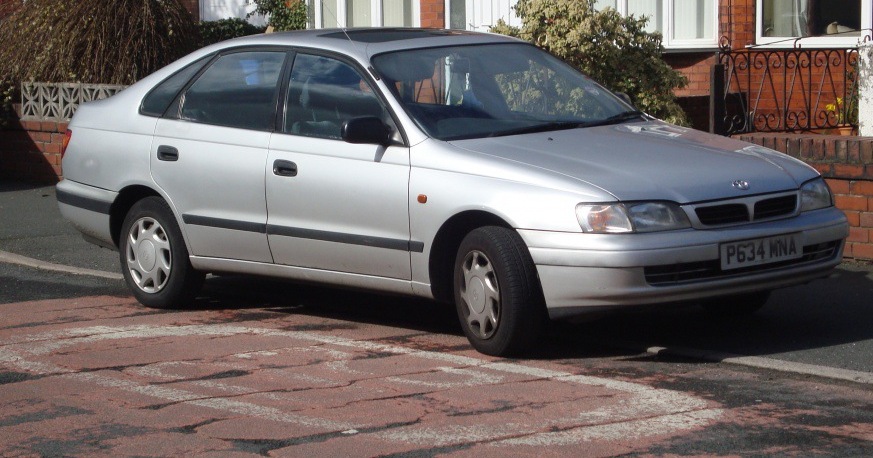
| Generation | Carina E Hatch (T19) |
| Type (Engine) | 2.0 i 16V GLi (133 Hp) |
| Start of production | 1993 |
| End of production | 1998 |
| Powertrain Architecture | Internal Combustion engine |
| Body type | Hatchback |
| Seats | 5 |
| Doors | 5 |
| Fuel consumption (combined) | 7.7 l/100 km |
| Fuel consumption (US mpg) | 30.5 US mpg |
| Fuel consumption (UK mpg) | 36.7 UK mpg |
| Fuel consumption (km/l) | 13 km/l |
| Fuel Type | Petrol (Gasoline) |
| Acceleration 0 – 100 km/h | 9 sec |
| Acceleration 0 – 62 mph | 9 sec |
| Acceleration 0 – 60 mph | 8.6 sec |
| Maximum speed | 205 km/h (127.38 mph) |
| Weight-to-power ratio | 8.9 kg/Hp |
| Weight-to-torque ratio | 6.4 kg/Nm |
| Power | 133 Hp @ 5800 rpm |
| Power per litre | 66.6 Hp/l |
| Torque | 183 Nm @ 4400 rpm (134.97 lb.-ft. @ 4400 rpm) |
| Engine layout | Front, Transverse |
| Engine Model/Code | 3S-FE |
| Engine displacement | 1998 cm3 (121.93 cu. in.) |
| Number of cylinders | 4 |
| Engine configuration | Inline |
| Cylinder Bore | 86 mm (3.39 in.) |
| Piston Stroke | 86 mm (3.39 in.) |
| Compression ratio | 9.8:1 |
| Number of valves per cylinder | 4 |
| Fuel injection system | Multi-port manifold injection |
| Engine aspiration | Naturally aspirated engine |
| Valvetrain | DOHC |
| Engine oil capacity | 3.9 l (4.12 US qt | 3.43 UK qt) |
| Coolant capacity | 6.5 l (6.87 US qt | 5.72 UK qt) |
| Kerb Weight | 1180 kg (2601.45 lbs.) |
| Max. weight | 1700 kg (3747.86 lbs.) |
| Max load | 520 kg (1146.4 lbs.) |
| Trunk (boot) space – minimum | 470 l (16.6 cu. ft.) |
| Trunk (boot) space – maximum | 1250 l (44.14 cu. ft.) |
| Fuel tank capacity | 60 l (15.85 US gal | 13.2 UK gal) |
| Length | 4530 mm (178.35 in.) |
| Width | 1695 mm (66.73 in.) |
| Height | 1410 mm (55.51 in.) |
| Wheelbase | 2580 mm (101.57 in.) |
| Front track | 1465 mm (57.68 in.) |
| Rear track | 1445 mm (56.89 in.) |
| Drivetrain Architecture | Front wheel drive |
| Number of gears | 5 |
| Gearbox type | Manual transmission |
| Front suspension | Spring Strut |
| Rear suspension | Coil spring |
| Front brakes | Ventilated discs |
| Rear brakes | Drum |
| Assisting systems | ABS (Anti-lock braking system) |
| Steering type | Steering rack and pinion |
| Power steering | Hydraulic Steering |
| Tires size | 185/65 R14 |
The Toyota Carina E, launched in 1992, was a crucial model for Toyota in establishing a stronger foothold in the European market. Replacing the Carina II, the E-series represented a more modern and refined approach to the mid-size segment. The 2.0 i 16V GLi variant, introduced in 1993, was a key component of the range, offering a balance between performance and economy. Built on the T19 platform, the Carina E aimed to provide a comfortable and reliable driving experience, appealing to families and individuals seeking a practical and well-equipped vehicle. The GLi trim level signified a good level of standard equipment, making it a popular choice for buyers.
Powertrain & Engine Architecture
At the heart of the 2.0 i 16V GLi was the 3S-FE engine, a 1.998-liter, inline-four cylinder powerplant. This engine was a mainstay in Toyota’s lineup during the 1990s, known for its reliability and relatively smooth operation. The “16V” designation indicates the engine featured four valves per cylinder, contributing to improved breathing and power output. The 3S-FE utilized a multi-port fuel injection system, delivering fuel directly to each intake port for precise fuel metering and efficient combustion. The engine employed a double overhead camshaft (DOHC) valvetrain, further enhancing its performance characteristics. The 5-speed manual transmission was the standard offering for this trim, providing drivers with direct control over the engine’s power. The transmission was chosen for its durability and relatively precise shift feel.
Driving Characteristics
The 2.0 i 16V GLi offered a respectable driving experience for its time. With 133 horsepower and 183 Nm (135 lb-ft) of torque, acceleration from 0 to 60 mph took around 8.6 seconds, and it could reach a top speed of 205 km/h (127 mph). While not a sports car, the engine provided sufficient power for comfortable highway cruising and overtaking maneuvers. The 5-speed manual transmission allowed drivers to keep the engine in its optimal power band, maximizing performance. Compared to the base 1.6L models, the 2.0L offered a noticeable improvement in responsiveness. However, it didn’t possess the outright performance of the more expensive and less common 2.2L variants. The front-wheel-drive configuration provided predictable handling, although it lacked the dynamic finesse of some rear-wheel-drive competitors.
Equipment & Trim Levels
The GLi trim level placed the 2.0 i 16V in a comfortable mid-range position within the Carina E lineup. Standard features typically included power steering, central locking, electric windows, and an upgraded audio system. Interior upholstery was usually cloth, with a focus on durability and comfort. Optional extras available for the GLi included air conditioning, alloy wheels, and a sunroof. The dashboard layout was functional and straightforward, prioritizing ease of use over stylistic flair. The Carina E generally offered a well-equipped interior for its price point, competing favorably with rivals from Ford and Vauxhall.
Chassis & Braking
The Carina E utilized a conventional front-wheel-drive chassis layout. Front suspension consisted of MacPherson strut springs, while the rear employed a coil spring setup. This configuration provided a comfortable ride quality, absorbing bumps and imperfections in the road surface effectively. Braking duties were handled by ventilated discs at the front and drum brakes at the rear. Anti-lock Braking System (ABS) was standard equipment on the GLi trim, enhancing safety by preventing wheel lockup during hard braking. The steering system was a rack-and-pinion setup with hydraulic power assistance, providing light and precise steering feel.
Market Reception & Comparison
The Toyota Carina E 2.0 i 16V GLi was generally well-received by automotive critics. It was praised for its reliability, comfortable ride, and good value for money. However, some critics noted that its styling was somewhat conservative compared to its rivals. In terms of fuel economy, the 2.0L engine offered a reasonable balance between performance and efficiency, achieving around 30.5 US mpg on combined cycles. Compared to the 1.6L models, the 2.0L offered a significant performance boost, but at the expense of slightly higher fuel consumption. The 2.2L variants provided even more power, but were considerably more expensive and less common.
Legacy
The Toyota Carina E, and specifically the 2.0 i 16V GLi, has earned a reputation for long-term reliability. The 3S-FE engine is known for its durability and ability to withstand high mileage with proper maintenance. Today, well-maintained examples are becoming increasingly sought after by enthusiasts and collectors. While not a particularly rare car, finding a Carina E in good condition can be challenging. The car represents a solid and dependable choice for those seeking a classic 1990s family car, offering a blend of practicality, comfort, and Toyota’s renowned reliability. Parts availability remains reasonable, making it a viable option for restoration and continued use.