
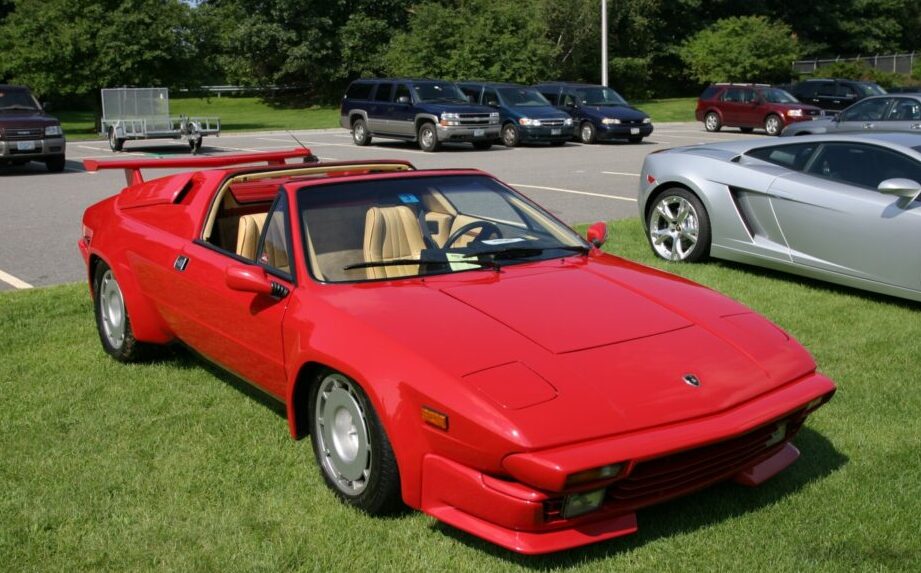
The Lamborghini Jalpa P 350 V8 (255 Hp) was a sports car produced by the Italian manufacturer Lamborghini between 1982 and 1988. Designed as a more accessible and attainable Lamborghini compared to the Countach, the Jalpa represented the company’s attempt to broaden its appeal and increase sales volume. It was the final Lamborghini model produced under the ownership of the Mimran brothers. The Jalpa’s design, penned by Bertone’s Marcello Gandini, offered a more refined and contemporary aesthetic than its angular predecessor, the Silhouette, while still retaining the signature Lamborghini flair.
Technical Specifications
| Brand | Lamborghini |
| Model | Jalpa |
| Generation | Jalpa |
| Type (Engine) | P 350 V8 (255 Hp) |
| Start of production | June, 1982 |
| End of production | June, 1988 |
| Powertrain Architecture | Internal Combustion engine |
| Body type | Targa |
| Seats | 2 |
| Doors | 2 |
| Fuel Type | Petrol (Gasoline) |
| Acceleration 0 – 100 km/h | 6.4 sec |
| Acceleration 0 – 62 mph | 6.4 sec |
| Acceleration 0 – 60 mph | 6.8 sec |
| Maximum speed | 248 km/h (154.1 mph) |
| Weight-to-power ratio | 5.9 kg/Hp, 170 Hp/tonne |
| Weight-to-torque ratio | 4.8 kg/Nm, 209.3 Nm/tonne |
| Power | 255 Hp @ 7000 rpm |
| Power per litre | 73.2 Hp/l |
| Torque | 314 Nm @ 3500 rpm (231.59 lb.-ft. @ 3500 rpm) |
| Engine layout | Middle, Transverse |
| Engine displacement | 3485 cm3 (212.67 cu. in.) |
| Number of cylinders | 8 |
| Engine configuration | V-engine |
| Cylinder Bore | 86 mm (3.39 in.) |
| Piston Stroke | 75 mm (2.95 in.) |
| Compression ratio | 9.2:1 |
| Number of valves per cylinder | 2 |
| Fuel injection system | Carburettor |
| Engine aspiration | Naturally aspirated engine |
| Valvetrain | DOHC |
| Engine oil capacity | 9 l (9.51 US qt | 7.92 UK qt) |
| Coolant | 15 l (15.85 US qt | 13.2 UK qt) |
| Kerb Weight | 1500 kg (3306.93 lbs.) |
| Max. weight | 1830 kg (4034.46 lbs.) |
| Max load | 330 kg (727.53 lbs.) |
| Fuel tank capacity | 80 l (21.13 US gal | 17.6 UK gal) |
| Length | 4330 mm (170.47 in.) |
| Width | 1880 mm (74.02 in.) |
| Height | 1140 mm (44.88 in.) |
| Wheelbase | 2450 mm (96.46 in.) |
| Front track | 1500 mm (59.06 in.) |
| Rear (Back) track | 1554 mm (61.18 in.) |
| Ride height (ground clearance) | 140 mm (5.51 in.) |
| Minimum turning circle (turning diameter) | 11 m (36.09 ft.) |
| Drivetrain Architecture | The Internal combustion engine (ICE) drives the rear wheels of the vehicle. |
| Drive wheel | Rear wheel drive |
| Number of gears and type of gearbox | 5 gears, manual transmission |
| Front suspension | Independent, type McPherson with coil spring and anti-roll bar |
| Rear suspension | Spring Strut, Wishbone, Transverse stabilizer |
| Front brakes | Disc |
| Rear brakes | Disc |
| Steering type | Steering rack and pinion |
| Tires size | Front wheel tires: 205/55 R16Rear wheel tires: 225/55 R16 |
| Wheel rims size | Front wheel rims: 7.5J x 16Rear wheel rims: 7.5J x 16 |
Background and Development
The Jalpa emerged during a period of transition for Lamborghini. The Countach, while iconic, was becoming increasingly expensive and complex. Lamborghini needed a model that could attract a wider customer base without diluting the brand’s image of high performance and exclusivity. The Jalpa was conceived as that model. It was named after a breed of fighting bull, continuing Lamborghini’s tradition of naming its cars after Spanish fighting bulls. The Jalpa was based on the earlier Silhouette and Spyder models, but featured significant improvements in terms of refinement, usability, and overall performance. The design was finalized by Bertone under the direction of Marcello Gandini, resulting in a sleek, wedge-shaped silhouette that was characteristic of 1980s sports car design.
Engine and Performance
The heart of the Jalpa was its 3.5-liter V8 engine, designated the P 350. This engine, while sharing some lineage with the earlier Lamborghini V8s, was specifically designed for the Jalpa. It produced 255 horsepower at 7,000 rpm and 231 lb-ft of torque at 3,500 rpm. The engine was transversely mounted behind the driver and passenger, contributing to the car’s balanced handling. Power was delivered to the rear wheels through a five-speed manual transmission. The Jalpa could accelerate from 0 to 60 mph in approximately 6.8 seconds and achieve a top speed of around 154 mph. While not as brutally fast as the Countach, the Jalpa offered a more accessible and enjoyable driving experience, particularly on winding roads. The use of carburetors, rather than fuel injection, was a cost-saving measure, but it also contributed to the engine’s responsive throttle characteristics.
Positioning in the Lamborghini Lineup
The Jalpa occupied a unique position within the Lamborghini lineup. It was positioned below the flagship Countach in terms of price and performance, making it the entry-level Lamborghini. However, it was still a significantly expensive and exclusive vehicle. The Jalpa targeted buyers who wanted the prestige and excitement of owning a Lamborghini but didn’t necessarily require the extreme performance or high running costs of the Countach. Compared to the Countach, the Jalpa offered a more comfortable and refined interior, as well as improved visibility and ease of use. It was also more reliable and less demanding to maintain, although still requiring specialized care.
Comparison with Siblings
During its production run, the Jalpa didn’t have direct siblings in the traditional sense. The Countach remained the halo car, representing the pinnacle of Lamborghini performance. However, the Jalpa was a direct successor to the Silhouette and Spyder, which were also V8-powered mid-engine sports cars. The Jalpa represented a significant improvement over these earlier models in terms of refinement, build quality, and overall performance. Unlike the Countach, which was available with a larger V12 engine, the Jalpa was exclusively powered by the 3.5-liter V8. This made the Jalpa more manageable and accessible for a wider range of drivers. The V8 engine also offered a different character than the V12, with a more responsive and rev-happy nature. Maintenance on the Jalpa, while still expensive, was generally less complex and costly than on the Countach.
Legacy
Production of the Jalpa ceased in 1988, coinciding with the Chrysler acquisition of Lamborghini. The Jalpa was never a huge sales success, with only around 410 examples produced. However, it remains a highly sought-after classic Lamborghini, appreciated for its elegant design, engaging driving experience, and relative affordability compared to other models from the era. The Jalpa represents a unique chapter in Lamborghini’s history, showcasing the company’s attempt to broaden its appeal and create a more accessible sports car. Today, the Jalpa is a collectible car that offers a taste of Lamborghini ownership without the extreme price tag of its more famous siblings.
