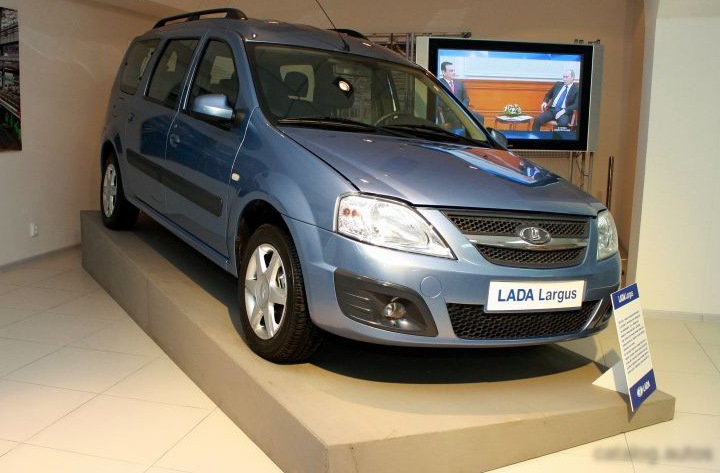
The Lada Largus Furgon, particularly the 1.6-liter (90 horsepower) variant introduced with the 2021 facelift, represents a pragmatic and affordable commercial vehicle primarily aimed at the Russian and Eastern European markets. While not sold officially in the United States, understanding its specifications and positioning provides insight into the demands of its target demographic and the broader landscape of budget-focused utility vehicles. This specific configuration, with its naturally aspirated engine and five-speed manual transmission, occupied the entry-level position within the Largus Furgon range.
Technical Specifications
| Brand | Lada |
| Model | Largus |
| Generation | Largus Furgon (facelift 2021) |
| Type (Engine) | 1.6 (90 Hp) |
| Start of production | 2021 |
| Powertrain Architecture | Internal Combustion engine |
| Body type | Minivan |
| Seats | 2 |
| Doors | 5 |
| Fuel consumption (urban) | 11.1 l/100 km (21.2 US mpg, 25.4 UK mpg, 9 km/l) |
| Fuel consumption (extra urban) | 6.7 l/100 km (35.1 US mpg, 42.2 UK mpg, 14.9 km/l) |
| Fuel consumption (combined) | 8.3 l/100 km (28.3 US mpg, 34 UK mpg, 12 km/l) |
| Fuel Type | Petrol (Gasoline) |
| Acceleration 0 – 100 km/h | 14.3 sec |
| Acceleration 0 – 62 mph | 14.3 sec |
| Acceleration 0 – 60 mph | 13.6 sec |
| Maximum speed | 160 km/h (99.42 mph) |
| Emission standard | Euro 5 |
| Weight-to-power ratio | 14 kg/Hp, 71.4 Hp/tonne |
| Weight-to-torque ratio | 8.8 kg/Nm, 113.5 Nm/tonne |
| Power | 90 Hp @ 5000 rpm |
| Power per litre | 56.4 Hp/l |
| Torque | 143 Nm @ 3800 rpm (105.47 lb.-ft. @ 3800 rpm) |
| Engine layout | Front, Transverse |
| Engine Model/Code | 11182 |
| Engine displacement | 1596 cm3 (97.39 cu. in.) |
| Number of cylinders | 4 |
| Engine configuration | Inline |
| Number of valves per cylinder | 2 |
| Fuel injection system | Multi-port manifold injection |
| Engine aspiration | Naturally aspirated engine |
| Engine oil capacity | 3.85 l (4.07 US qt | 3.39 UK qt) |
| Coolant capacity | 6.4 l (6.76 US qt | 5.63 UK qt) |
| Kerb Weight | 1260 kg (2777.82 lbs.) |
| Max. weight | 1985 kg (4376.18 lbs.) |
| Max load | 725 kg (1598.35 lbs.) |
| Trunk (boot) space – maximum | 2540 l (89.7 cu. ft.) |
| Fuel tank capacity | 50 l (13.21 US gal | 11 UK gal) |
| Permitted trailer load without brakes | 650 kg (1433 lbs.) |
| Length | 4488 mm (176.69 in.) |
| Width | 1735 mm (68.31 in.) |
| Height | 1656 mm (65.2 in.) |
| Wheelbase | 2905 mm (114.37 in.) |
| Front track | 1469 mm (57.83 in.) |
| Rear (Back) track | 1466 mm (57.72 in.) |
| Front overhang | 813 mm (32.01 in.) |
| Rear overhang | 770 mm (30.31 in.) |
| Ride height (ground clearance) | 172 mm (6.77 in.) |
| Drivetrain Architecture | Front wheel drive, Internal Combustion engine |
| Drive wheel | Front wheel drive |
| Number of gears and type of gearbox | 5 gears, manual transmission |
| Front suspension | Independent, type McPherson with coil spring and anti-roll bar |
| Rear suspension | Semi-independent, coil spring |
| Front brakes | Ventilated discs |
| Rear brakes | Drum |
| Assisting systems | ABS (Anti-lock braking system) |
| Steering type | Steering rack and pinion |
| Tires size | 185/65 R15 |
| Wheel rims size | 15 |
Overview and Market Positioning
The Lada Largus Furgon is essentially a panel van derivative of the Largus station wagon, itself based on the Renault Dacia Logan MCV. Introduced in 2012, the Largus was designed to fill a gap in the Lada lineup for a practical, affordable, and spacious vehicle suitable for both commercial and family use. The 2021 facelift brought minor cosmetic updates and refinements, but the core mechanicals remained largely unchanged. The 1.6-liter, 90-horsepower engine and five-speed manual transmission combination was the base offering, prioritizing affordability and fuel economy over outright performance.
In its primary markets, the Largus Furgon competes with other budget-oriented vans and light commercial vehicles. It’s favored by small businesses, tradespeople, and those needing a versatile vehicle for carrying goods or equipment. The Furgon’s large cargo capacity (2540 liters) and relatively low operating costs make it an attractive option for those prioritizing practicality and value.
Engine and Performance
The heart of this Largus variant is the 1.6-liter, naturally aspirated inline-four cylinder engine (model 11182). Producing 90 horsepower at 5000 rpm and 143 Nm (105.47 lb-ft) of torque at 3800 rpm, it’s not a powerhouse. Acceleration is modest, taking around 14.3 seconds to reach 100 km/h (62 mph). Top speed is limited to 160 km/h (99.42 mph). The engine’s design emphasizes durability and simplicity rather than high-end performance. It utilizes a multi-port fuel injection system and meets Euro 5 emission standards.
The five-speed manual transmission is the only gearbox option for this trim level. While not offering the convenience of an automatic, it provides drivers with greater control and contributes to better fuel economy. The front-wheel-drive configuration is standard, keeping costs down and simplifying the drivetrain.
Comparison with Other Largus Variants
The 1.6-liter 90 hp Largus Furgon served as the entry point to the range. Stepping up, buyers could opt for a more powerful 1.6-liter engine with slightly more horsepower (around 106 hp). While the performance increase wasn’t dramatic, it did offer a noticeable improvement in acceleration and overall drivability. There were no diesel options available for the Furgon.
Compared to the passenger-oriented Largus station wagon, the Furgon prioritizes cargo space and utility. The rear seats are typically removed in the Furgon configuration, maximizing the available load area. The Furgon also features reinforced suspension components to handle heavier loads.
Suspension, Brakes, and Handling
The Largus Furgon utilizes a McPherson strut independent suspension setup at the front, providing a reasonable level of ride comfort and handling. The rear suspension is a semi-independent coil spring design, which is a cost-effective solution for commercial vehicles. Ventilated disc brakes are used at the front, while drum brakes are found at the rear. ABS (Anti-lock Braking System) is standard, enhancing safety during emergency braking situations.
The steering is rack and pinion, offering adequate precision and feedback. The vehicle rides on 185/65 R15 tires, which provide a balance between comfort and durability. Overall, the Largus Furgon is not designed for sporty handling, but it offers a stable and predictable driving experience suitable for its intended purpose.
Practical Considerations and Reliability
The Lada Largus Furgon’s appeal lies in its practicality and affordability. Its large cargo capacity, relatively low running costs, and simple mechanical design make it a popular choice for businesses and individuals seeking a no-frills utility vehicle. While not known for luxurious features or cutting-edge technology, the Largus Furgon offers a robust and dependable solution for transporting goods and equipment. Maintenance is generally straightforward and inexpensive, thanks to the readily available parts and the engine’s relatively simple construction. However, build quality and refinement are areas where the Largus Furgon lags behind more modern competitors.