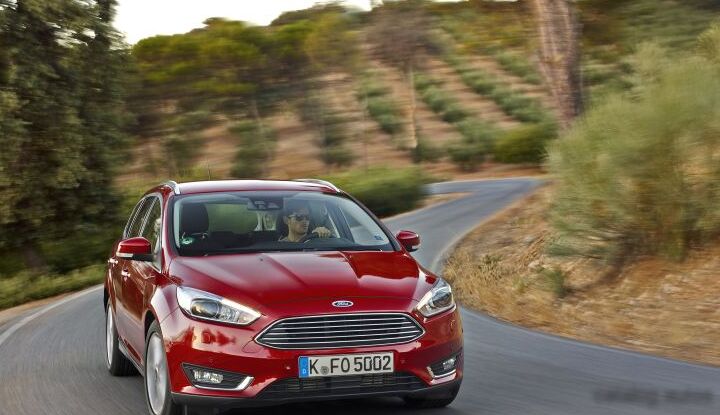
The Ford Focus III Wagon, specifically the facelifted version produced from 2014 to 2018, represented a significant evolution of Ford’s compact family car. Within the third generation (2011-2018) lineup, the 2.0 TDCi 150 horsepower variant equipped with the PowerShift dual-clutch transmission occupied a middle ground, offering a balance between fuel efficiency, performance, and practicality. This model aimed to appeal to buyers needing a versatile vehicle for both daily commuting and longer journeys, with the added convenience of an automatic transmission. It was a key offering in the European market, where wagons remained popular, and was also available in select other regions.
Technical Specifications
| Brand | Ford |
| Model | Focus |
| Generation | Focus III Wagon (facelift 2014) |
| Type (Engine) | 2.0 TDCi (150 Hp) PowerShift |
| Start of production | 2014 |
| End of production | 2018 |
| Powertrain Architecture | Internal Combustion engine |
| Body type | Station wagon (estate) |
| Seats | 5 |
| Doors | 5 |
| Fuel consumption (urban) | 6.1 l/100 km (38.6 US mpg, 46.3 UK mpg, 16.4 km/l) |
| Fuel consumption (extra urban) | 4 l/100 km (58.8 US mpg, 70.6 UK mpg, 25 km/l) |
| Fuel consumption (combined) | 4.8 l/100 km (49 US mpg, 58.9 UK mpg, 20.8 km/l) |
| CO2 emissions | 124 g/km |
| Fuel Type | Diesel |
| Acceleration 0 – 100 km/h | 8.9 sec |
| Acceleration 0 – 62 mph | 8.9 sec |
| Acceleration 0 – 60 mph | 8.5 sec |
| Maximum speed | 208 km/h (129.25 mph) |
| Emission standard | Euro 6 |
| Weight-to-power ratio | 11 kg/Hp, 90.6 Hp/tonne |
| Weight-to-torque ratio | 4.5 kg/Nm, 223.6 Nm/tonne |
| Power | 150 Hp @ 3750 rpm |
| Power per litre | 75.1 Hp/l |
| Torque | 370 Nm @ 2000-3250 rpm (272.9 lb.-ft. @ 2000-3250 rpm) |
| Engine layout | Front, Transverse |
| Engine Model/Code | T7DB |
| Engine displacement | 1997 cm3 (121.86 cu. in.) |
| Number of cylinders | 4 |
| Engine configuration | Inline |
| Cylinder Bore | 85 mm (3.35 in.) |
| Piston Stroke | 88 mm (3.46 in.) |
| Compression ratio | 16:1 |
| Number of valves per cylinder | 4 |
| Fuel injection system | Diesel Commonrail |
| Engine aspiration | Turbocharger, Intercooler |
| Valvetrain | DOHC |
| Engine oil capacity | 6.1 l (6.45 US qt | 5.37 UK qt) |
| Coolant | 8 l (8.45 US qt | 7.04 UK qt) |
| Kerb Weight | 1655 kg (3648.65 lbs.) |
| Max. weight | 2050 kg (4519.48 lbs.) |
| Max load | 395 kg (870.83 lbs.) |
| Trunk (boot) space – minimum | 476 l (16.81 cu. ft.) |
| Trunk (boot) space – maximum | 1502 l (53.04 cu. ft.) |
| Fuel tank capacity | 60 l (15.85 US gal | 13.2 UK gal) |
| Length | 4556 mm (179.37 in.) |
| Width | 1823 mm (71.77 in.) |
| Height | 1505 mm (59.25 in.) |
| Wheelbase | 2648 mm (104.25 in.) |
| Front track | 1544 mm (60.79 in.) |
| Rear (Back) track | 1559 mm (61.38 in.) |
| Minimum turning circle | 11 m (36.09 ft.) |
| Drivetrain Architecture | Front wheel drive |
| Number of gears and type of gearbox | 6 gears, automatic transmission PowerShift |
| Front suspension | Independent, type McPherson with coil spring and anti-roll bar |
| Rear suspension | Independent multi-link suspension |
| Front brakes | Disc |
| Rear brakes | Disc |
| Tires size | 205/55 R16; 215/50 R17 |
| Wheel rims size | 6.5J x 16; 7.0J x 17 |
INTRODUCTION
The 2.0 TDCi 150 PS PowerShift variant of the Ford Focus III Wagon (facelift) arrived in 2014 as part of a mid-cycle refresh for the third-generation Focus. Built on the C346 platform (internally known as 1HX0 for the hatchback and wagon), this version aimed to provide a more refined and efficient option for buyers seeking a practical and comfortable estate car. The facelift brought updated styling, improved interior materials, and enhanced technology, including the availability of Ford’s SYNC 2 infotainment system. The 2.0 TDCi engine was a mainstay of the Focus range, offering a good compromise between performance and fuel economy, and the PowerShift transmission provided the convenience of automatic operation with the efficiency benefits of a dual-clutch design.
Powertrain & Engine Architecture
At the heart of this Focus variant lies the Ford T7DB 2.0-liter turbocharged diesel engine. This engine is a four-cylinder, inline configuration, utilizing a common-rail direct fuel injection system and a variable geometry turbocharger. The T7DB engine boasts a compression ratio of 16:1, contributing to its efficiency. The engine’s DOHC (Double Overhead Camshaft) valvetrain, with four valves per cylinder, optimizes airflow for improved power delivery. The PowerShift transmission, a six-speed dual-clutch transmission (DCT), is a key component. It operates similarly to two manual transmissions in one, allowing for quick and smooth gear changes without the traditional torque interruption of a conventional automatic. This transmission utilizes two separate clutches – one for odd-numbered gears and one for even-numbered gears – to pre-select the next gear, resulting in faster shifts and improved fuel efficiency.
Driving Characteristics
The 2.0 TDCi 150 PS PowerShift Focus Wagon delivers a respectable driving experience. While not a performance-oriented vehicle, the 370 Nm (272.9 lb-ft) of torque available from 2000-3250 rpm provides ample pulling power for everyday driving and overtaking maneuvers. Acceleration from 0-60 mph takes approximately 8.5 seconds, and the car reaches a top speed of 129.25 mph. The PowerShift transmission generally offers smooth and quick gear changes, particularly in automatic mode. However, some drivers have reported occasional hesitation or jerkiness at low speeds, a common characteristic of early dual-clutch transmissions. The gear ratios are tuned for a balance of fuel efficiency and usability, with a relatively tall sixth gear for highway cruising. Compared to the lower-powered 1.6 TDCi variants, the 2.0 TDCi offers noticeably more performance, while the higher-output 2.0 TDCi 163 PS version provides a further performance boost but at the expense of slightly reduced fuel economy.
Equipment & Trim Levels
The 2.0 TDCi 150 PS PowerShift typically came equipped as a mid-range trim level, often designated as ‘Titanium’ or similar. Standard features generally included air conditioning, power windows, power mirrors, a CD/MP3 stereo system, and alloy wheels. The facelifted models benefited from the upgraded SYNC 2 infotainment system with a touchscreen display, offering navigation, Bluetooth connectivity, and voice control. Optional extras included leather upholstery, heated front seats, a panoramic sunroof, parking sensors, and advanced driver-assistance systems like lane departure warning and automatic emergency braking. Interior upholstery was typically cloth, with higher trims offering partial leather options. The dashboard layout was revised during the facelift, featuring a more modern and user-friendly design.
Chassis & Braking
The Focus III Wagon utilizes an independent suspension setup on both the front and rear axles. The front suspension employs a McPherson strut design with a coil spring and anti-roll bar, while the rear features a multi-link suspension system. This configuration provides a good balance of ride comfort and handling. Braking duties are handled by disc brakes on all four wheels, providing adequate stopping power. Anti-lock Braking System (ABS) and Electronic Stability Control (ESC) are standard safety features. The chassis was tuned to accommodate the increased weight of the diesel engine and PowerShift transmission, with slightly stiffer springs and dampers compared to the petrol-powered models.
Market Reception & Comparison
The Ford Focus III Wagon 2.0 TDCi 150 PS PowerShift was generally well-received by automotive critics. It was praised for its fuel efficiency, comfortable ride, and spacious interior. The PowerShift transmission was a point of contention, with some reviewers noting its occasional quirks, but overall it was considered a convenient and efficient option. Compared to rivals like the Volkswagen Golf Estate and Skoda Octavia Estate, the Focus offered a more engaging driving experience and a slightly more stylish design. Fuel economy figures of around 49 US mpg (combined) were competitive for its class. Reliability was generally good, although some owners reported issues with the PowerShift transmission, particularly in early production models.
Legacy
The 2.0 TDCi 150 PS PowerShift Focus Wagon remains a popular choice in the used car market. Its combination of practicality, fuel efficiency, and reasonable performance makes it a versatile option for families and individuals alike. While the PowerShift transmission requires careful maintenance and occasional servicing, it is generally a reliable unit when properly cared for. The Focus III Wagon, in general, established a strong reputation for its handling and overall build quality, and this variant continues to be a well-regarded example of a modern European estate car. Its longevity and continued presence on roads today are a testament to its enduring appeal.