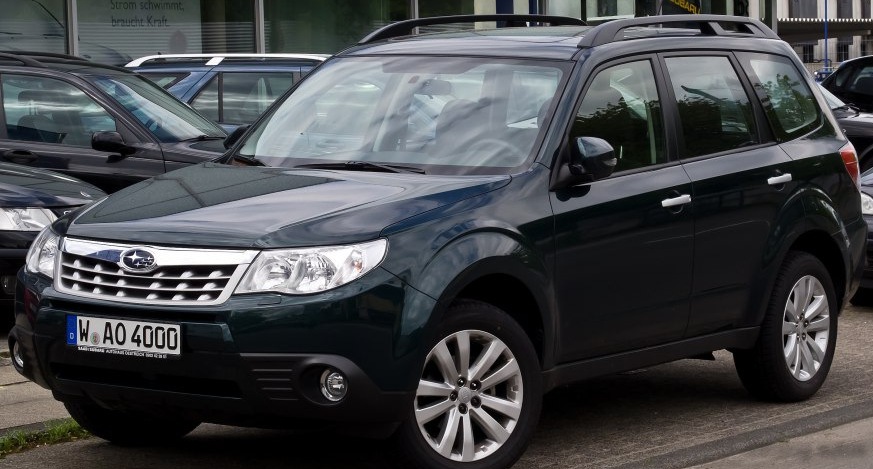
The Subaru Forester III, specifically the facelifted model produced from 2010 to 2013, represented a significant evolution of Subaru’s popular compact SUV. Within the Forester III range, the 2.0i variant, producing 150 horsepower, served as a core offering, positioned as a balance between affordability and capability. This model year saw styling updates and refinements to the already well-regarded Forester platform, solidifying its position in the competitive crossover SUV segment, particularly in markets like Europe, Australia, and North America. The 2.0i was a key volume seller, appealing to buyers seeking a practical, all-wheel-drive vehicle for everyday use and light-duty adventures.
Technical Specifications
| Brand | Subaru |
| Model | Forester |
| Generation | Forester III (facelift 2010) |
| Type (Engine) | 2.0 i (150 Hp) |
| Start of production | 2010 |
| End of production | 2013 |
| Powertrain Architecture | Internal Combustion engine |
| Body type | SUV, Crossover |
| Seats | 5 |
| Doors | 5 |
| Fuel consumption (combined) | 7.5 l/100 km (31.4 US mpg, 37.7 UK mpg, 13.3 km/l) |
| Fuel Type | Petrol (Gasoline) |
| Acceleration 0 – 100 km/h | 10.7 sec |
| Acceleration 0 – 62 mph | 10.7 sec |
| Acceleration 0 – 60 mph | 10.2 sec |
| Maximum speed | 185 km/h (114.95 mph) |
| Weight-to-power ratio | 9.8 kg/Hp, 101.7 Hp/tonne |
| Weight-to-torque ratio | 7.4 kg/Nm, 134.2 Nm/tonne |
| Power | 150 Hp @ 6000 rpm |
| Power per litre | 75.2 Hp/l |
| Torque | 198 Nm @ 4200 rpm (146.04 lb.-ft. @ 4200 rpm) |
| Engine layout | Front, Longitudinal |
| Engine displacement | 1995 cm3 (121.74 cu. in.) |
| Number of cylinders | 4 |
| Engine configuration | Boxer |
| Number of valves per cylinder | 4 |
| Fuel injection system | Multi-port manifold injection |
| Engine aspiration | Naturally aspirated engine |
| Valvetrain | DOHC |
| Engine oil capacity | 4.2 l (4.44 US qt | 3.7 UK qt) |
| Kerb Weight | 1475 kg (3251.82 lbs.) |
| Trunk (boot) space – minimum | 450 l (15.89 cu. ft.) |
| Length | 4560 mm (179.53 in.) |
| Width | 1780 mm (70.08 in.) |
| Height | 1700 mm (66.93 in.) |
| Drive wheel | All wheel drive (4×4) |
| Number of gears and type of gearbox | 6 gears, manual transmission |
| Assisting systems | ABS (Anti-lock braking system) |
| Steering type | Steering rack and pinion |
Powertrain & Engine Architecture
The heart of the 2010-2013 Subaru Forester 2.0i is the EJ205 2.0-liter naturally aspirated boxer-four engine. Subaru’s horizontally-opposed “boxer” configuration is renowned for its inherent balance, contributing to smooth operation and reduced vibration. The EJ205 utilizes a cast iron block and aluminum cylinder heads, a common construction for durability and weight reduction. Fuel delivery is managed by a multi-point fuel injection system, providing precise fuel metering for optimal combustion. The engine features a dual overhead camshaft (DOHC) valvetrain with four valves per cylinder, enhancing volumetric efficiency and contributing to the engine’s 150 horsepower output at 6000 rpm and 198 Nm (146 lb-ft) of torque at 4200 rpm. The engine is longitudinally mounted, a characteristic of Subaru’s symmetrical all-wheel-drive system. The 6-speed manual transmission was a standard offering, providing drivers with direct control over the engine’s power.
Driving Characteristics
The 2.0i Forester offered a comfortable and capable driving experience, though it wasn’t designed for outright performance. The 150 hp engine provided adequate power for everyday driving situations, including highway merging and passing maneuvers. However, when fully loaded with passengers and cargo, the engine could feel somewhat strained, particularly on inclines. The 6-speed manual transmission allowed drivers to keep the engine in its optimal power band, but the gear ratios were spaced to prioritize fuel efficiency rather than rapid acceleration. Compared to the more powerful 2.5i models, the 2.0i Forester felt noticeably less responsive. The symmetrical all-wheel-drive system provided excellent traction in various weather conditions, making it a confident handler on slippery surfaces. The steering was light and precise, contributing to a user-friendly driving experience.
Equipment & Trim Levels
The 2.0i Forester typically came standard with a respectable array of features. These included air conditioning, power windows and locks, a basic audio system with CD player, and alloy wheels. Safety features such as ABS, electronic brakeforce distribution, and multiple airbags were also standard. Higher trim levels, often denoted with suffixes like “Premium” or “Limited,” added features such as a sunroof, upgraded audio systems, leather upholstery, heated front seats, and automatic climate control. Optional extras could include a navigation system, rear parking sensors, and a cargo area organizer.
Chassis & Braking
The Forester III utilized a MacPherson strut front suspension and a double-wishbone rear suspension, providing a comfortable ride and predictable handling. The suspension was tuned to prioritize comfort over sporty handling, making it well-suited for everyday driving. The 2.0i models typically featured disc brakes on all four wheels, providing adequate stopping power. ABS (Anti-lock Braking System) was standard, enhancing braking performance and stability in emergency situations. The vehicle’s relatively high ground clearance, a hallmark of Subaru’s SUVs, allowed it to tackle moderate off-road terrain with ease.
Market Reception & Comparison
The 2.0i Forester was generally well-received by automotive critics as a practical and reliable crossover SUV. It was praised for its spacious interior, comfortable ride, and standard all-wheel-drive system. However, some critics noted that the 2.0-liter engine lacked the power and refinement of the larger 2.5-liter engine. Fuel economy was considered average for its class. Compared to competitors like the Honda CR-V and Toyota RAV4, the Forester offered a unique combination of all-wheel-drive capability and a relatively affordable price point. The 2.0i model was often seen as a good value for buyers who didn’t require the extra power of the higher-trim models.
Legacy
The Subaru Forester III 2.0i has proven to be a durable and reliable vehicle in the used car market. The EJ205 engine, while not without its potential maintenance needs (such as head gasket issues common to some Subaru engines), is generally considered robust when properly maintained. The symmetrical all-wheel-drive system continues to be a major selling point for used Forester models. Today, these vehicles are often sought after by buyers looking for a practical, affordable, and capable all-weather vehicle. Parts availability is generally good, and the Forester’s relatively simple mechanical design makes it relatively easy to maintain and repair. The 2010-2013 Forester 2.0i remains a popular choice for those seeking a dependable and versatile crossover SUV.