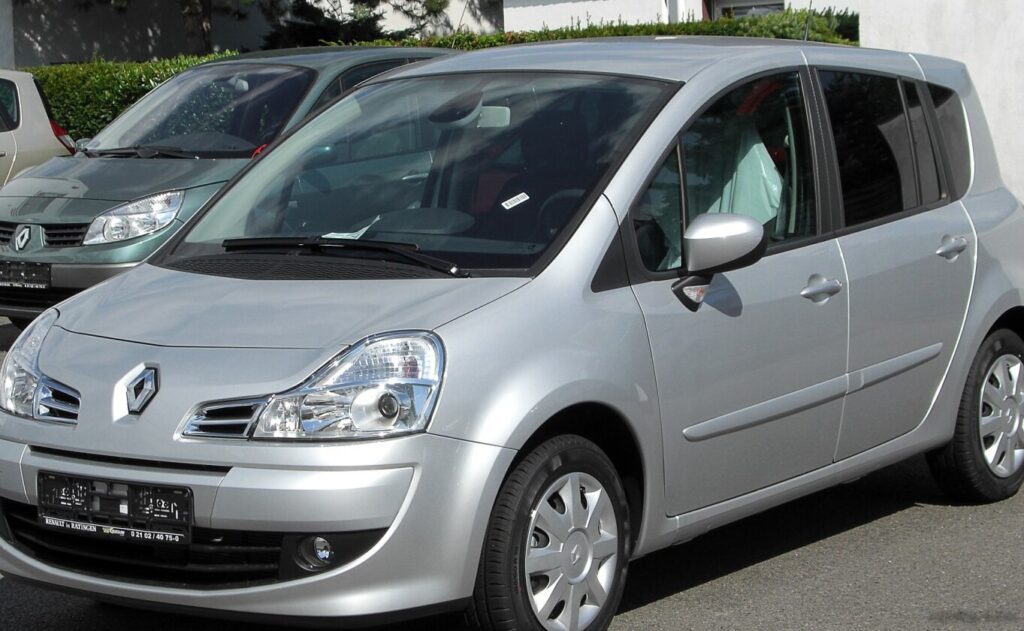
The Renault Grand Modus 1.2 16V (75 hp) represents an entry-level offering within the second-generation (Phase II) of Renault’s Modus mini MPV, produced from 2008 to 2012. Positioned as a practical and affordable family vehicle, the Grand Modus aimed to provide increased space and versatility compared to the standard Modus, while remaining compact enough for urban environments. This particular variant, with its 1.2-liter engine and five-speed manual transmission, was designed for economy-minded buyers prioritizing fuel efficiency and low running costs over outright performance. It served as a key model in Renault’s European lineup, competing with vehicles like the Opel/Vauxhall Meriva and Fiat Idea.
Technical Specifications
| Brand | Renault |
| Model | Modus |
| Generation | Grand Modus (Phase II, 2008) |
| Type (Engine) | 1.2 16V (75 Hp) |
| Start of production | 2008 |
| End of production | 2012 |
| Powertrain Architecture | Internal Combustion engine |
| Body type | Hatchback |
| Seats | 5 |
| Doors | 5 |
| Fuel consumption (urban) | 7.6 l/100 km (30.9 US mpg, 37.2 UK mpg, 13.2 km/l) |
| Fuel consumption (extra urban) | 4.9 l/100 km (48 US mpg, 57.6 UK mpg, 20.4 km/l) |
| Fuel consumption (combined) | 5.9 l/100 km (39.9 US mpg, 47.9 UK mpg, 16.9 km/l) |
| CO2 emissions | 140 g/km |
| Fuel Type | Petrol (Gasoline) |
| Acceleration 0 – 100 km/h | 13.7 sec |
| Acceleration 0 – 62 mph | 13.7 sec |
| Acceleration 0 – 60 mph | 13 sec |
| Maximum speed | 163 km/h (101.28 mph) |
| Emission standard | Euro 4 |
| Weight-to-power ratio | 15.3 kg/Hp, 65.2 Hp/tonne |
| Weight-to-torque ratio | 11 kg/Nm, 91.3 Nm/tonne |
| Power | 75 Hp @ 5500 rpm |
| Power per litre | 65.3 Hp/l |
| Torque | 105 Nm @ 4250 rpm (77.44 lb.-ft. @ 4250 rpm) |
| Engine layout | Front, Transverse |
| Engine Model/Code | D4F |
| Engine displacement | 1149 cm3 (70.12 cu. in.) |
| Number of cylinders | 4 |
| Engine configuration | Inline |
| Cylinder Bore | 69 mm (2.72 in.) |
| Piston Stroke | 76.8 mm (3.02 in.) |
| Compression ratio | 9.8:1 |
| Number of valves per cylinder | 4 |
| Fuel injection system | Multi-port manifold injection |
| Engine aspiration | Naturally aspirated engine |
| Engine oil capacity | 4.2 l (4.44 US qt | 3.7 UK qt) |
| Coolant | 5 l (5.28 US qt | 4.4 UK qt) |
| Kerb Weight | 1150 kg (2535.32 lbs.) |
| Max. weight | 1640 kg (3615.58 lbs.) |
| Max load | 490 kg (1080.27 lbs.) |
| Trunk (boot) space – minimum | 305 l (10.77 cu. ft.) |
| Trunk (boot) space – maximum | 1454 l (51.35 cu. ft.) |
| Fuel tank capacity | 51 l (13.47 US gal | 11.22 UK gal) |
| Max. roof load | 80 kg (176.37 lbs.) |
| Permitted trailer load with brakes (12%) | 900 kg (1984.16 lbs.) |
| Permitted trailer load without brakes | 550 kg (1212.54 lbs.) |
| Permitted towbar download | 75 kg (165.35 lbs.) |
| Length | 4034 mm (158.82 in.) |
| Width | 1709 mm (67.28 in.) |
| Width including mirrors | 1960 mm (77.17 in.) |
| Height | 1589 mm (62.56 in.) |
| Wheelbase | 2575 mm (101.38 in.) |
| Front track | 1472 mm (57.95 in.) |
| Rear (Back) track | 1450 mm (57.09 in.) |
| Front overhang | 802 mm (31.57 in.) |
| Rear overhang | 657 mm (25.87 in.) |
| Ride height (ground clearance) | 120 mm (4.72 in.) |
| Minimum turning circle (turning diameter) | 10.4 m (34.12 ft.) |
| Drivetrain Architecture | The Internal combustion engine (ICE) drives the front wheels of the vehicle. |
| Drive wheel | Front wheel drive |
| Number of gears and type of gearbox | 5 gears, manual transmission |
| Front suspension | Independent, type McPherson with coil spring and anti-roll bar |
| Rear suspension | Semi-independent, coil spring |
| Front brakes | Ventilated discs |
| Rear brakes | Drum |
| Assisting systems | ABS (Anti-lock braking system) |
| Steering type | Steering rack and pinion |
| Tires size | 165/65 R15 |
| Wheel rims size | 15 |
Powertrain & Engine Architecture
The Grand Modus 1.2 16V utilizes Renault’s D4F engine, a naturally aspirated, inline-four cylinder petrol engine. This engine, a mainstay in Renault’s small car lineup, features a multi-point fuel injection system and a single overhead camshaft (SOHC) operating four valves per cylinder. The 16-valve configuration, while not particularly advanced, contributes to reasonable power output for its displacement. The engine’s 75 horsepower peak is achieved at 5500 rpm, while its 105 Nm (77.44 lb-ft) of torque is delivered at 4250 rpm. The five-speed manual transmission provides a relatively conventional gear ratio spread, prioritizing fuel economy over rapid acceleration. The transmission is known for its light shift action, but isn’t particularly sporty in feel.
Driving Characteristics
The 1.2 16V Grand Modus offers modest performance. Acceleration from 0-100 km/h (0-62 mph) takes approximately 13.7 seconds, and top speed is limited to 163 km/h (101.28 mph). In real-world driving, the engine feels adequate for urban and suburban commutes, but struggles when fully loaded or attempting overtaking maneuvers on highways. The gear ratios are geared towards economy, meaning the engine often needs to be revved to maintain speed, especially when climbing hills. Compared to higher-output versions of the Modus, such as those equipped with the 1.6-liter engine, the 1.2 feels noticeably underpowered. However, the lighter engine weight contributes to nimble handling and predictable cornering.
Equipment & Trim Levels
The Grand Modus 1.2 16V typically came equipped with a basic, yet functional, level of standard equipment. This included power steering, central locking, electric front windows, and an adjustable steering column. Safety features such as ABS and driver/passenger airbags were also standard. Interior upholstery was typically cloth, with a simple dashboard layout. Optional extras included air conditioning, alloy wheels, a CD player, and rear electric windows. The trim level often dictated the availability of these options, with higher trims offering more features as standard.
Chassis & Braking
The Grand Modus utilizes a McPherson strut front suspension and a semi-independent coil spring rear suspension. This setup provides a comfortable ride quality, absorbing bumps and imperfections in the road surface effectively. The front brakes are ventilated discs, offering adequate stopping power, while the rear brakes are drums, a cost-saving measure common in this segment. The steering is a rack and pinion system, providing precise and responsive control. The relatively lightweight construction of the vehicle contributes to its agile handling characteristics.
Market Reception & Comparison
The Renault Grand Modus 1.2 16V was generally well-received by critics as a practical and affordable family car. However, its performance was often criticized as being underwhelming, particularly when compared to rivals offering more powerful engines. Fuel economy was a strong point, with the 1.2-liter engine achieving combined fuel consumption figures of around 5.9 l/100 km (39.9 US mpg). Reliability was generally good, although some owners reported minor issues with the engine’s ignition system. Compared to the diesel-powered versions of the Modus, the 1.2 offered lower purchase price but higher running costs due to fuel consumption.
Legacy
The Renault Grand Modus 1.2 16V remains a relatively common sight on used car markets today. The D4F engine is known for its durability, provided it has been regularly maintained. However, potential buyers should be aware of potential issues with the ignition coils and fuel injectors. The Grand Modus’s spacious interior and practical design continue to appeal to budget-conscious buyers seeking a versatile family vehicle. While not a performance icon, the 1.2 16V variant represents a sensible and economical choice for those prioritizing fuel efficiency and low running costs.