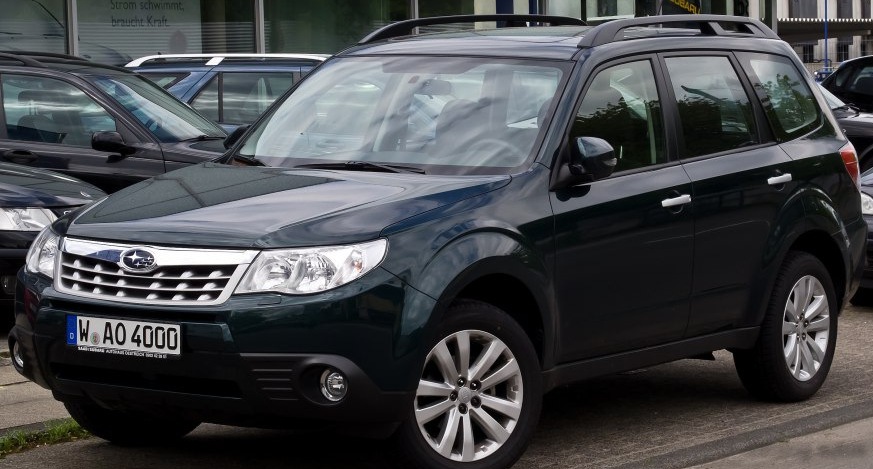
The Subaru Forester III (facelift, produced from 2010 to 2013) 2.5, equipped with a 171 horsepower engine and an E-4AT automatic transmission, represents a significant iteration of Subaru’s popular compact SUV. This variant occupied a middle ground within the Forester III lineup, offering a balance between performance, fuel efficiency, and affordability. It was primarily marketed towards families and individuals seeking a practical, all-weather vehicle with Subaru’s renowned symmetrical all-wheel drive system. The facelift brought styling updates and refinements to the already well-regarded third-generation Forester, solidifying its position in the competitive crossover SUV segment.
Technical Specifications
| Brand | Subaru |
| Model | Forester |
| Generation | Forester III (facelift 2010) |
| Type (Engine) | 2.5 (171 Hp) AWD E-4AT |
| Start of production | 2010 |
| End of production | 2013 |
| Powertrain Architecture | Internal Combustion engine |
| Body type | SUV, Crossover |
| Seats | 5 |
| Doors | 5 |
| Fuel consumption (urban) | 12.5 l/100 km (18.8 US mpg, 22.6 UK mpg, 8 km/l) |
| Fuel consumption (extra urban) | 7.5 l/100 km (31.4 US mpg, 37.7 UK mpg, 13.3 km/l) |
| Fuel consumption (combined) | 9.3 l/100 km (25.3 US mpg, 30.4 UK mpg, 10.8 km/l) |
| CO2 emissions | 220 g/km |
| Fuel Type | Petrol (Gasoline) |
| Acceleration 0 – 100 km/h | 10.2 sec |
| Acceleration 0 – 62 mph | 10.2 sec |
| Acceleration 0 – 60 mph | 9.7 sec |
| Maximum speed | 185 km/h (114.95 mph) |
| Emission standard | Euro 4 |
| Weight-to-power ratio | 8.7 kg/Hp, 114.8 Hp/tonne |
| Weight-to-torque ratio | 6.3 kg/Nm, 157.7 Nm/tonne |
| Power | 171 Hp @ 5800 rpm |
| Power per litre | 68.5 Hp/l |
| Torque | 235 Nm @ 4100 rpm (173.33 lb.-ft. @ 4100 rpm) |
| Engine layout | Front, Longitudinal |
| Engine Model/Code | FB25 |
| Engine displacement | 2498 cm3 (152.44 cu. in.) |
| Number of cylinders | 4 |
| Engine configuration | Boxer |
| Cylinder Bore | 94 mm (3.7 in.) |
| Piston Stroke | 90 mm (3.54 in.) |
| Compression ratio | 10:1 |
| Number of valves per cylinder | 4 |
| Fuel injection system | Multi-port manifold injection |
| Engine aspiration | Naturally aspirated engine |
| Valvetrain | DOHC, AVCS |
| Engine oil capacity | 5.2 l (5.49 US qt | 4.58 UK qt) |
| Coolant capacity | 6.9 l (7.29 US qt | 6.07 UK qt) |
| Kerb Weight | 1490-1495 kg (3284.89 – 3295.91 lbs.) |
| Trunk (boot) space – minimum | 450 l (15.89 cu. ft.) |
| Trunk (boot) space – maximum | 1660 l (58.62 cu. ft.) |
| Fuel tank capacity | 60 l (15.85 US gal | 13.2 UK gal) |
| Permitted trailer load with brakes (12%) | 1400 kg (3086.47 lbs.) |
| Permitted trailer load without brakes | 750 kg (1653.47 lbs.) |
| Length | 4560 mm (179.53 in.) |
| Width | 1795 mm (70.67 in.) |
| Height | 1700 mm (66.93 in.) |
| Wheelbase | 2615 mm (102.95 in.) |
| Front track | 1530 mm (60.24 in.) |
| Rear track | 1530 mm (60.24 in.) |
| Ride height (ground clearance) | 220 mm (8.66 in.) |
| Minimum turning circle | 10.5 m (34.45 ft.) |
| Drivetrain Architecture | All wheel drive (4×4) |
| Number of gears | 4 |
| Gearbox type | Automatic transmission E-4AT |
| Front suspension | Independent, type McPherson with coil spring and anti-roll bar |
| Rear suspension | Double wishbone, Transverse stabilizer |
| Front brakes | Ventilated discs |
| Rear brakes | Disc |
| Assisting systems | ABS (Anti-lock braking system) |
| Steering type | Steering rack and pinion |
| Power steering | Hydraulic Steering |
| Tires size | 215/65 R16 |
| Wheel rims size | 6.5J x 16 |
INTRODUCTION
The 2010-2013 Subaru Forester III facelift, specifically the 2.5-liter model paired with the E-4AT automatic transmission, was a key offering in Subaru’s lineup. Built on the 1HX0/A3 platform, this Forester aimed to provide a comfortable and capable all-weather vehicle for a broad range of buyers. The facelift brought subtle but noticeable improvements to the exterior styling, interior materials, and refinement. This variant was positioned as a practical choice for families and individuals prioritizing safety, reliability, and all-wheel-drive capability over outright performance.
Powertrain & Engine Architecture
At the heart of this Forester variant lies the FB25 2.5-liter naturally aspirated boxer engine. This engine, a hallmark of Subaru’s engineering, features a horizontally opposed configuration, which contributes to a lower center of gravity and improved balance. The FB25 utilizes multi-port fuel injection and a double overhead camshaft (DOHC) valvetrain with Active Valve Control System (AVCS) on both intake and exhaust camshafts. This AVCS system optimizes valve timing for improved performance and fuel efficiency. The E-4AT is a four-speed automatic transmission designed to provide smooth and reliable shifting. While not as technologically advanced as some contemporary transmissions, it was known for its durability and suitability for everyday driving. The engine produces 171 horsepower at 5800 rpm and 235 Nm (173.33 lb.-ft.) of torque at 4100 rpm.
Driving Characteristics
The 171 hp Forester 2.5 with the E-4AT automatic delivers adequate, though not exhilarating, performance. Acceleration from 0-60 mph takes approximately 9.7 seconds, and the top speed is around 115 mph. The automatic transmission, while smooth, can feel somewhat dated compared to more modern transmissions with more gears. The gear ratios are tuned for fuel efficiency and comfortable cruising rather than sporty acceleration. Compared to the manual transmission versions of the same engine, the automatic sacrifices some responsiveness. The symmetrical all-wheel-drive system provides excellent traction in various weather conditions, making it a confident handler on slippery surfaces. The boxer engine’s low center of gravity contributes to stable cornering, but the relatively soft suspension setup prioritizes ride comfort over sharp handling.
Equipment & Trim Levels
The 2010-2013 Forester 2.5 with the E-4AT typically came standard with features such as air conditioning, power windows and locks, a CD player with auxiliary input, and basic safety equipment including ABS and multiple airbags. Higher trim levels offered upgrades like a sunroof, upgraded audio system, leather upholstery, and heated front seats. Interior upholstery was typically cloth, with optional leather available. The dashboard layout was functional and straightforward, prioritizing ease of use over flashy design. Optional extras included a navigation system and a rear-view camera.
Chassis & Braking
The Forester III utilizes an independent McPherson strut suspension in the front and a double wishbone suspension in the rear. This setup provides a comfortable ride and decent handling characteristics. The front brakes are ventilated discs, while the rear brakes are solid discs. The hydraulic power steering provides a reasonably weighted feel, although it lacks the precision of more modern electric power steering systems. The vehicle’s relatively high ground clearance (8.66 inches) enhances its off-road capability and makes it well-suited for navigating rough terrain.
Market Reception & Comparison
The Forester III 2.5 E-4AT was generally well-received by critics as a practical and reliable SUV. However, some reviewers noted that the four-speed automatic transmission felt dated compared to the continuously variable transmissions (CVTs) and six-speed automatics offered by competitors. Fuel economy was considered average for its class, with combined fuel consumption around 25.3 US mpg. Compared to the higher-output turbocharged Forester XT models, the 2.5 offered a more affordable price point and better fuel efficiency, but at the expense of performance. Compared to the diesel options available in Europe, the 2.5 gasoline engine provided a smoother and quieter driving experience, but with lower torque and potentially higher running costs.
Legacy
The FB25 engine, in general, has proven to be a reliable powerplant, although head gasket issues were a concern in earlier iterations of the engine (addressed in later revisions). The E-4AT automatic transmission is also known for its durability, provided it receives regular maintenance. Today, used Forester III 2.5 E-4AT models represent a relatively affordable and practical option for buyers seeking a dependable all-wheel-drive SUV. Their reputation for reliability and capability continues to make them a popular choice in the used car market, particularly in regions with harsh winter weather.