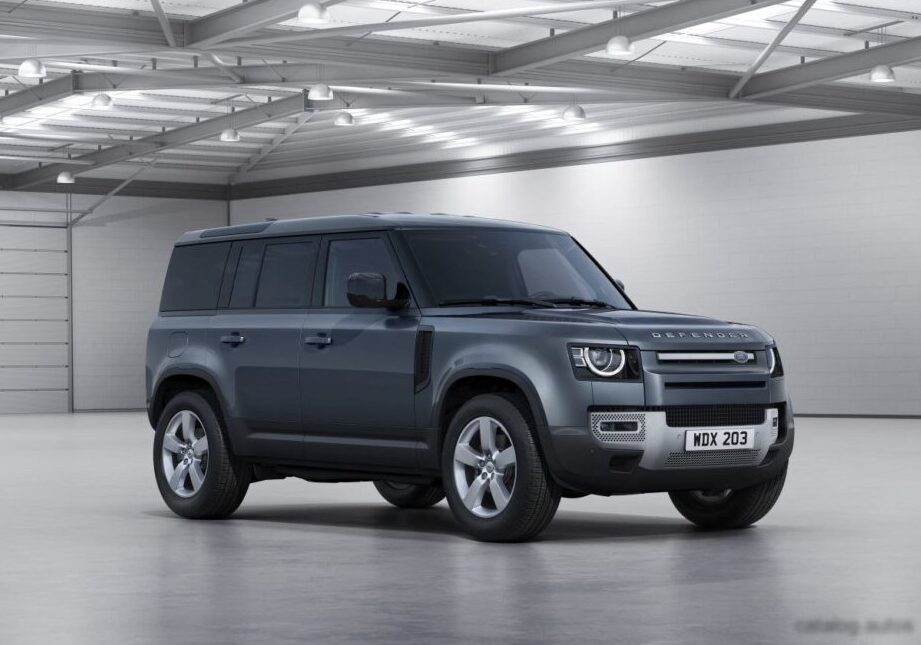
The Land Rover Defender 110 3.0 P400, produced from September 2019 through May 2024, represents a significant evolution of the iconic Defender lineage. This variant, part of the L663 generation, positions itself as a premium offering within the Defender 110 range, blending off-road capability with on-road refinement and a moderate degree of performance. It utilizes a mild-hybrid powertrain, combining a 3.0-liter inline-six cylinder gasoline engine with an electric motor to enhance efficiency and responsiveness. The P400 designation indicates its 400 horsepower output, making it a step up from the base engine options while remaining below the more potent supercharged variants.
Technical Specifications
| Brand | Land Rover |
| Model | Defender |
| Generation | Defender 110 (L663) |
| Type (Engine) | 3.0 P400 (400 Hp) Mild Hybrid AWD Automatic |
| Start of production | September, 2019 |
| End of production | May, 2024 |
| Powertrain Architecture | MHEV (Mild Hybrid Electric Vehicle) |
| Body type | Off-road vehicle |
| Seats | 5 |
| Doors | 5 |
| Fuel consumption at Low speed (WLTP) | 14.9-15.8 l/100 km (15.8 – 14.9 US mpg, 19 – 17.9 UK mpg, 6.7 – 6.3 km/l) |
| Fuel consumption at Medium speed (WLTP) | 10.7-11.4 l/100 km (22 – 20.6 US mpg, 26.4 – 24.8 UK mpg, 9.3 – 8.8 km/l) |
| Fuel consumption at high speed (WLTP) | 9.5-10.3 l/100 km (24.8 – 22.8 US mpg, 29.7 – 27.4 UK mpg, 10.5 – 9.7 km/l) |
| Fuel consumption at very high speed (WLTP) | 11.7-12.8 l/100 km (20.1 – 18.4 US mpg, 24.1 – 22.1 UK mpg, 8.5 – 7.8 km/l) |
| Combined fuel consumption (WLTP) | 11.2-12.1 l/100 km (21 – 19.4 US mpg, 25.2 – 23.3 UK mpg, 8.9 – 8.3 km/l) |
| CO2 emissions (WLTP) | 255-275 g/km |
| Fuel consumption (economy) – urban (NEDC, WLTP equivalent) | 12.2-12.5 l/100 km (19.3 – 18.8 US mpg, 23.2 – 22.6 UK mpg, 8.2 – 8 km/l) |
| Fuel consumption (economy) – extra urban (NEDC, WLTP equivalent) | 8.1-8.4 l/100 km (29 – 28 US mpg, 34.9 – 33.6 UK mpg, 12.3 – 11.9 km/l) |
| Fuel consumption (economy) – combined (NEDC, WLTP equivalent) | 9.6-9.9 l/100 km (24.5 – 23.8 US mpg, 29.4 – 28.5 UK mpg, 10.4 – 10.1 km/l) |
| CO2 emissions (NEDC, WLTP equivalent) | 220-226 g/km |
| Fuel Type | Petrol (Gasoline) |
| Acceleration 0 – 100 km/h | 6.1 sec |
| Acceleration 0 – 62 mph | 6.1 sec |
| Acceleration 0 – 60 mph | 5.8 sec |
| Maximum speed | 208 km/h (129.25 mph) |
| Emission standard | Euro 6d-TEMP-EVAP-ISC |
| Weight-to-power ratio | 5.7 kg/Hp, 175 Hp/tonne |
| Weight-to-torque ratio | 4.2 kg/Nm, 240.6 Nm/tonne |
| Power | 400 Hp @ 5500 rpm |
| Power per litre | 133.5 Hp/l |
| Torque | 550 Nm @ 2000-5000 rpm (405.66 lb.-ft. @ 2000-5000 rpm) |
| Engine layout | Front, Longitudinal |
| Engine Model/Code | Ingenium / PT306 |
| Engine displacement | 2996 cm3 (182.83 cu. in.) |
| Number of cylinders | 6 |
| Engine configuration | Inline |
| Cylinder Bore | 83 mm (3.27 in.) |
| Piston Stroke | 92.29 mm (3.63 in.) |
| Compression ratio | 10.5:1 |
| Number of valves per cylinder | 4 |
| Fuel injection system | Direct injection |
| Engine aspiration | Turbocharger, Intercooler |
| Engine oil capacity | 8.8 l (9.3 US qt | 7.74 UK qt) |
| Coolant | 12.4 l (13.1 US qt | 10.91 UK qt) |
| Kerb Weight | 2286 kg (5039.77 lbs.) |
| Max. weight | 3165 kg (6977.63 lbs.) |
| Max load | 879 kg (1937.86 lbs.) |
| Trunk (boot) space – minimum | 1075 l (37.96 cu. ft.) |
| Trunk (boot) space – maximum | 2380 l (84.05 cu. ft.) |
| Fuel tank capacity | 90 l (23.78 US gal | 19.8 UK gal) |
| Max. roof load | 100 kg (220.46 lbs.) |
| Permitted trailer load with brakes (12%) | 3500 kg (7716.18 lbs.) |
| Permitted trailer load without brakes | 750 kg (1653.47 lbs.) |
| Permitted towbar download | 150 kg (330.69 lbs.) |
| Length | 5018 mm (197.56 in.) |
| Width | 1996 mm (78.58 in.) |
| Width with mirrors folded | 2008 mm (79.06 in.) |
| Width including mirrors | 2105 mm (82.87 in.) |
| Height | 1967 mm (77.44 in.) |
| Wheelbase | 3022 mm (118.98 in.) |
| Front track | 1704 mm (67.09 in.) |
| Rear (Back) track | 1700 mm (66.93 in.) |
| Front overhang | 845 mm (33.27 in.) |
| Rear overhang | 1151 mm (45.31 in.) |
| Ride height (ground clearance) | 218-291 mm (8.58 – 11.46 in.) |
| Drag coefficient (Cd) | 0.4 |
| Minimum turning circle (turning diameter) | 13.12 m (43.04 ft.) |
| Approach angle | 30.1-38° |
| Departure angle | 37.7-40° |
| Ramp-over (brakeover) angle | 22-28° |
| Climb angle | 45° |
| Wading depth | 900 mm (35.43 in.) |
| Drivetrain Architecture | ICE and electric motor permanently drive all four wheels. |
| Drive wheel | All wheel drive (4×4) |
| Number of gears and type of gearbox | 8 gears, automatic transmission |
| Front suspension | Double wishbone |
| Rear suspension | Independent multi-link suspension |
| Front brakes | Disc, 363 mm |
| Rear brakes | Disc, 350 mm |
| Assisting systems | ABS (Anti-lock braking system) |
| Steering type | Steering rack and pinion |
| Power steering | Electric Steering |
| Tires size | 255/70 R18; 255/65 R19; 255/60 R20 |
| Wheel rims size | 8J x 18; 8J x 19; 8.5J x 20 |
INTRODUCTION
The Land Rover Defender 110 3.0 P400, launched in 2019, marked the return of the Defender nameplate after a 23-year hiatus. Unlike its predecessor, which was a body-on-frame design, the L663 utilizes a monocoque construction based on the Premium Lightweight Architecture (PLA), shared with other Jaguar Land Rover vehicles. This shift allowed for a more refined driving experience and improved on-road manners while retaining the Defender’s legendary off-road prowess. The 3.0 P400 variant occupied a middle ground in the 110 lineup, offering a balance between performance, fuel economy, and price. It served as a popular choice for buyers seeking a capable and comfortable SUV for both daily driving and adventurous excursions.
Powertrain & Engine Architecture
At the heart of the Defender 110 P400 lies Land Rover’s Ingenium engine family, specifically the PT306 3.0-liter inline-six cylinder gasoline engine. This engine features a single twin-scroll turbocharger and direct fuel injection, producing 400 horsepower at 5500 rpm and 550 Nm (405.66 lb.-ft.) of torque between 2000 and 5000 rpm. The “P400” designation directly reflects this power output. The mild-hybrid system incorporates a 48-volt electric motor that assists the engine during acceleration and allows for smoother start-stop operation, improving fuel efficiency. The engine’s architecture is notable for its compact design and lightweight construction, contributing to the vehicle’s overall balance. The engine is longitudinally mounted, powering all four wheels through an eight-speed automatic transmission sourced from ZF. This transmission is known for its smooth shifting and responsiveness, and is calibrated to provide a balance between performance and fuel economy.
Driving Characteristics
The Defender 110 P400 delivers a surprisingly refined driving experience for a vehicle of its size and off-road capability. The 400 hp engine provides ample power for confident acceleration and effortless highway cruising. The eight-speed automatic transmission shifts smoothly and efficiently, although it may occasionally exhibit a slight hesitation during quick downshifts. Compared to the base four-cylinder engine, the P400 offers a significant performance upgrade, while remaining more accessible and fuel-efficient than the higher-output supercharged variants. The mild-hybrid system contributes to a responsive feel, particularly during initial acceleration. The Defender’s advanced Terrain Response system allows drivers to tailor the vehicle’s settings to various driving conditions, optimizing traction and control for on-road and off-road adventures. Despite its size, the Defender 110 P400 feels relatively agile and composed on paved roads, thanks to its well-tuned suspension and precise steering.
Equipment & Trim Levels
The Defender 110 P400 typically came well-equipped, even in its base form. Standard features included leather upholstery, a touchscreen infotainment system with Apple CarPlay and Android Auto compatibility, LED headlights, and a suite of advanced driver-assistance systems such as emergency braking and lane-keeping assist. Higher trim levels offered additional luxuries, such as premium leather options, a panoramic sunroof, a premium audio system, and adaptive cruise control. Optional extras included a wading depth sensor, electronic air suspension, and a variety of exterior styling enhancements. The interior design prioritized practicality and durability, with a focus on rugged materials and intuitive controls.
Chassis & Braking
The Defender 110 P400 features a robust chassis designed to withstand demanding off-road conditions. It utilizes a double-wishbone front suspension and an independent multi-link rear suspension, providing a comfortable ride and excellent wheel articulation. Braking duties are handled by ventilated disc brakes on all four wheels, providing ample stopping power. The electronic stability control system is integrated with the Terrain Response system to optimize braking performance in various conditions. The vehicle’s high ground clearance and approach/departure angles contribute to its exceptional off-road capability.
Market Reception & Comparison
The Land Rover Defender 110 P400 received generally positive reviews from automotive critics. It was praised for its blend of off-road capability, on-road refinement, and modern technology. Critics noted that the P400 offered a compelling balance between performance and fuel economy, making it a practical choice for a wide range of buyers. Compared to the base four-cylinder Defender 110, the P400 provided a noticeable performance boost. Compared to the supercharged variants, it offered a more affordable price point and slightly better fuel efficiency. Some critics noted that the Defender 110’s size and weight could make it challenging to maneuver in tight urban environments.
Legacy
The Land Rover Defender 110 P400 has established itself as a desirable and capable SUV in the used car market. The Ingenium engine has proven to be relatively reliable, although regular maintenance is essential. The mild-hybrid system has also demonstrated good durability. The Defender 110’s timeless design and legendary off-road heritage continue to attract enthusiasts. As a result, well-maintained P400 models tend to hold their value relatively well. The L663 Defender represents a significant step forward for the iconic nameplate, blending tradition with modern technology and offering a compelling package for those seeking a versatile and capable SUV.