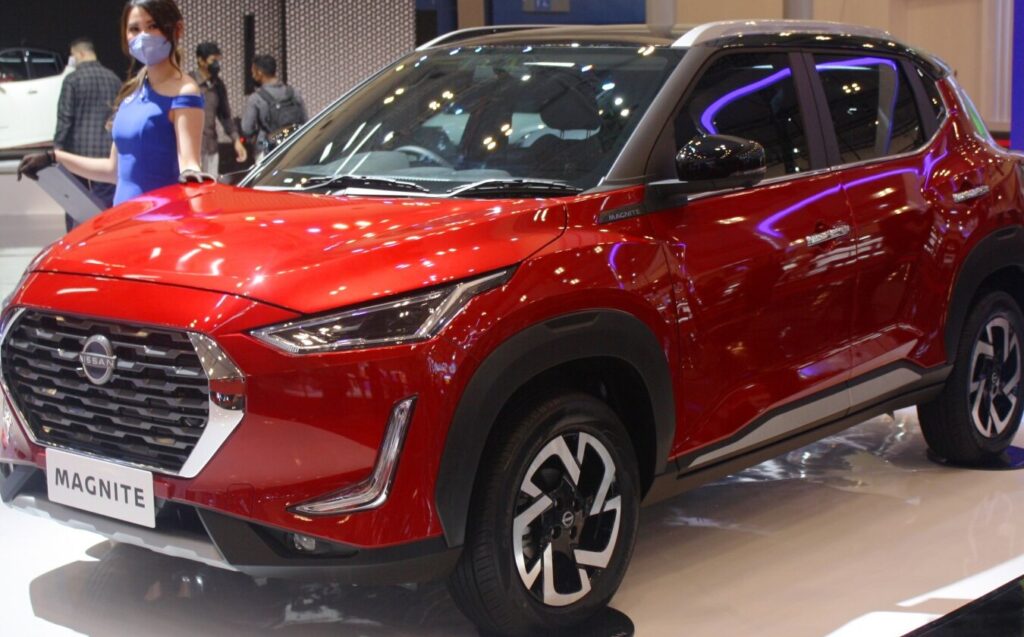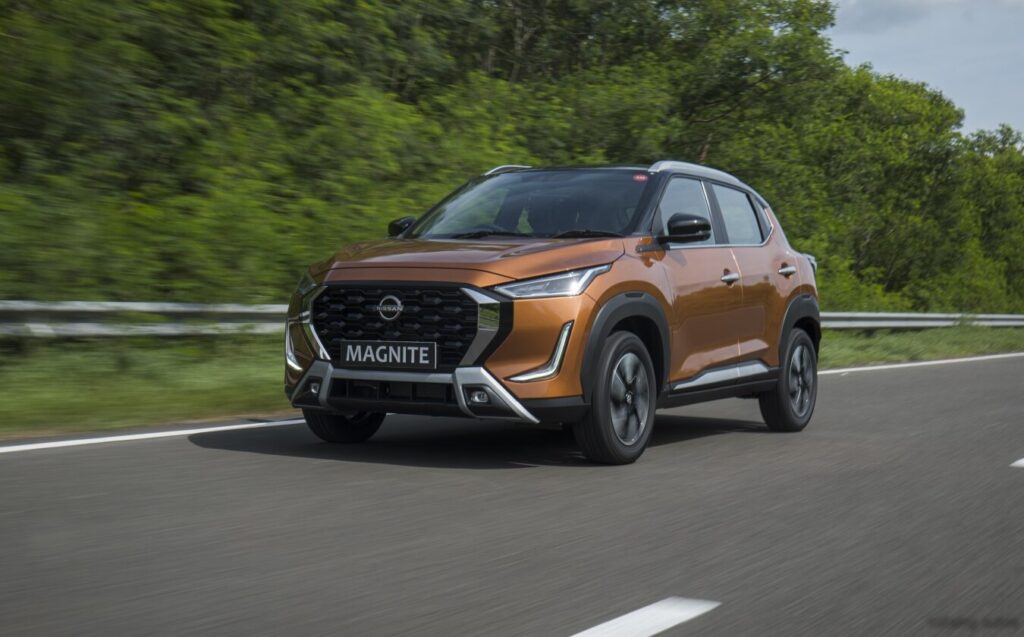
The Nissan Magnite, launched in India in late 2020 and subsequently introduced to other markets including South Africa and Latin America, represents Nissan’s entry into the highly competitive subcompact SUV segment. The 2024 facelift, introduced in October 2024, brought styling revisions and updated features to the model. This article focuses specifically on the 1.0 Turbo variant, producing 100 horsepower, paired with a 5-speed manual transmission. This configuration served as a key offering within the Magnite lineup, positioned as a balance between affordability and performance, appealing to buyers seeking a fuel-efficient and relatively engaging driving experience.
Technical Specifications
| Brand | Nissan |
| Model | Magnite |
| Generation | Magnite (facelift 2024) |
| Type (Engine) | 1.0 Turbo (100 Hp) |
| Start of production | October, 2024 |
| Powertrain Architecture | Internal Combustion engine |
| Body type | SUV |
| Seats | 5 |
| Doors | 5 |
| Fuel consumption (combined) | 5 l/100 km (47 US mpg, 56.5 UK mpg, 20 km/l) |
| Fuel Type | Petrol (Gasoline) |
| Emission standard | BS VI Phase 2 |
| Weight-to-power ratio | 11 kg/Hp, 90.7 Hp/tonne |
| Weight-to-torque ratio | 6.9 kg/Nm, 145.1 Nm/tonne |
| Power | 100 Hp @ 5000 rpm |
| Power per litre | 100.1 Hp/l |
| Torque | 160 Nm @ 2800-3600 rpm (118.01 lb.-ft. @ 2800-3600 rpm) |
| Engine layout | Front, Transverse |
| Engine Model/Code | HRA0DET |
| Engine displacement | 999 cm3 (60.96 cu. in.) |
| Number of cylinders | 3 |
| Engine configuration | Inline |
| Cylinder Bore | 72.2 mm (2.84 in.) |
| Piston Stroke | 81.3 mm (3.2 in.) |
| Number of valves per cylinder | 4 |
| Fuel injection system | Multi-port manifold injection |
| Engine aspiration | Turbocharger, Intercooler |
| Valvetrain | DOHC |
| Engine oil capacity | 3.4 l (3.59 US qt | 2.99 UK qt) |
| Coolant | 5.95 l (6.29 US qt | 5.24 UK qt) |
| Kerb Weight | 1103 kg (2431.7 lbs.) |
| Max. weight | 1486 kg (3276.07 lbs.) |
| Max load | 383 kg (844.37 lbs.) |
| Trunk (boot) space – minimum | 336 l (11.87 cu. ft.) |
| Trunk (boot) space – maximum | 690 l (24.37 cu. ft.) |
| Fuel tank capacity | 40 l (10.57 US gal | 8.8 UK gal) |
| Max. roof load | 50 kg (110.23 lbs.) |
| Length | 3994 mm (157.24 in.) |
| Width | 1758 mm (69.21 in.) |
| Height | 1572 mm (61.89 in.) |
| Wheelbase | 2500 mm (98.43 in.) |
| Front track | 1536 mm (60.47 in.) |
| Rear (Back) track | 1535 mm (60.43 in.) |
| Ride height (ground clearance) | 205 mm (8.07 in.) |
| Minimum turning circle | 10 m (32.81 ft.) |
| Drivetrain Architecture | Front wheel drive |
| Number of gears and type of gearbox | 5 gears, manual transmission |
| Front suspension | Independent, type McPherson with coil spring and anti-roll bar |
| Rear suspension | Semi-independent, coil spring |
| Front brakes | Disc |
| Rear brakes | Drum |
| Assisting systems | ABS (Anti-lock braking system) |
| Steering type | Steering rack and pinion |
| Power steering | Electric Steering |
| Tires size | 195/60 R16 |
| Wheel rims size | 5.5J x 16 |
INTRODUCTION
The Nissan Magnite 1.0 Turbo (100 Hp) represents a significant offering in the subcompact SUV market, particularly in regions like India and South Africa where it has gained considerable traction. Introduced with the facelift in October 2024, this variant builds upon the original Magnite’s foundation, offering a turbocharged engine for improved performance. The Magnite is built on the CMF-A+ platform, shared with the Renault Triber, allowing for cost-effective production and a competitive price point. The 1.0 Turbo trim aimed to provide a step up in driving experience compared to the naturally aspirated engine option, while remaining accessible to a broad range of buyers.
Powertrain & Engine Architecture
At the heart of the Magnite 1.0 Turbo lies the HRA0DET, a 999cc, three-cylinder turbocharged petrol engine. This engine utilizes a single overhead camshaft (DOHC) configuration with four valves per cylinder, contributing to its relatively efficient operation. The engine employs multi-port fuel injection and is paired with a turbocharger and intercooler to boost power output. The 5-speed manual transmission is a conventional setup, offering a direct connection between the engine and the front wheels. The engine’s compact size and lightweight construction contribute to the Magnite’s overall agility. Nissan engineers focused on balancing performance with fuel efficiency, resulting in a powerplant that delivers adequate power for everyday driving while maintaining reasonable fuel consumption figures.
Driving Characteristics
The 100 horsepower and 160 Nm (118 lb-ft) of torque produced by the 1.0 Turbo engine provide a noticeable improvement in performance compared to the base engine. While not a sports car, the Magnite 1.0 Turbo offers sufficient power for overtaking maneuvers and navigating city traffic with ease. The turbocharger provides a boost in power from around 2800 rpm, offering a more responsive driving experience. The 5-speed manual transmission allows drivers to maintain optimal engine speed for various driving conditions. Compared to automatic variants, the manual transmission provides greater driver control and a more engaging driving experience. However, it requires more driver involvement, particularly in stop-and-go traffic. The relatively light weight of the Magnite contributes to its nimble handling characteristics.
Equipment & Trim Levels
The Magnite 1.0 Turbo typically came equipped with a range of standard features, including air conditioning, power windows, and a basic audio system. Higher trim levels offered additional features such as a touchscreen infotainment system with Apple CarPlay and Android Auto compatibility, a rear parking camera, and alloy wheels. Safety features generally included dual airbags, ABS, and electronic brake-force distribution (EBD). Interior upholstery was typically cloth, with higher trims offering options for leatherette seats. The dashboard layout was functional and straightforward, prioritizing ease of use. Optional extras often included a sunroof, automatic climate control, and a more advanced audio system.
Chassis & Braking
The Nissan Magnite utilizes a McPherson strut suspension setup at the front, providing a comfortable ride and responsive handling. The rear suspension employs a semi-independent torsion beam configuration, which is a cost-effective solution for this class of vehicle. Front brakes are disc brakes, providing adequate stopping power, while rear brakes are drum brakes to keep costs down. The electric power steering system offers light and precise steering feel. The Magnite’s relatively high ground clearance of 205mm (8.07 inches) allows it to navigate rough roads and uneven surfaces with ease. Stabilizer bars are included to reduce body roll during cornering.
Market Reception & Comparison
The Nissan Magnite 1.0 Turbo received generally positive reviews from automotive critics, who praised its value for money, spacious interior, and peppy engine. Compared to other subcompact SUVs in its class, such as the Maruti Suzuki Brezza and Hyundai Venue, the Magnite offered a compelling combination of features and performance at a competitive price point. Fuel economy was also a strong point, with the 1.0 Turbo engine achieving around 20 km/l (47 US mpg) in real-world driving conditions. Some critics noted that the interior materials were not as premium as those found in some competitors, but this was generally accepted given the Magnite’s affordable price tag. Reliability reports have been generally positive, with few major issues reported.
Legacy
The Nissan Magnite 1.0 Turbo has established itself as a popular choice in the subcompact SUV segment, particularly in emerging markets. Its combination of affordability, fuel efficiency, and decent performance has resonated with buyers seeking a practical and stylish vehicle. The HRA0DET engine has proven to be a reliable and durable powerplant, and the Magnite’s overall build quality is generally considered to be good. On the used car market, the Magnite 1.0 Turbo holds its value reasonably well, reflecting its popularity and reputation for reliability. As Nissan continues to refine the Magnite, it is expected to remain a key player in the competitive subcompact SUV landscape.