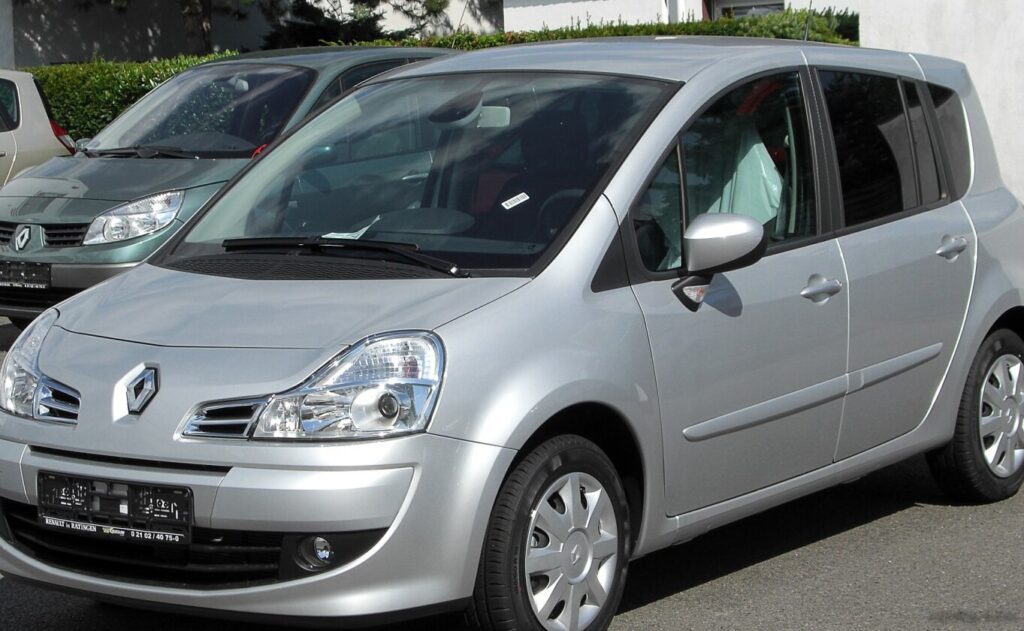
The Renault Grand Modus 1.5 dCi 68 hp (produced from 2008 to 2012) represents an entry-level offering within the second-generation (Phase II) of Renault’s Modus mini MPV. Positioned as a fuel-efficient and practical city car, the Grand Modus aimed to provide affordable family transport with a focus on interior space and versatility. This variant, powered by the K9K turbocharged diesel engine, was primarily sold in European markets where diesel engines held significant popularity due to favorable taxation and fuel economy. It served as the base model, offering a more economical alternative to the higher-powered diesel and petrol options available in the Modus range.
Technical Specifications
| Brand | Renault |
| Model | Modus |
| Generation | Grand Modus (Phase II, 2008) |
| Type (Engine) | 1.5 dCi (68 Hp) |
| Start of production | 2008 |
| End of production | 2012 |
| Powertrain Architecture | Internal Combustion engine |
| Body type | Hatchback |
| Seats | 5 |
| Doors | 5 |
| Fuel consumption (urban) | 5.6 l/100 km (42 US mpg, 50.4 UK mpg, 17.9 km/l) |
| Fuel consumption (extra urban) | 4.2 l/100 km (56 US mpg, 67.3 UK mpg, 23.8 km/l) |
| Fuel consumption (combined) | 4.7 l/100 km (50 US mpg, 60.1 UK mpg, 21.3 km/l) |
| CO2 emissions | 125 g/km |
| Fuel Type | Diesel |
| Acceleration 0 – 100 km/h | 15.7 sec |
| Acceleration 0 – 62 mph | 15.7 sec |
| Acceleration 0 – 60 mph | 14.9 sec |
| Maximum speed | 158 km/h (98.18 mph) |
| Emission standard | Euro 4 |
| Weight-to-power ratio | 17.8 kg/Hp, 56.2 Hp/tonne |
| Weight-to-torque ratio | 7.6 kg/Nm, 132.2 Nm/tonne |
| Power | 68 Hp @ 4000 rpm |
| Power per litre | 46.5 Hp/l |
| Torque | 160 Nm @ 1700 rpm (118.01 lb.-ft. @ 1700 rpm) |
| Engine layout | Front, Transverse |
| Engine Model/Code | K9K Turbo |
| Engine displacement | 1461 cm3 (89.16 cu. in.) |
| Number of cylinders | 4 |
| Engine configuration | Inline |
| Cylinder Bore | 76 mm (2.99 in.) |
| Piston Stroke | 80.5 mm (3.17 in.) |
| Compression ratio | 17.9:1 |
| Number of valves per cylinder | 2 |
| Fuel injection system | Diesel Commonrail |
| Engine aspiration | Turbocharger, Intercooler |
| Engine oil capacity | 4.6 l (4.86 US qt | 4.05 UK qt) |
| Coolant | 5.7 l (6.02 US qt | 5.02 UK qt) |
| Kerb Weight | 1210 kg (2667.59 lbs.) |
| Max. weight | 1685 kg (3714.79 lbs.) |
| Max load | 475 kg (1047.2 lbs.) |
| Trunk (boot) space – minimum | 305 l (10.77 cu. ft.) |
| Trunk (boot) space – maximum | 1454 l (51.35 cu. ft.) |
| Fuel tank capacity | 51 l (13.47 US gal | 11.22 UK gal) |
| Max. roof load | 80 kg (176.37 lbs.) |
| Permitted trailer load with brakes (12%) | 850 kg (1873.93 lbs.) |
| Permitted trailer load without brakes | 550 kg (1212.54 lbs.) |
| Permitted towbar download | 75 kg (165.35 lbs.) |
| Length | 4034 mm (158.82 in.) |
| Width | 1709 mm (67.28 in.) |
| Width including mirrors | 1960 mm (77.17 in.) |
| Height | 1589 mm (62.56 in.) |
| Wheelbase | 2575 mm (101.38 in.) |
| Front track | 1472 mm (57.95 in.) |
| Rear (Back) track | 1450 mm (57.09 in.) |
| Front overhang | 802 mm (31.57 in.) |
| Rear overhang | 657 mm (25.87 in.) |
| Ride height (ground clearance) | 120 mm (4.72 in.) |
| Minimum turning circle (turning diameter) | 10.4 m (34.12 ft.) |
| Drivetrain Architecture | The Internal combustion engine (ICE) drives the front wheels of the vehicle. |
| Drive wheel | Front wheel drive |
| Number of gears and type of gearbox | 5 gears, manual transmission |
| Front suspension | Independent, type McPherson with coil spring and anti-roll bar |
| Rear suspension | Semi-independent, coil spring |
| Front brakes | Ventilated discs |
| Rear brakes | Drum |
| Assisting systems | ABS (Anti-lock braking system) |
| Steering type | Steering rack and pinion |
| Tires size | 165/65 R15 |
| Wheel rims size | 15 |
Powertrain & Engine Architecture
The heart of this Grand Modus variant is the Renault K9K 1.5-liter turbocharged diesel engine. This engine, part of the K-series family, had been widely used across the Renault-Nissan alliance in various applications. The 68 hp version utilizes a single turbocharger with an intercooler to improve efficiency and power delivery. Fuel is delivered via a Diesel Commonrail direct injection system, contributing to refined combustion and reduced emissions. The engine features a two-valve per cylinder configuration and a relatively high compression ratio of 17.9:1, typical for diesel engines. The engine is transversely mounted at the front of the vehicle. The 5-speed manual transmission was the only gearbox option available with this engine configuration, prioritizing fuel economy over outright performance.
Driving Characteristics
The 1.5 dCi 68 hp Grand Modus offers modest performance. Acceleration is leisurely, with a 0-60 mph time of around 14.9 seconds. The engine’s 160 Nm (118 lb-ft) of torque, available from 1700 rpm, provides adequate pulling power for everyday driving, but overtaking maneuvers require careful planning. The 5-speed gearbox is geared for economy, with taller ratios contributing to lower fuel consumption at cruising speeds. Compared to the more powerful 1.5 dCi 90 hp version, this variant feels noticeably slower, particularly when fully loaded. The manual transmission provides a more engaging driving experience than an automatic would, but it lacks the convenience of self-shifting gears.
Equipment & Trim Levels
The base-level Grand Modus 1.5 dCi 68 hp typically came equipped with basic features such as power steering, central locking, and an adjustable steering column. Interior upholstery was typically cloth, and the dashboard featured a simple, functional design. Air conditioning was often an optional extra, as were features like alloy wheels, electric windows, and a CD player. Safety equipment included ABS brakes and driver/passenger airbags. The focus was on providing a practical and affordable vehicle, so luxury features were kept to a minimum.
Chassis & Braking
The Grand Modus utilizes a McPherson strut front suspension and a semi-independent coil spring rear suspension. This setup provides a comfortable ride quality, well-suited for urban driving. Front brakes are ventilated discs, offering adequate stopping power, while the rear brakes are drums, a cost-saving measure common in this segment. The car’s relatively light weight (1210 kg / 2667.59 lbs) helps to compensate for the modest braking performance. A stabilizer bar is fitted to the front suspension to reduce body roll during cornering.
Market Reception & Comparison
The Renault Grand Modus 1.5 dCi 68 hp was generally well-received as an economical and practical city car. Critics praised its fuel efficiency and spacious interior for its size. However, the engine’s lack of power was a common criticism, particularly when compared to more powerful alternatives. Compared to the 90 hp diesel version, the 68 hp model offered significantly lower running costs but at the expense of performance. It competed with other small MPVs like the Fiat Idea and the Citroën C3 Picasso, offering a similar blend of practicality and affordability.
Legacy
The K9K engine, in its various iterations, has proven to be a relatively reliable powertrain. While not without its potential issues (such as turbocharger wear and potential injector problems), the engine is generally considered durable and capable of high mileage with proper maintenance. In the used car market, the Grand Modus 1.5 dCi 68 hp remains an affordable option for those seeking a fuel-efficient and practical vehicle. Its simplicity and relatively low running costs make it an attractive choice for budget-conscious buyers, although potential buyers should be aware of the engine’s limited power output.