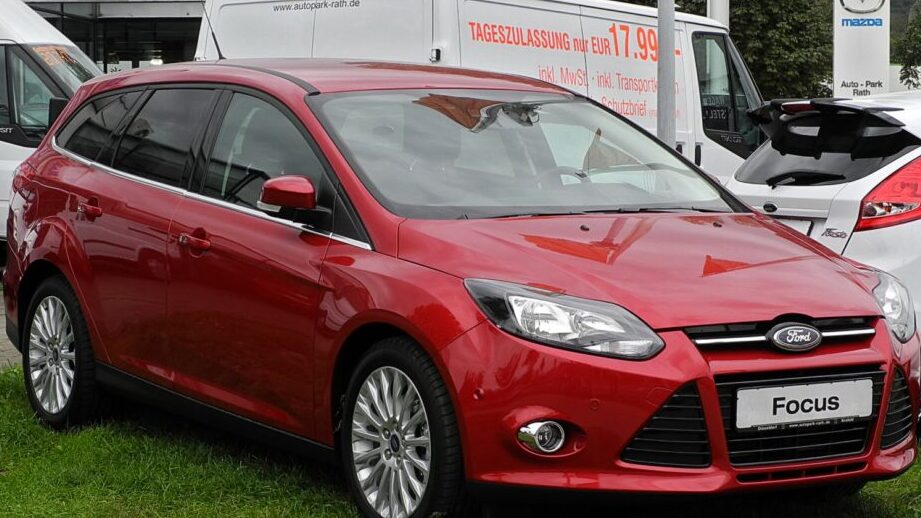
The Ford Focus III Wagon ST 2.0 EcoBoost, produced from 2012 to 2014, represented the performance-oriented variant of the third-generation Focus wagon. Positioned as the flagship trim, it aimed to deliver a sporty driving experience combined with the practicality of a station wagon. This model was primarily marketed in Europe, where the demand for performance estates was significant, though limited examples were available in other markets. It built upon the success of the Mk II Focus ST, offering increased power and refined handling. The Focus III ST wagon occupied a niche between mainstream family wagons and more focused hot hatches, appealing to drivers seeking a versatile and engaging vehicle.
Technical Specifications
| Brand | Ford |
| Model | Focus |
| Generation | Focus III Wagon |
| Type (Engine) | ST 2.0 EcoBoost (250 Hp) |
| Start of production | 2012 |
| End of production | 2014 |
| Powertrain Architecture | Internal Combustion engine |
| Body type | Station wagon (estate) |
| Seats | 5 |
| Doors | 5 |
| Fuel consumption (urban) | 9.9 l/100 km (23.8 US mpg) |
| Fuel consumption (extra urban) | 5.6 l/100 km (42 US mpg) |
| Fuel consumption (combined) | 7.2 l/100 km (32.7 US mpg) |
| CO2 emissions | 169 g/km |
| Fuel Type | Petrol (Gasoline) |
| Acceleration 0 – 100 km/h | 6.5 sec |
| Acceleration 0 – 62 mph | 6.5 sec |
| Acceleration 0 – 60 mph | 6.2 sec |
| Maximum speed | 248 km/h (154.1 mph) |
| Emission standard | Euro 5 |
| Weight-to-power ratio | 5.5 kg/Hp |
| Weight-to-torque ratio | 3.9 kg/Nm |
| Power | 250 Hp @ 5500 rpm |
| Torque | 360 Nm @ 2000-4500 rpm (265.52 lb.-ft.) |
| Engine layout | Front, Transverse |
| Engine Model/Code | R9DA |
| Engine displacement | 2000 cm3 (122.05 cu. in.) |
| Number of cylinders | 4 |
| Engine configuration | Inline |
| Cylinder Bore | 87.5 mm (3.44 in.) |
| Piston Stroke | 83.1 mm (3.27 in.) |
| Compression ratio | 9.3:1 |
| Number of valves per cylinder | 4 |
| Fuel injection system | Direct injection |
| Engine aspiration | Turbocharger, Intercooler |
| Valvetrain | DOHC |
| Engine oil capacity | 5.4 l (5.71 US qt | 4.75 UK qt) |
| Coolant capacity | 6.45 l (6.82 US qt | 5.68 UK qt) |
| Kerb Weight | 1386 kg (3055.61 lbs.) |
| Max. weight | 2050 kg (4519.48 lbs.) |
| Max load | 664 kg (1463.87 lbs.) |
| Trunk (boot) space – minimum | 476 l (16.81 cu. ft.) |
| Trunk (boot) space – maximum | 1502 l (53.04 cu. ft.) |
| Fuel tank capacity | 55 l (14.53 US gal | 12.1 UK gal) |
| Length | 4566 mm (179.76 in.) |
| Width | 1823 mm (71.77 in.) |
| Height | 1505 mm (59.25 in.) |
| Wheelbase | 2648 mm (104.25 in.) |
| Front track | 1544 mm (60.79 in.) |
| Rear track | 1534 mm (60.39 in.) |
| Minimum turning circle | 12 m (39.37 ft.) |
| Drivetrain | Front wheel drive |
| Number of gears | 6 |
| Gearbox type | Manual transmission |
| Front suspension | Independent type McPherson |
| Rear suspension | Independent multi-link suspension |
| Front brakes | Ventilated discs |
| Rear brakes | Disc |
| Assisting systems | ABS (Anti-lock braking system) |
| Steering type | Steering rack and pinion |
| Tires size | 235/40 R18 |
| Wheel rims size | 8.5J x 18 |
Powertrain & Engine Architecture
The heart of the Focus III Wagon ST is the 2.0-liter EcoBoost inline-four cylinder engine, designated as the R9DA. This engine is a direct-injected, turbocharged powerplant, representing a significant upgrade over the naturally aspirated engines found in lower trim levels. Direct injection allows for precise fuel delivery, improving both power and efficiency. The turbocharger, coupled with an intercooler, provides increased air intake, boosting horsepower and torque. The engine utilizes a dual overhead camshaft (DOHC) valvetrain with four valves per cylinder, optimizing airflow for enhanced performance. The 6-speed manual transmission was the sole gearbox option, chosen for its driver engagement and ability to handle the engine’s output. The engine’s torque curve is relatively flat, delivering 360 Nm (265 lb-ft) of torque between 2000 and 4500 rpm, providing strong acceleration across a wide range of engine speeds.
Driving Characteristics
The 250 hp and 265 lb-ft of torque, combined with the front-wheel-drive layout, resulted in a spirited driving experience. Acceleration from 0 to 60 mph was achieved in approximately 6.2 seconds, and the car could reach a top speed of 154 mph. The manual transmission offered precise shifts, allowing drivers to fully exploit the engine’s powerband. Compared to the standard Focus wagon, the ST featured a significantly more responsive throttle and a more aggressive exhaust note. While the front-wheel-drive configuration could exhibit some torque steer under hard acceleration, the well-tuned suspension and limited-slip differential (optional on some markets) helped to mitigate this effect. The ST’s suspension was noticeably firmer than that of the standard wagon, providing improved handling and cornering stability, but at the expense of some ride comfort.
Equipment & Trim Levels
The Focus III Wagon ST came well-equipped as standard. Interior features typically included sport seats upholstered in a combination of cloth and leather, a leather-wrapped steering wheel, and aluminum pedal caps. The dashboard featured unique ST badging and instrumentation. Standard equipment also included air conditioning, a CD/MP3 stereo system, and alloy wheels. Optional extras included a sunroof, navigation system, parking sensors, and upgraded audio systems. Recaro seats were also available as an option, providing even greater support and bolstering for spirited driving.
Chassis & Braking
The Focus III Wagon ST benefited from a revised chassis and suspension setup compared to the standard wagon. The front suspension utilized McPherson struts with stiffer springs and dampers, while the rear suspension employed an independent multi-link design. A thicker stabilizer bar was fitted to both the front and rear axles to reduce body roll. The braking system featured ventilated discs on all four wheels, providing ample stopping power. Anti-lock braking system (ABS) was standard. The ST also featured a slightly wider track than the standard wagon, further enhancing stability.
Market Reception & Comparison
The Focus III Wagon ST was generally well-received by automotive critics. It was praised for its powerful engine, engaging handling, and practical wagon body style. Compared to other hot hatches and performance wagons of the time, such as the Volkswagen Golf GTI or the Octavia VRS, the Focus ST offered a compelling combination of performance and value. Fuel economy was respectable for a performance car, averaging around 32.7 mpg in combined driving. Reliability was generally good, although some owners reported minor issues with the turbocharger and fuel injectors. The ST offered a more focused driving experience than the lower-powered Focus wagon trims, making it a popular choice for enthusiasts.
Legacy
The Ford Focus III Wagon ST 2.0 EcoBoost remains a popular choice in the used car market. Its combination of performance, practicality, and affordability has made it a desirable option for drivers seeking a versatile and engaging vehicle. The 2.0-liter EcoBoost engine has proven to be relatively reliable, although regular maintenance is essential. The ST’s sporty suspension and handling characteristics continue to appeal to enthusiasts, and its wagon body style offers ample cargo space for everyday use. The Focus III ST helped solidify Ford’s reputation for producing fun-to-drive and well-engineered performance cars.