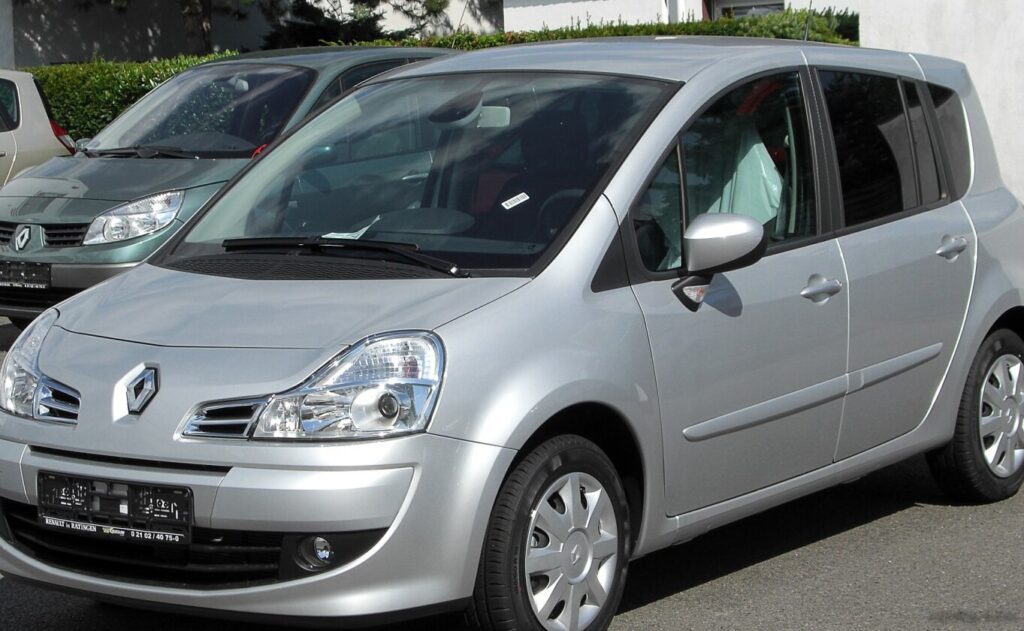
The Renault Grand Modus 1.5 dCi 86 hp (Phase II, produced from 2008 to 2012) represented an entry-level diesel option within the Grand Modus range, a compact multi-purpose vehicle (MPV) marketed primarily in Europe. Positioned as a practical and economical choice, this variant aimed at buyers prioritizing fuel efficiency and affordability over outright performance. It was part of the second generation (Phase II) of the Modus, which brought styling updates and minor equipment revisions to the original model launched in 2004. The Grand Modus, an extended version of the standard Modus, offered increased rear passenger space and a larger boot, enhancing its family-oriented appeal. This particular engine and transmission combination was a significant part of the lineup, offering a balance between cost and usability.
Technical Specifications
| Brand | Renault |
| Model | Modus |
| Generation | Grand Modus (Phase II, 2008) |
| Type (Engine) | 1.5 dCi (86 Hp) |
| Start of production | 2008 |
| End of production | 2012 |
| Powertrain Architecture | Internal Combustion engine |
| Body type | Hatchback |
| Seats | 5 |
| Doors | 5 |
| Fuel consumption (urban) | 5.2 l/100 km (45.2 US mpg, 54.3 UK mpg, 19.2 km/l) |
| Fuel consumption (extra urban) | 4.1 l/100 km (57.4 US mpg, 68.9 UK mpg, 24.4 km/l) |
| Fuel consumption (combined) | 4.5 l/100 km (52.3 US mpg, 62.8 UK mpg, 22.2 km/l) |
| CO2 emissions | 119 g/km |
| Fuel Type | Diesel |
| Acceleration 0 – 100 km/h | 13.4 sec |
| Acceleration 0 – 62 mph | 13.4 sec |
| Acceleration 0 – 60 mph | 12.7 sec |
| Maximum speed | 171 km/h (106.25 mph) |
| Emission standard | Euro 4 |
| Weight-to-power ratio | 14.1 kg/Hp, 70.8 Hp/tonne |
| Weight-to-torque ratio | 6.1 kg/Nm, 164.6 Nm/tonne |
| Power | 86 Hp @ 3750 rpm |
| Power per litre | 58.9 Hp/l |
| Torque | 200 Nm @ 1900 rpm (147.51 lb.-ft. @ 1900 rpm) |
| Engine layout | Front, Transverse |
| Engine Model/Code | K9K Turbo |
| Engine displacement | 1461 cm3 (89.16 cu. in.) |
| Number of cylinders | 4 |
| Engine configuration | Inline |
| Cylinder Bore | 76 mm (2.99 in.) |
| Piston Stroke | 80.5 mm (3.17 in.) |
| Compression ratio | 17.9:1 |
| Number of valves per cylinder | 2 |
| Fuel injection system | Diesel Commonrail |
| Engine aspiration | Turbocharger, Intercooler |
| Engine oil capacity | 4.6 l (4.86 US qt | 4.05 UK qt) |
| Coolant | 5.7 l (6.02 US qt | 5.02 UK qt) |
| Kerb Weight | 1215 kg (2678.62 lbs.) |
| Max. weight | 1685 kg (3714.79 lbs.) |
| Max load | 470 kg (1036.17 lbs.) |
| Trunk (boot) space – minimum | 305 l (10.77 cu. ft.) |
| Trunk (boot) space – maximum | 1454 l (51.35 cu. ft.) |
| Fuel tank capacity | 51 l (13.47 US gal | 11.22 UK gal) |
| Max. roof load | 80 kg (176.37 lbs.) |
| Permitted trailer load with brakes (12%) | 850 kg (1873.93 lbs.) |
| Permitted trailer load without brakes | 550 kg (1212.54 lbs.) |
| Permitted towbar download | 75 kg (165.35 lbs.) |
| Length | 4034 mm (158.82 in.) |
| Width | 1709 mm (67.28 in.) |
| Width including mirrors | 1960 mm (77.17 in.) |
| Height | 1589 mm (62.56 in.) |
| Wheelbase | 2575 mm (101.38 in.) |
| Front track | 1472 mm (57.95 in.) |
| Rear (Back) track | 1450 mm (57.09 in.) |
| Front overhang | 802 mm (31.57 in.) |
| Rear overhang | 657 mm (25.87 in.) |
| Ride height (ground clearance) | 120 mm (4.72 in.) |
| Minimum turning circle (turning diameter) | 10.4 m (34.12 ft.) |
| Drivetrain Architecture | The Internal combustion engine (ICE) drives the front wheels of the vehicle. |
| Drive wheel | Front wheel drive |
| Number of gears and type of gearbox | 5 gears, manual transmission |
| Front suspension | Independent, type McPherson with coil spring and anti-roll bar |
| Rear suspension | Semi-independent, coil spring |
| Front brakes | Ventilated discs |
| Rear brakes | Drum |
| Assisting systems | ABS (Anti-lock braking system) |
| Steering type | Steering rack and pinion |
| Tires size | 165/65 R15; 185/55 R16 |
| Wheel rims size | 15; 16 |
Powertrain & Engine Architecture
The heart of this Grand Modus variant is the Renault K9K 1.5-liter turbocharged diesel engine. This engine, part of the K9K family, had been widely used across the Renault-Nissan alliance in various applications. The 86 hp version, specifically, utilized a turbocharger with an intercooler to boost power and torque. The engine employed a diesel common rail direct injection system, delivering fuel directly into the cylinders at high pressure for improved combustion efficiency and reduced emissions. The K9K engine is an inline-four cylinder configuration with two valves per cylinder. The engine’s relatively high compression ratio of 17.9:1 is typical for diesel engines, contributing to their efficiency. The engine was typically paired with a five-speed manual transmission, although an automated manual transmission (Quickshift) was also available as an option. The transmission was chosen for its balance of cost and efficiency, rather than outright performance.
Driving Characteristics
The 1.5 dCi 86 hp Grand Modus offered modest performance. Acceleration from 0-60 mph took around 12.7 seconds, and top speed was approximately 106 mph. The engine’s 200 Nm (147 lb-ft) of torque, available from 1900 rpm, provided adequate pulling power for everyday driving, making it suitable for urban commutes and highway cruising. However, it wasn’t particularly quick, and overtaking maneuvers required careful planning. The five-speed gearbox was geared for economy, with taller ratios prioritizing fuel efficiency over rapid acceleration. Compared to higher-output versions of the Grand Modus, such as those with the 1.6 petrol engine, the 1.5 dCi felt noticeably slower, but offered significantly better fuel economy. The manual transmission provided a more engaging driving experience than the optional automated manual.
Equipment & Trim Levels
The 1.5 dCi 86 hp Grand Modus typically came equipped with a reasonable level of standard features. These included power steering, central locking, electric front windows, and an adjustable steering column. Safety features such as ABS and front airbags were also standard. Interior upholstery was typically cloth, and the dashboard featured a functional, if somewhat basic, design. Optional extras included air conditioning, alloy wheels, a CD player, and rear electric windows. Trim levels varied depending on the market, but generally, this engine was offered in base or mid-range trims, focusing on value for money.
Chassis & Braking
The Grand Modus featured a McPherson strut front suspension and a semi-independent coil spring rear suspension. This setup provided a comfortable ride, although it wasn’t particularly sporty. The front brakes were ventilated discs, offering adequate stopping power, while the rear brakes were drums, a cost-saving measure common in this segment. The steering was a rack and pinion system, providing reasonable precision. Stabilizer bars were fitted to both the front and rear axles to reduce body roll during cornering.
Market Reception & Comparison
The Renault Grand Modus 1.5 dCi 86 hp was generally well-received by critics as a practical and economical MPV. Its fuel efficiency was a major selling point, and it was praised for its spacious interior and versatile seating arrangements. However, some reviewers criticized its lack of performance and somewhat basic interior. Compared to other MPVs in its class, such as the Opel Meriva or Citroën C3 Picasso, the Grand Modus offered a competitive price point and good fuel economy, but lacked the refinement and driving dynamics of some rivals. The 1.5 dCi engine was known for its reliability, although regular maintenance was essential to ensure long-term durability.
Legacy
The Renault Grand Modus 1.5 dCi 86 hp remains a relatively common sight on used car markets today. The K9K engine has proven to be a durable and reliable unit when properly maintained. However, potential buyers should be aware of the potential for diesel particulate filter (DPF) issues, particularly on vehicles that have primarily been used for short journeys. Overall, this variant represents a sensible and economical choice for buyers seeking a practical and affordable MPV. Its fuel efficiency and relatively low running costs continue to make it an attractive option in the used car market.