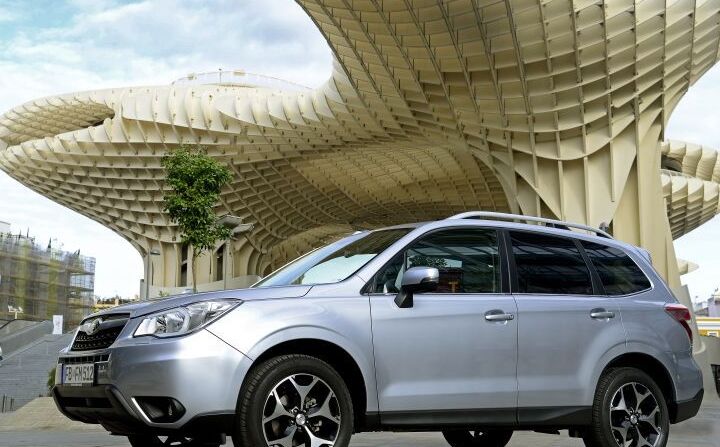
The Subaru Forester IV 2.5, produced from 2012 to 2015, represents a significant evolution in Subaru’s popular compact SUV lineup. This generation, internally designated as the SJ Forester, aimed to broaden the Forester’s appeal with increased comfort, improved fuel efficiency, and enhanced safety features. The 2.5-liter variant, equipped with a continuously variable transmission (CVT) and symmetrical all-wheel drive (AWD), served as a core model within the range, positioned as a practical and versatile option for families and individuals seeking a capable all-weather vehicle. It bridged the gap between the base 2.5i model and the more performance-oriented 2.0XT turbocharged version.
Technical Specifications
| Brand | Subaru |
| Model | Forester |
| Generation | Forester IV |
| Type (Engine) | 2.5 (175 Hp) CVT 4WD |
| Start of production | 2012 |
| End of production | 2015 |
| Powertrain Architecture | Internal Combustion engine |
| Body type | SUV, Crossover |
| Seats | 5 |
| Doors | 5 |
| Fuel consumption (urban) | 10.9 l/100 km (21.6 US mpg) |
| Fuel consumption (extra urban) | 6.7 l/100 km (35.1 US mpg) |
| Fuel consumption (combined) | 8.2 l/100 km (28.7 US mpg) |
| Fuel Type | Petrol (Gasoline) |
| Acceleration 0 – 100 km/h | 9.9 sec |
| Acceleration 0 – 62 mph | 9.9 sec |
| Acceleration 0 – 60 mph | 9.4 sec |
| Maximum speed | 196 km/h (121.79 mph) |
| Weight-to-power ratio | 8.6 kg/Hp |
| Weight-to-torque ratio | 6.4 kg/Nm |
| Power | 175 Hp @ 5800 rpm |
| Torque | 235 Nm @ 4100 rpm (173.33 lb.-ft. @ 4100 rpm) |
| Engine layout | Front, Longitudinal |
| Engine Model/Code | FB25 |
| Engine displacement | 2498 cm3 (152.44 cu. in.) |
| Number of cylinders | 4 |
| Engine configuration | Boxer |
| Cylinder Bore | 94 mm (3.7 in.) |
| Piston Stroke | 90 mm (3.54 in.) |
| Compression ratio | 10:1 |
| Number of valves per cylinder | 4 |
| Fuel injection system | Multi-port manifold injection |
| Engine aspiration | Naturally aspirated engine |
| Valvetrain | DOHC |
| Engine oil capacity | 4.8 l (5.07 US qt | 4.22 UK qt) |
| Kerb Weight | 1513 kg (3335.59 lbs.) |
| Trunk (boot) space – minimum | 488 l (17.23 cu. ft.) |
| Trunk (boot) space – maximum | 1577 l (55.69 cu. ft.) |
| Fuel tank capacity | 60 l (15.85 US gal | 13.2 UK gal) |
| Length | 4595 mm (180.91 in.) |
| Width | 1795 mm (70.67 in.) |
| Height | 1735 mm (68.31 in.) |
| Wheelbase | 2640 mm (103.94 in.) |
| Front track | 1545 mm (60.83 in.) |
| Rear track | 1550 mm (61.02 in.) |
| Ride height (ground clearance) | 220 mm (8.66 in.) |
| Minimum turning circle | 10.6 m (34.78 ft.) |
| Drive wheel | All wheel drive (4×4) |
| Front suspension | Independent coil spring |
| Rear suspension | Semi-independent, coil spring |
| Front brakes | Ventilated discs |
| Rear brakes | Disc |
| Assisting systems | ABS (Anti-lock braking system) |
| Steering type | Steering rack and pinion |
| Power steering | Electric Steering |
| Tires size | 225/60 R17 |
| Wheel rims size | 17 |
Powertrain & Engine Architecture
The heart of the Forester IV 2.5 is the FB25 2.5-liter naturally aspirated boxer-four engine. This engine, a hallmark of Subaru’s engineering, features horizontally opposed pistons, which contribute to a lower center of gravity and reduced vibration. The FB25 utilizes multi-point fuel injection and a double overhead camshaft (DOHC) valvetrain with four valves per cylinder. The engine’s design prioritizes fuel efficiency and smooth power delivery over outright performance. Paired with the FB25 is a Lineartronic CVT (Continuously Variable Transmission). This transmission, unlike traditional automatic transmissions with fixed gear ratios, uses a belt and pulley system to provide a virtually infinite number of gear ratios, optimizing engine speed for fuel economy or power as needed. The symmetrical all-wheel drive system is standard, distributing power to all four wheels for enhanced traction and stability in various driving conditions.
Driving Characteristics
The 2.5-liter CVT combination in the Forester IV delivers a comfortable and predictable driving experience. Acceleration from 0-60 mph takes approximately 9.4 seconds, which is adequate for everyday driving but doesn’t offer particularly sporty performance. The CVT effectively minimizes harsh shifts, providing a smooth and linear power delivery. However, some drivers may find the CVT’s “rubber band” feel – where engine RPMs rise independently of vehicle speed – less engaging than a traditional automatic. The symmetrical all-wheel drive system provides confident handling in inclement weather and on unpaved surfaces. The Forester’s relatively high ground clearance (8.66 inches) also allows for light off-road capability.
Equipment & Trim Levels
The 2.5i Premium trim, which was a common configuration for this engine and transmission pairing, included standard features such as automatic climate control, a rearview camera, Bluetooth connectivity, and a six-speaker audio system. Higher trim levels, like the Limited, added features like leather upholstery, a power driver’s seat, and a premium audio system. Optional extras included a power moonroof, navigation system, and Subaru’s EyeSight driver-assist technology, which incorporates adaptive cruise control, lane departure warning, and pre-collision braking.
Chassis & Braking
The Forester IV utilizes a MacPherson strut front suspension and a double-wishbone rear suspension, providing a comfortable ride and predictable handling. The chassis was designed to balance rigidity with weight reduction. Braking duties are handled by ventilated discs at the front and solid discs at the rear. Anti-lock braking system (ABS) is standard. The suspension tuning is geared towards comfort and stability rather than sporty handling, making it well-suited for everyday driving and family use.
Market Reception & Comparison
The Subaru Forester IV 2.5 CVT 4WD was generally well-received by automotive critics. It was praised for its spacious interior, comfortable ride, standard all-wheel drive, and good fuel economy (around 28.7 US mpg combined). Compared to the 2.0XT turbocharged model, the 2.5 offered a more affordable price point and better fuel efficiency, but at the expense of performance. Compared to other compact SUVs of the time, like the Honda CR-V and Toyota RAV4, the Forester stood out with its standard all-wheel drive and unique boxer engine configuration. Some critics noted the CVT’s lack of responsiveness compared to traditional automatic transmissions.
Legacy
The FB25 engine, when properly maintained, has proven to be a relatively reliable powertrain. Common issues include oil consumption and occasional head gasket leaks, but these are not widespread. The Lineartronic CVT, while generally durable, requires regular fluid changes to prevent premature wear. In the used car market, the Forester IV 2.5 CVT 4WD remains a popular choice due to its practicality, reliability, and all-weather capability. Its reputation for longevity and relatively low maintenance costs contribute to its continued appeal.