
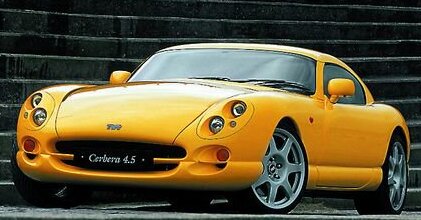
The TVR Cerbera 4.2 i V8, produced between 1998 and 2003, represents a high-performance iteration of TVR’s flagship grand tourer. Positioned as the top-of-the-line model within the Cerbera range, it offered a significant step up in power and performance compared to the earlier 4.0-liter and 4.3-liter versions. The Cerbera, named after the three-headed dog guarding the gates of the Underworld in Greek mythology, was TVR’s attempt to create a spacious, four-seat GT car that still retained the company’s characteristic focus on driver engagement and raw speed. It was built on a bespoke chassis, utilizing a combination of steel and composite materials, and was notable for its distinctive styling and hand-built construction. The 4.2 i V8 model, with its substantial power output, became the most sought-after variant during the Cerbera’s production run.
Technical Specifications
| Brand | TVR |
| Model | Cerbera |
| Generation | Cerbera |
| Type (Engine) | 4.2 i V8 (360 Hp) |
| Start of production | 1998 |
| End of production | 2003 |
| Powertrain Architecture | Internal Combustion engine |
| Body type | Coupe |
| Seats | 4 |
| Doors | 2 |
| Fuel consumption (combined) | 13 l/100 km (18.1 US mpg, 21.7 UK mpg, 7.7 km/l) |
| Fuel Type | Petrol (Gasoline) |
| Acceleration 0 – 100 km/h | 4.2 sec |
| Acceleration 0 – 62 mph | 4.2 sec |
| Acceleration 0 – 60 mph | 4 sec |
| Maximum speed | 289 km/h (179.58 mph) |
| Weight-to-power ratio | 3.1 kg/Hp, 327.3 Hp/tonne |
| Weight-to-torque ratio | 2.5 kg/Nm, 394.5 Nm/tonne |
| Power | 360 Hp @ 6500 rpm |
| Power per litre | 86 Hp/l |
| Torque | 434 Nm @ 4500 rpm (320.1 lb.-ft. @ 4500 rpm) |
| Engine layout | Front, Longitudinal |
| Engine displacement | 4185 cm3 (255.38 cu. in.) |
| Number of cylinders | 8 |
| Engine configuration | V-engine |
| Cylinder Bore | 88 mm (3.46 in.) |
| Piston Stroke | 86 mm (3.39 in.) |
| Compression ratio | 10:1 |
| Number of valves per cylinder | 2 |
| Fuel injection system | Multi-port manifold injection |
| Engine aspiration | Naturally aspirated engine |
| Valvetrain | DOHC |
| Engine oil capacity | 6 l (6.34 US qt | 5.28 UK qt) |
| Coolant | 12 l (12.68 US qt | 10.56 UK qt) |
| Kerb Weight | 1100 kg (2425.08 lbs.) |
| Trunk (boot) space – minimum | 390 l (13.77 cu. ft.) |
| Fuel tank capacity | 65 l (17.17 US gal | 14.3 UK gal) |
| Length | 4280 mm (168.5 in.) |
| Width | 1865 mm (73.43 in.) |
| Height | 1220 mm (48.03 in.) |
| Wheelbase | 2566 mm (101.02 in.) |
| Front track | 1464 mm (57.64 in.) |
| Rear (Back) track | 1470 mm (57.87 in.) |
| Drivetrain Architecture | Rear wheel drive |
| Number of gears and type of gearbox | 5 gears, manual transmission |
| Front suspension | Spring Strut |
| Rear suspension | Spring Strut |
| Front brakes | Ventilated discs |
| Rear brakes | Ventilated discs |
| Assisting systems | ABS (Anti-lock braking system) |
| Steering type | Steering rack and pinion |
| Tires size | 225/45 ZR16; 245/45 ZR16 |
Powertrain & Engine Architecture
The heart of the Cerbera 4.2 i V8 is its 4.2-liter, naturally aspirated V8 engine. This engine, designated as the TVR AJP8, was a significant departure from TVR’s previous Rover-sourced V8s. It featured a 90-degree V-angle, aluminum alloy block and cylinder heads, and a dual overhead camshaft (DOHC) valvetrain with two valves per cylinder. The multi-port fuel injection system, combined with a relatively high 10:1 compression ratio, contributed to the engine’s impressive power output. The AJP8 engine was known for its responsiveness and distinctive exhaust note. The standard transmission for the 4.2 i V8 was a five-speed manual gearbox, providing a direct connection between the engine and the rear wheels. While an automatic transmission was offered on some Cerbera models, it was less common with the 4.2-liter engine due to its focus on performance.
Driving Characteristics
The Cerbera 4.2 i V8 delivered a thrilling driving experience. Its 360 horsepower and 320 lb-ft of torque allowed for rapid acceleration – 0 to 60 mph in around 4 seconds and a top speed approaching 180 mph. The manual transmission, with its well-defined gate, encouraged spirited driving. The car felt relatively light and agile, thanks to its weight of around 2,425 pounds. However, the Cerbera wasn’t without its quirks. The suspension, while providing a reasonably comfortable ride, could feel somewhat unsettled on uneven surfaces. The steering, though direct, lacked some of the precision found in more modern sports cars. Compared to the earlier 4.0-liter and 4.3-liter Cerberas, the 4.2 i V8 offered a substantial increase in performance, making it the preferred choice for drivers seeking a truly engaging and visceral driving experience.
Equipment & Trim Levels
The Cerbera 4.2 i V8 was generally well-equipped, though the emphasis remained on performance rather than luxury. Standard features included leather upholstery, power windows, central locking, and an aftermarket stereo system. The interior design was relatively minimalist, with a focus on functionality. Optional extras included air conditioning, heated seats, and upgraded audio systems. The Cerbera’s interior was hand-trimmed, and customers could specify a range of colors and materials to personalize their vehicle. The dashboard layout was straightforward, with clearly marked gauges for speed, RPM, oil pressure, and coolant temperature.
Chassis & Braking
The Cerbera’s chassis was a steel spaceframe with composite body panels. This construction method aimed to provide a balance of strength, rigidity, and lightweight. The suspension utilized independent double wishbones at the front and a live axle with trailing arms at the rear. Ventilated disc brakes were fitted to all four wheels, providing ample stopping power. An anti-lock braking system (ABS) was standard. The car’s relatively low weight and well-balanced chassis contributed to its agile handling characteristics. The rear track was slightly wider than the front, enhancing stability.
Market Reception & Comparison
The TVR Cerbera 4.2 i V8 was generally well-received by automotive critics, who praised its performance, distinctive styling, and engaging driving experience. However, it was also criticized for its build quality, which was often inconsistent due to the hand-built nature of the car. Compared to other grand tourers of the era, such as the Porsche 911 and the BMW 6 Series, the Cerbera offered a more raw and visceral experience, but lacked the refinement and reliability of its German competitors. Fuel economy was also relatively poor, averaging around 18 mpg. The Cerbera’s unique character and limited production numbers made it a desirable car for enthusiasts.
Legacy
The TVR Cerbera 4.2 i V8 remains a sought-after classic car today. Its distinctive styling and powerful V8 engine continue to appeal to enthusiasts. However, the AJP8 engine is known to be somewhat temperamental, requiring regular maintenance and careful monitoring. Parts availability can also be a challenge, as TVR went out of business in 2006. Despite these challenges, the Cerbera 4.2 i V8 is a rewarding car to own and drive, offering a unique and unforgettable driving experience. Well-maintained examples command a premium in the used car market, reflecting their rarity and desirability.
