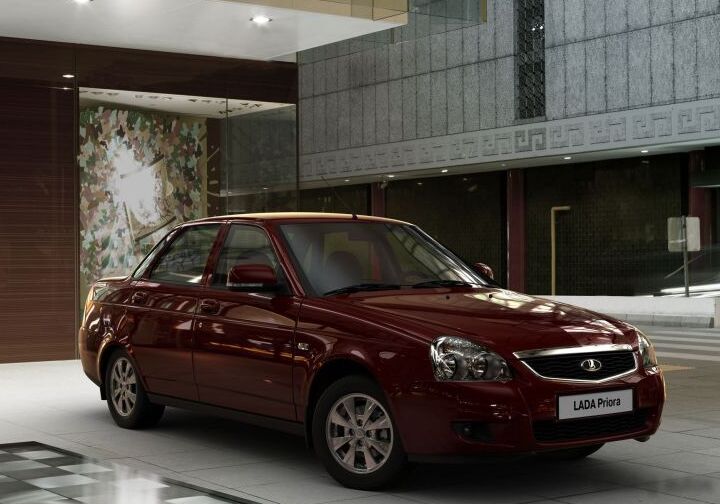
The Lada Priora I Combi (facelift 2013) 1.6 (106 hp) Automatic represents a significant iteration of the Priora, Lada’s attempt to modernize and offer a more competitive vehicle in the early 2010s. Produced from 2013 until July 2018, this station wagon (estate) variant aimed to provide practical family transport with a degree of affordability. It sat within the Priora range as a mid-level offering, bridging the gap between the base models and potentially more equipped, though less common, trims. The facelift brought updated styling and minor mechanical refinements to the original Priora platform, which was based on the aging but robust 2110 series.
| Brand | Lada |
| Model | Priora |
| Generation | Priora I Combi (facelift 2013) |
| Type (Engine) | 1.6 (106 Hp) Automatic |
| Start of production | 2013 |
| End of production | July, 2018 |
| Powertrain Architecture | Internal Combustion engine |
| Body type | Station wagon (estate) |
| Seats | 5 |
| Doors | 5 |
| Fuel consumption (urban) | 8.5 l/100 km (27.7 US mpg, 33.2 UK mpg, 11.8 km/l) |
| Fuel consumption (extra urban) | 5.5 l/100 km (42.8 US mpg, 51.4 UK mpg, 18.2 km/l) |
| Fuel consumption (combined) | 6.6 l/100 km (35.6 US mpg, 42.8 UK mpg, 15.2 km/l) |
| Fuel Type | Petrol (Gasoline) |
| Acceleration 0 – 100 km/h | 12.6 sec |
| Acceleration 0 – 62 mph | 12.6 sec |
| Acceleration 0 – 60 mph | 12 sec |
| Maximum speed | 183 km/h (113.71 mph) |
| Weight-to-power ratio | 11 kg/Hp, 91.1 Hp/tonne |
| Weight-to-torque ratio | 7.9 kg/Nm, 127.3 Nm/tonne |
| Power | 106 Hp @ 5800 rpm |
| Power per litre | 66.4 Hp/l |
| Torque | 148 Nm @ 4200 rpm (109.16 lb.-ft. @ 4200 rpm) |
| Engine layout | Front, Transverse |
| Engine displacement | 1596 cm3 (97.39 cu. in.) |
| Number of cylinders | 4 |
| Engine configuration | Inline |
| Number of valves per cylinder | 4 |
| Fuel injection system | Multi-port manifold injection |
| Engine aspiration | Naturally aspirated engine |
| Engine oil capacity | 3.2 l (3.38 US qt | 2.82 UK qt) |
| Coolant capacity | 6.3 l (6.66 US qt | 5.54 UK qt) |
| Kerb Weight | 1163 kg (2563.98 lbs) |
| Max. weight | 1593 kg (3511.96 lbs) |
| Max load | 430 kg (947.99 lbs) |
| Trunk (boot) space – minimum | 444 l (15.68 cu. ft.) |
| Trunk (boot) space – maximum | 777 l (27.44 cu. ft.) |
| Fuel tank capacity | 43 l (11.36 US gal | 9.46 UK gal) |
| Permitted trailer load with brakes (12%) | 800 kg (1763.7 lbs) |
| Permitted trailer load without brakes | 500 kg (1102.31 lbs) |
| Length | 4340 mm (170.87 in) |
| Width | 1680 mm (66.14 in) |
| Height | 1508 mm (59.37 in) |
| Wheelbase | 2492 mm (98.11 in) |
| Front track | 1410 mm (55.51 in) |
| Rear (Back) track | 1380 mm (54.33 in) |
| Ride height (ground clearance) | 165 mm (6.5 in) |
| Drivetrain Architecture | Front wheel drive |
| Number of gears and type of gearbox | 5 gears, automatic transmission |
| Front suspension | Independent, type McPherson with coil spring and anti-roll bar |
| Rear suspension | Semi-independent, coil spring |
| Front brakes | Ventilated discs |
| Rear brakes | Drum |
| Assisting systems | ABS (Anti-lock braking system) |
| Steering type | Steering rack and pinion |
| Tires size | 175/65 R14; 185/60 R14; 185/65 R14 |
| Wheel rims size | 14 |
Powertrain & Engine Architecture
The 1.6-liter engine, typically identified by engine codes such as VAZ-21174, is a four-cylinder, inline configuration. It features a multi-point fuel injection system, a relatively simple setup for the time, and a single overhead camshaft (SOHC) operating four valves per cylinder. This engine is known for its robustness, though it lacks the sophistication of more modern designs. The 106 horsepower output is achieved at 5800 rpm, while peak torque of 148 Nm (109.16 lb-ft) arrives at 4200 rpm. The automatic transmission is a four-speed unit, a common choice for Lada during this period. It’s not known for particularly quick shifts or fuel efficiency, but it provided a level of convenience that appealed to a broader range of drivers. The transmission’s gear ratios are tuned for economy and drivability rather than outright performance.
Driving Characteristics
The Priora 1.6 Automatic delivers modest performance. Acceleration from 0 to 100 km/h (0-62 mph) takes around 12.6 seconds, and top speed is rated at 183 km/h (113.71 mph). Compared to the manual transmission versions of the same engine, the automatic suffers a noticeable performance penalty due to the transmission’s inherent inefficiencies and the added weight. The four-speed automatic also limits the engine’s ability to stay in its optimal power band. In real-world driving, the car feels adequate for everyday commuting and highway cruising, but overtaking maneuvers require careful planning. The automatic transmission tends to hunt for gears on inclines, and the overall driving experience is best described as utilitarian.
Equipment & Trim Levels
The 1.6 Automatic trim typically included basic features such as power steering, central locking, and electric front windows. Air conditioning was often an optional extra. Interior upholstery was generally cloth, with a simple dashboard layout. Higher trim levels, if available, might have added features like alloy wheels, a more sophisticated audio system, and upgraded interior trim. However, the focus of this variant was affordability, so luxury features were generally limited. Safety equipment was also basic, typically including ABS and driver/passenger airbags.
Chassis & Braking
The Priora Combi utilizes a McPherson strut front suspension and a semi-independent coil spring rear suspension. This setup provides a reasonable ride quality, though it’s not particularly refined. The front brakes are ventilated discs, offering adequate stopping power, while the rear brakes are drums, a cost-saving measure. The chassis is relatively simple and robust, designed for durability rather than sporty handling. Stabilizer bars were included to reduce body roll, but the car’s overall handling characteristics are best described as neutral and predictable.
Market Reception & Comparison
The Lada Priora 1.6 Automatic was generally viewed as a practical and affordable option in its target market. Critics acknowledged its spacious interior and reasonable fuel economy (6.6 l/100 km combined), but also pointed out its lack of refinement and relatively slow performance. Compared to other trims in the Priora lineup, the 1.6 Automatic offered a more comfortable driving experience for those who preferred an automatic transmission, but it sacrificed performance. The 1.6 manual was a more popular choice for drivers seeking better fuel economy and acceleration. Compared to competitors from Western Europe or Asia, the Priora lagged behind in terms of build quality, technology, and overall refinement.
Legacy
The Lada Priora, including the 1.6 Automatic variant, has developed a reputation for being a relatively reliable and inexpensive car to maintain, particularly in regions where parts are readily available and labor costs are low. However, corrosion can be a significant issue, especially in areas with harsh winters. The powertrain, while not particularly sophisticated, is generally durable if properly maintained. On the used car market, the Priora 1.6 Automatic remains an affordable option for those seeking a practical and spacious station wagon. Its simplicity and robust construction make it a viable choice for drivers who prioritize functionality over luxury or performance. However, potential buyers should be aware of the car’s age and potential maintenance needs.