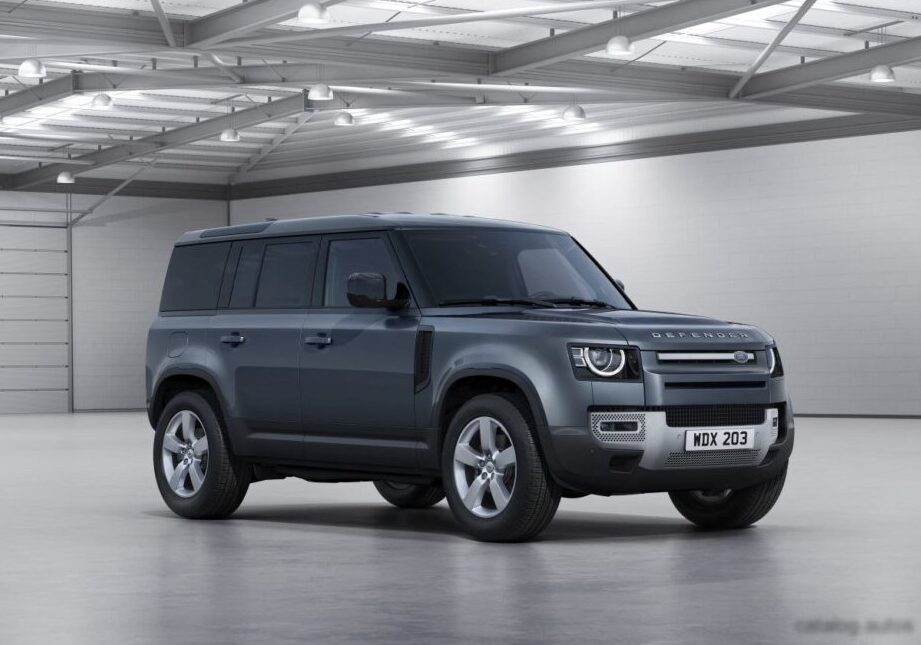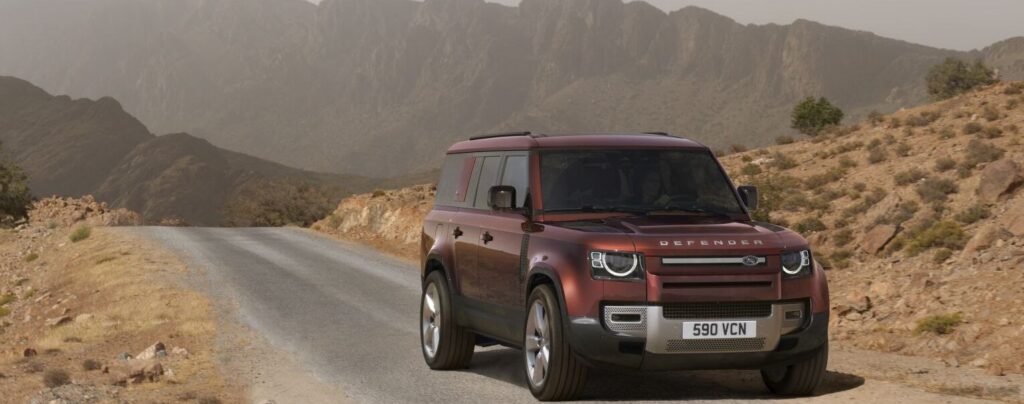
The Land Rover Defender 130 (L663) 3.0 P300 AWD Automatic represents a significant expansion of the revived Defender lineup, introduced in May 2022. Positioned as the largest variant of the L663 generation, the 130 offers optional eight-seat accommodation alongside the traditional Defender off-road capability and now, a greater emphasis on passenger comfort. This model builds upon the foundation of the aluminum-intensive monocoque chassis first seen in the 2020 Defender 90 and 110, extending the wheelbase and body length to accommodate the additional seating and cargo space. The P300 designation signifies the engine – a 3.0-liter turbocharged inline-six producing 300 horsepower, paired exclusively with an eight-speed automatic transmission and Land Rover’s intelligent all-wheel-drive system.
Technical Specifications
| Brand | Land Rover |
| Model | Defender |
| Generation | Defender 130 (L663) |
| Type (Engine) | 3.0 P300 (300 Hp) AWD Automatic |
| Start of production | May, 2022 |
| Powertrain Architecture | Internal Combustion engine |
| Body type | Off-road vehicle |
| Seats | 5-8 |
| Doors | 5 |
| Fuel consumption at Low speed (WLTP) | 15-15.8 l/100 km (15.7 – 14.9 US mpg, 18.8 – 17.9 UK mpg, 6.7 – 6.3 km/l) |
| Fuel consumption at Medium speed (WLTP) | 11-11.7 l/100 km (21.4 – 20.1 US mpg, 25.7 – 24.1 UK mpg, 9.1 – 8.5 km/l) |
| Fuel consumption at high speed (WLTP) | 9.6-10.5 l/100 km (24.5 – 22.4 US mpg, 29.4 – 26.9 UK mpg, 10.4 – 9.5 km/l) |
| Fuel consumption at very high speed (WLTP) | 11.8-12.9 l/100 km (19.9 – 18.2 US mpg, 23.9 – 21.9 UK mpg, 8.5 – 7.8 km/l) |
| Combined fuel consumption (WLTP) | 11.4-12.3 l/100 km (20.6 – 19.1 US mpg, 24.8 – 23 UK mpg, 8.8 – 8.1 km/l) |
| CO2 emissions (WLTP) | 258-279 g/km |
| Fuel Type | Petrol (Gasoline) |
| Acceleration 0 – 100 km/h | 8 sec |
| Acceleration 0 – 62 mph | 8 sec |
| Acceleration 0 – 60 mph | 7.5 sec |
| Maximum speed | 191 km/h (118.68 mph) |
| Weight-to-power ratio | 8.4 kg/Hp, 119.7 Hp/tonne |
| Weight-to-torque ratio | 5.3 kg/Nm, 187.5 Nm/tonne |
| Power | 300 Hp @ 4800-6000 rpm |
| Power per litre | 100.1 Hp/l |
| Torque | 470 Nm @ 1500-4250 rpm (346.65 lb.-ft. @ 1500-4250 rpm) |
| Engine layout | Front, Longitudinal |
| Engine Model/Code | Ingenium / PT204 |
| Engine displacement | 2996 cm3 (182.83 cu. in.) |
| Number of cylinders | 6 |
| Engine configuration | Inline |
| Cylinder Bore | 83 mm (3.27 in.) |
| Piston Stroke | 92.3 mm (3.63 in.) |
| Compression ratio | 10.5:1 |
| Number of valves per cylinder | 4 |
| Fuel injection system | Direct injection |
| Engine aspiration | Turbocharger, Intercooler |
| Valvetrain | DOHC |
| Engine oil capacity | 7 l (7.4 US qt | 6.16 UK qt) |
| Coolant | 11.3 l (11.94 US qt | 9.94 UK qt) |
| Kerb Weight | 2507-2528 kg (5526.99 – 5573.29 lbs.) |
| Max. weight | 3380 kg (7451.62 lbs.) |
| Max load | 852-873 kg (1878.34 – 1924.64 lbs.) |
| Trunk (boot) space – minimum | 290 l (10.24 cu. ft.) |
| Trunk (boot) space – maximum | 2078 l (73.38 cu. ft.) |
| Fuel tank capacity | 90 l (23.78 US gal | 19.8 UK gal) |
| Max. roof load | 168 kg (370.38 lbs.) |
| Permitted trailer load with brakes (12%) | 3000 kg (6613.87 lbs.) |
| Permitted trailer load without brakes | 750 kg (1653.47 lbs.) |
| Permitted towbar download | 120 kg (264.55 lbs.) |
| Length | 5358 mm (210.94 in.) |
| Width with mirrors folded | 2008 mm (79.06 in.) |
| Width including mirrors | 2105 mm (82.87 in.) |
| Height | 1970 mm (77.56 in.) |
| Front track | 1706 mm (67.17 in.) |
| Rear (Back) track | 1702 mm (67.01 in.) |
| Ride height (ground clearance) | 219-290 mm (8.62 – 11.42 in.) |
| Minimum turning circle (turning diameter) | 13.1 m (42.98 ft.) |
| Approach angle | 30.1-37.5° |
| Departure angle | 24.5-28.5° |
| Ramp-over (brakeover) angle | 22-27.8° |
| Wading depth | 900 mm (35.43 in.) |
| Drivetrain Architecture | The Internal combustion engine (ICE) drives permanently the four wheels of the vehicle. |
| Drive wheel | All wheel drive (4×4) |
| Number of gears and type of gearbox | 8 gears, automatic transmission |
| Front suspension | Double wishbone |
| Rear suspension | Independent multi-link suspension |
| Front brakes | Ventilated discs, 363 mm |
| Rear brakes | Ventilated discs, 350 mm |
INTRODUCTION
The Land Rover Defender 130 P300 AWD Automatic, launched in 2022, extends the Defender family with a focus on providing spaciousness without sacrificing off-road prowess. Built on the L663 platform, which debuted with the 90 and 110 models, the 130 distinguishes itself with a 300mm longer wheelbase and an overall length increase of 340mm. This allows for the option of a third row of seats, increasing passenger capacity to up to eight. The P300 variant, powered by the Ingenium 3.0-liter inline-six engine, occupies a middle ground in the 130 lineup, offering a balance between performance and fuel efficiency. It’s positioned below the more powerful P400 and P500 models, and above potential future entry-level options.
Powertrain & Engine Architecture
At the heart of the Defender 130 P300 lies Land Rover’s Ingenium engine family, specifically the PT204 3.0-liter inline-six cylinder petrol engine. This engine utilizes a turbocharger and direct fuel injection to produce 300 horsepower and 470 Nm (346.65 lb-ft) of torque. The engine features a DOHC (Double Overhead Camshaft) valvetrain and a compression ratio of 10.5:1. The Ingenium engine is known for its relatively lightweight construction, utilizing aluminum components to improve efficiency. The engine is longitudinally mounted in the front of the vehicle. The sole transmission option is an eight-speed automatic gearbox, providing smooth and efficient gear changes. This transmission is designed to handle the engine’s torque output and contribute to the Defender’s off-road capabilities through optimized gear ratios.
Driving Characteristics
The Defender 130 P300 delivers a comfortable and capable driving experience, though its increased size and weight compared to the 90 and 110 models are noticeable. Acceleration from 0-60 mph takes approximately 7.5 seconds, and 0-100 km/h in 8 seconds, making it adequately quick for everyday driving. The eight-speed automatic transmission is well-tuned, providing smooth shifts and responsive performance. While not as overtly sporty as some competitors, the P300 offers sufficient power for overtaking and highway cruising. The longer wheelbase contributes to a more stable ride, particularly on rough terrain, but can also make the vehicle feel less agile in tight corners. The all-wheel-drive system provides excellent traction in various conditions, and Land Rover’s Terrain Response system allows drivers to optimize the vehicle’s settings for different surfaces.
Equipment & Trim Levels
The Defender 130 P300 typically comes well-equipped as standard, reflecting Land Rover’s premium positioning. Standard features generally include leather upholstery, a touchscreen infotainment system with Apple CarPlay and Android Auto compatibility, a rearview camera, and a suite of driver-assistance systems such as lane departure warning and emergency braking. Optional extras can include a panoramic sunroof, premium audio system, heated and cooled seats, and advanced off-road packages with features like electronic active differential and adaptive cruise control. Interior trim options vary, allowing buyers to personalize the vehicle to their preferences. The 130’s extended body provides ample cargo space, even with the third row of seats in use.
Chassis & Braking
The Defender 130 utilizes a robust aluminum monocoque chassis, providing a strong and lightweight foundation. The suspension system consists of a double-wishbone setup at the front and an independent multi-link setup at the rear, offering a comfortable ride and good off-road articulation. Ventilated disc brakes are fitted to all four wheels, providing ample stopping power. The front brakes measure 363mm in diameter, while the rear brakes are 350mm. The vehicle is equipped with ABS (Anti-lock Braking System) and electronic stability control to enhance safety. The steering system is an electric power-assisted rack and pinion setup, providing precise and responsive steering feel.
Market Reception & Comparison
The Defender 130 P300 has been generally well-received by automotive critics, who praise its spaciousness, comfortable ride, and off-road capability. However, some reviewers have noted that the P300 engine, while adequate, feels less powerful than the higher-output P400 and P500 options, especially when fully loaded with passengers and cargo. Fuel economy is typical for a vehicle of this size and type, ranging from 20.6 to 19.1 US mpg combined. Compared to the Defender 110 P300, the 130 offers significantly more space but comes at the cost of increased weight and a slightly higher price. Against competitors like the BMW X7 and Mercedes-Benz GLS, the Defender 130 offers a more rugged and adventurous character.
Legacy
The Defender 130 P300 represents a modern interpretation of the iconic Defender nameplate, blending traditional Land Rover values of off-road capability and durability with contemporary comfort and technology. While it’s still relatively early in its lifecycle, the Ingenium engine family has proven to be generally reliable, and the aluminum chassis is resistant to corrosion. The long-term reliability of the eight-speed automatic transmission remains to be fully assessed, but early indications are positive. As a used vehicle, the Defender 130 P300 is expected to hold its value well, appealing to buyers seeking a spacious, capable, and distinctive SUV.