
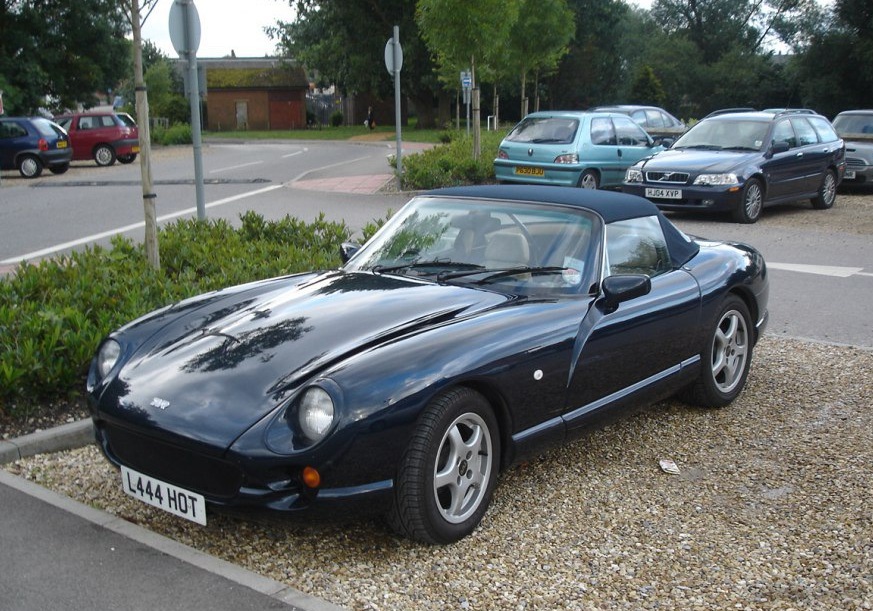
The TVR Chimaera 5.0, produced between 1997 and 2003, represents a high-performance iteration of the Chimaera model line. Positioned as the flagship variant, it offered a significant power upgrade over the earlier 4.0-liter versions, solidifying TVR’s reputation for building raw, driver-focused sports cars. The Chimaera, as a whole, was intended to be a more comfortable and refined grand tourer compared to the smaller, more track-oriented TVR Griffith, appealing to buyers seeking a blend of performance and usability. The 5.0-liter model specifically targeted enthusiasts desiring substantial power in a classically styled, British roadster.
Technical Specifications
| Brand | TVR |
| Model | Chimaera |
| Generation | Chimaera |
| Type (Engine) | 5.0 (326 Hp) |
| Start of production | 1997 |
| End of production | 2003 |
| Powertrain Architecture | Internal Combustion engine |
| Body type | Cabriolet |
| Seats | 2 |
| Doors | 2 |
| Fuel consumption (urban) | 19 l/100 km (12.4 US mpg) |
| Fuel consumption (extra urban) | 11 l/100 km (21.4 US mpg) |
| Fuel Type | Petrol (Gasoline) |
| Acceleration 0 – 100 km/h | 4.4 sec |
| Acceleration 0 – 62 mph | 4.4 sec |
| Acceleration 0 – 60 mph | 4.2 sec |
| Maximum speed | 269 km/h (167.15 mph) |
| Power | 326 Hp @ 5500 rpm |
| Power per litre | 65.2 Hp/l |
| Torque | 434 Nm @ 4000 rpm (320.1 lb.-ft. @ 4000 rpm) |
| Engine layout | Front, Longitudinal |
| Engine displacement | 4997 cm3 (304.94 cu. in.) |
| Number of cylinders | 8 |
| Engine configuration | V-engine |
| Cylinder Bore | 94 mm (3.7 in.) |
| Piston Stroke | 90 mm (3.54 in.) |
| Compression ratio | 10:1 |
| Number of valves per cylinder | 2 |
| Fuel injection system | Multi-port manifold injection |
| Engine aspiration | Naturally aspirated engine |
| Engine oil capacity | 5 l (5.28 US qt | 4.4 UK qt) |
| Coolant | 12 l (12.68 US qt | 10.56 UK qt) |
| Trunk (boot) space (minimum) | 310 l (10.95 cu. ft.) |
| Fuel tank capacity | 57 l (15.06 US gal | 12.54 UK gal) |
| Length | 3965 mm (156.1 in.) |
| Width | 1730 mm (68.11 in.) |
| Height | 1223 mm (48.15 in.) |
| Wheelbase | 2282 mm (89.84 in.) |
| Front track | 1460 mm (57.48 in.) |
| Rear track | 1470 mm (57.87 in.) |
| Drivetrain Architecture | Rear wheel drive |
| Drive wheel | Rear wheel drive |
| Number of gears and type of gearbox | 5 gears, manual transmission |
| Front suspension | Wishbone |
| Rear suspension | Wishbone |
| Front brakes | Ventilated discs |
| Rear brakes | Disc |
| Assisting systems | ABS (Anti-lock braking system) |
| Steering type | Steering rack and pinion |
| Power steering | Hydraulic Steering |
| Tires size | 205/55 R15 |
Powertrain & Engine Architecture
The heart of the Chimaera 5.0 is its 4.997-liter (304.94 cubic inch) Rover V8 engine. This engine, derived from the Buick-Oldsmobile-Pontiac 3.5-liter V8, was extensively modified by TVR over the years. The 5.0-liter version featured a larger bore and stroke compared to earlier iterations, resulting in increased displacement and power output. It utilized a multi-port fuel injection system, managed by an engine control unit (ECU), to deliver fuel to the cylinders. The engine boasted a compression ratio of 10:1 and employed two valves per cylinder. The engine’s robust construction and relatively simple design contributed to its reliability, although maintenance was crucial. The Chimaera 5.0 exclusively came with a five-speed manual transmission, delivering power to the rear wheels. This transmission was chosen to handle the increased torque output of the larger engine.
Driving Characteristics
The Chimaera 5.0 offered a thrilling driving experience characterized by strong acceleration and responsive handling. The 326 horsepower and 320 lb-ft of torque allowed for a 0-60 mph time of around 4.2 seconds, making it a genuinely quick car for its time. The manual transmission provided precise control, and the rear-wheel-drive configuration contributed to a lively and engaging driving feel. Compared to the 4.0-liter Chimaera, the 5.0-liter model offered a noticeable increase in performance across the entire rev range. While the 4.0-liter was adequate, the 5.0-liter felt significantly more powerful and capable, particularly during overtaking maneuvers. The relatively lightweight construction of the Chimaera further enhanced its agility and responsiveness.
Equipment & Trim Levels
The Chimaera 5.0 was generally well-equipped for a British sports car of its era, though luxury wasn’t its primary focus. Standard features included leather upholstery, power windows, and central locking. The interior design was relatively simple and functional, prioritizing the driving experience over lavish appointments. Options included upgraded audio systems, air conditioning (often considered essential), and various trim customization options. The dashboard layout was straightforward, with clearly visible gauges providing essential information to the driver. The Chimaera 5.0 didn’t have distinct trim levels in the traditional sense; customization was largely achieved through optional extras.
Chassis & Braking
The Chimaera utilized a steel spaceframe chassis, providing a strong and rigid foundation for the car. Suspension consisted of independent double wishbones at both the front and rear, offering a good balance between ride comfort and handling performance. Braking duties were handled by ventilated discs at the front and solid discs at the rear. An anti-lock braking system (ABS) was standard, enhancing safety and control during hard braking. The steering was a rack and pinion system with hydraulic power assistance, providing precise and responsive steering feel. The car rode on 15-inch wheels, typically fitted with 205/55 R15 tires.
Market Reception & Comparison
The TVR Chimaera 5.0 was generally well-received by automotive critics, who praised its performance, handling, and distinctive styling. However, it was also noted for its somewhat rough edges and lack of refinement compared to more mainstream sports cars. The 5.0-liter model was considered a significant improvement over the 4.0-liter, offering a more satisfying driving experience. Fuel economy was predictably poor, averaging around 12.4 US mpg in urban conditions and 21.4 US mpg on the highway. Reliability was a mixed bag, with some owners reporting few issues, while others experienced problems with the engine and electrical systems. Compared to the TVR Griffith, the Chimaera was seen as a more comfortable and practical grand tourer, while the Griffith was more focused on track performance.
Legacy
The TVR Chimaera 5.0 remains a desirable classic car among enthusiasts. Its combination of raw power, engaging handling, and distinctive styling has ensured its enduring appeal. While maintenance can be challenging due to the car’s age and the specialized nature of its components, the Rover V8 engine is generally considered robust and reliable when properly maintained. The Chimaera 5.0’s values have been steadily increasing in recent years, reflecting its growing popularity and rarity. Today, it represents a unique and exciting alternative to more conventional sports cars, offering a driving experience that is both visceral and rewarding. Finding well-maintained examples is becoming increasingly difficult, but for those willing to invest the time and effort, the Chimaera 5.0 offers a truly special ownership experience.
