
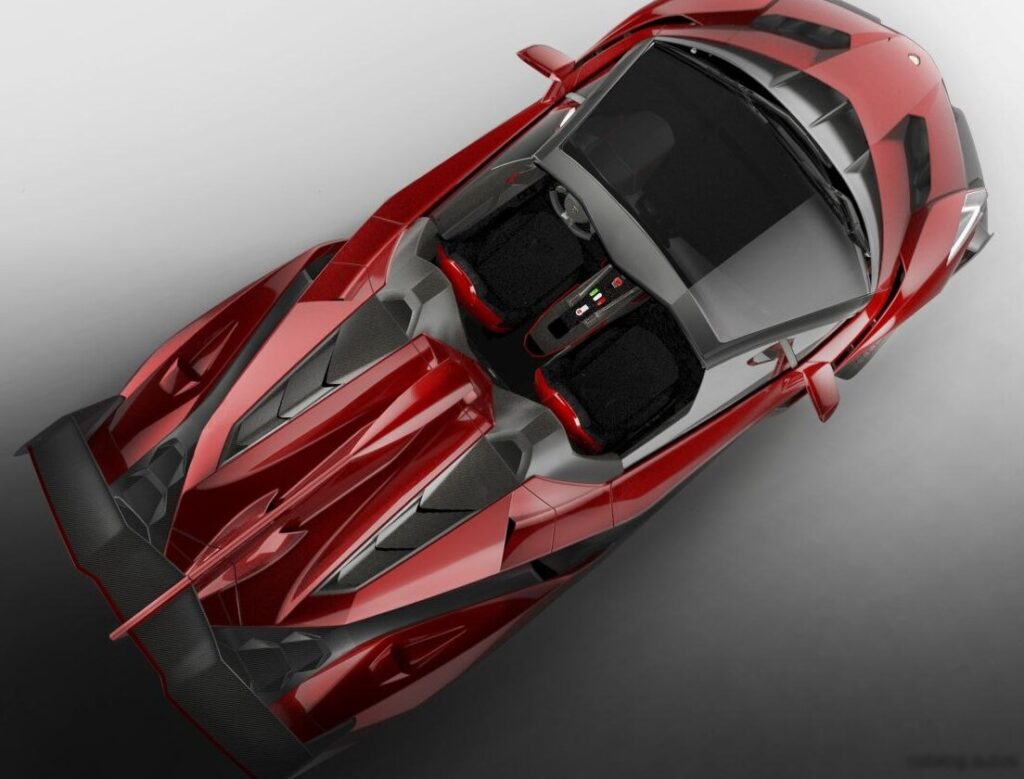
The Lamborghini Veneno LP 750-4 Roadster, produced in extremely limited numbers between 2013 and 2014, represents the pinnacle of open-top Lamborghini performance and exclusivity. Built to celebrate Lamborghini’s 50th anniversary, the Veneno Roadster is based on the Aventador platform (specifically the LP700-4) but features radical aerodynamic enhancements and a significantly higher price tag. Only nine examples were produced, making it one of the rarest modern supercars. The “LP 750-4” designation refers to the engine’s output of 750 horsepower and the all-wheel-drive system.
Technical Specifications
| Brand | Lamborghini |
| Model | Veneno |
| Generation | Veneno LP 750-4 Roadster |
| Type (Engine) | 6.5 V12 (750 Hp) |
| Start of production | 2013 |
| End of production | 2014 |
| Powertrain Architecture | Internal Combustion engine |
| Body type | Roadster |
| Seats | 2 |
| Doors | 2 |
| Fuel consumption (economy) – urban | 27.3 l/100 km (8.6 US mpg, 10.3 UK mpg, 3.7 km/l) |
| Fuel consumption (economy) – extra urban | 11.3 l/100 km (20.8 US mpg, 25 UK mpg, 8.8 km/l) |
| Fuel consumption (economy) – combined | 17.2 l/100 km (13.7 US mpg, 16.4 UK mpg, 5.8 km/l) |
| CO2 emissions | 398 g/km |
| Fuel Type | Petrol (Gasoline) |
| Acceleration 0 – 100 km/h | 2.9 sec |
| Acceleration 0 – 62 mph | 2.9 sec |
| Acceleration 0 – 60 mph | 2.8 sec |
| Maximum speed | 335 km/h (208.16 mph) |
| Emission standard | Euro 6 – LEV 2 |
| Weight-to-power ratio | 2 kg/Hp, 503.4 Hp/tonne |
| Weight-to-torque ratio | 2.2 kg/Nm, 463.1 Nm/tonne |
| Power | 750 Hp @ 8400 rpm |
| Power per litre | 115.4 Hp/l |
| Torque | 690 Nm @ 5500 rpm (508.92 lb.-ft. @ 5500 rpm) |
| Engine layout | Middle, Longitudinal |
| Engine Model/Code | L539 |
| Engine displacement | 6498 cm3 (396.53 cu. in.) |
| Number of cylinders | 12 |
| Engine configuration | V-engine |
| Cylinder Bore | 95 mm (3.74 in.) |
| Piston Stroke | 76.4 mm (3.01 in.) |
| Compression ratio | 11.8:1 |
| Number of valves per cylinder | 4 |
| Fuel injection system | Multi-port manifold injection |
| Engine aspiration | Naturally aspirated engine |
| Valvetrain | DOHC |
| Engine oil capacity | 13 l (13.74 US qt | 11.44 UK qt) |
| Coolant | 25 l (26.42 US qt | 22 UK qt) |
| Kerb Weight | 1490 kg (3284.89 lbs.) |
| Trunk (boot) space – minimum | 60 l (2.12 cu. ft.) |
| Fuel tank capacity | 90 l (23.78 US gal | 19.8 UK gal) |
| Length | 5020 mm (197.64 in.) |
| Width | 2075 mm (81.69 in.) |
| Height | 1165 mm (45.87 in.) |
| Wheelbase | 2700 mm (106.3 in.) |
| Minimum turning circle | 12.5 m (41.01 ft.) |
| Drivetrain Architecture | All wheel drive (4×4). ICE drives all four wheels. |
| Number of gears and type of gearbox | 7 gears, automatic transmission |
| Front suspension | Double wishbone |
| Rear suspension | Double wishbone |
| Front brakes | Ventilated discs, 400×38 mm |
| Rear brakes | Ventilated discs, 380×38 mm |
| Assisting systems | ABS (Anti-lock braking system) |
| Steering type | Steering rack and pinion |
| Power steering | Hydraulic Steering |
| Tires size | Front: 255/30 R20, Rear: 355/25 R21 |
| Wheel rims size | Front: 9J x 20, Rear: 13J x 21 |
Powertrain & Engine Architecture
At the heart of the Veneno Roadster lies Lamborghini’s naturally aspirated 6.5-liter V12 engine, designated L539. This engine is a direct descendant of the powerplant found in the Aventador, but it has been tuned to produce an additional 50 horsepower, bringing the total output to 750 hp at a screaming 8,400 rpm. Torque peaks at 508.92 lb-ft at 5,500 rpm. The engine utilizes a multi-point fuel injection system and a double overhead camshaft (DOHC) valvetrain. The engine is mounted longitudinally in a mid-engine configuration. The exhaust system is specifically tuned to deliver a characteristic Lamborghini sound. The engine is paired with a 7-speed ISR (Independent Shifting Rod) automated manual transmission, optimized for rapid gear changes. While technically an automated manual, it functions similarly to a traditional automatic transmission in everyday driving.
Driving Characteristics
The Veneno Roadster’s performance is nothing short of breathtaking. Acceleration from 0 to 60 mph is achieved in a mere 2.8 seconds, and it can reach a top speed of 208.16 mph. The all-wheel-drive system ensures optimal traction, even under hard acceleration. The ISR transmission provides incredibly quick shifts, but can be slightly jerky at lower speeds compared to a conventional automatic. The suspension is tuned for track performance, resulting in a firm ride, but it’s surprisingly compliant for a car of this caliber. The extensive use of carbon fiber significantly reduces weight, contributing to the car’s agility and responsiveness. The aerodynamic package generates substantial downforce, enhancing stability at high speeds.
Equipment & Trim Levels
Given its limited production run and exorbitant price, the Veneno Roadster was not offered with traditional trim levels or extensive options lists. Each car was largely bespoke, with owners working directly with Lamborghini to personalize the interior and exterior finishes. Standard features included a fully digital instrument cluster, a high-end audio system, and carbon fiber interior trim. The interior was focused on lightweight materials and a driver-centric layout. Options were limited to paint color, interior upholstery, and minor trim details. The Roadster configuration, with its open-top design, added a unique dimension to the driving experience.
Chassis & Braking
The Veneno Roadster’s chassis is based on the Aventador’s monocoque, but it has been extensively modified with increased use of carbon fiber to reduce weight and enhance rigidity. The suspension utilizes a double wishbone setup at both the front and rear, with adjustable dampers and stabilizers. The braking system features ventilated discs with six-piston calipers at the front and four-piston calipers at the rear. ABS (Anti-lock Braking System) is standard. The car rides on specially designed Pirelli P Zero tires, sized 255/30 R20 at the front and 355/25 R21 at the rear, mounted on lightweight alloy wheels.
Market Reception & Comparison
The Lamborghini Veneno Roadster was met with widespread acclaim from automotive journalists and enthusiasts. Critics praised its stunning design, incredible performance, and exclusivity. However, the car’s high price (over $4.5 million) and limited availability made it inaccessible to all but the wealthiest collectors. Compared to the Aventador, the Veneno Roadster offered significantly improved aerodynamics and a more focused driving experience. Its open-top configuration set it apart from the coupe version. Fuel economy, unsurprisingly, was poor, with a combined rating of just 13.7 US mpg. Reliability was not a primary concern for most owners, given the car’s limited use and high maintenance budget.
Legacy
The Lamborghini Veneno Roadster remains one of the most iconic and sought-after supercars of the 21st century. Its radical design and extreme performance have cemented its place in automotive history. On the used car market, Veneno Roadsters command astronomical prices, often exceeding their original MSRP. The powertrain, while not known for exceptional fuel efficiency, has proven to be relatively reliable when properly maintained. The Veneno Roadster represents the ultimate expression of Lamborghini’s engineering and design prowess, and it continues to inspire awe and admiration among car enthusiasts worldwide.
