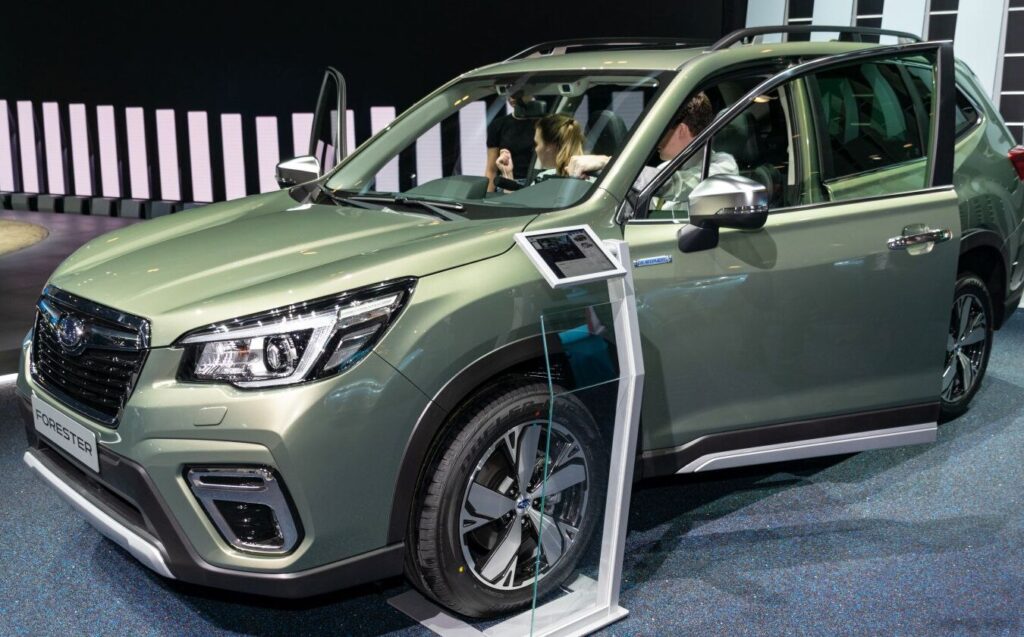
The Subaru Forester V 2.0 e-Boxer AWD Lineartronic, produced from March 2018 to August 2021, represents Subaru’s foray into mild hybrid technology within its popular Forester lineup. This variant, part of the fifth-generation Forester (introduced as the SK platform), aimed to balance fuel efficiency with Subaru’s renowned symmetrical all-wheel-drive capability. Positioned as a mid-range offering, it slotted between the naturally aspirated 2.5-liter models and potential higher-performance trims in select markets. The e-Boxer system was Subaru’s first step towards electrification, offering a modest power boost and improved fuel economy compared to its non-hybrid counterparts.
Technical Specifications
| Brand | Subaru |
| Model | Forester |
| Generation | Forester V |
| Type (Engine) | 2.0 e-Boxer (150 Hp) AWD Lineartronic |
| Start of production | March, 2018 |
| End of production | August, 2021 |
| Powertrain Architecture | MHEV (Mild Hybrid Electric Vehicle) |
| Body type | SUV, Crossover |
| Seats | 5 |
| Doors | 5 |
| CO2 emissions | 154 g/km |
| Fuel Type | Petrol (Gasoline) |
| Acceleration 0 – 100 km/h | 11.8 sec |
| Acceleration 0 – 62 mph | 11.8 sec |
| Acceleration 0 – 60 mph | 11.2 sec |
| Maximum speed | 117 km/h / 72.7 mph |
| Weight-to-power ratio | 11 kg/Hp, 90.6 Hp/tonne |
| Weight-to-torque ratio | 8.5 kg/Nm, 117.2 Nm/tonne |
| Electric motor power | 17 Hp |
| Electric motor Torque | 66 Nm / 48.68 lb.-ft. |
| Electric motor location | Integrated into the transmission |
| Power | 150 Hp @ 5600-6000 rpm |
| Power per litre | 75.2 Hp/l |
| Torque | 194 Nm @ 4000 rpm / 143.09 lb.-ft. @ 4000 rpm |
| Engine layout | Front, Transverse |
| Engine Model/Code | FB20 |
| Engine displacement | 1995 cm3 / 121.74 cu. in. |
| Number of cylinders | 4 |
| Engine configuration | Boxer |
| Cylinder Bore | 84 mm / 3.31 in. |
| Piston Stroke | 90 mm / 3.54 in. |
| Compression ratio | 12.5:1 |
| Number of valves per cylinder | 4 |
| Fuel injection system | Direct injection |
| Valvetrain | DOHC |
| Engine oil capacity | 4.2 l / 4.44 US qt | 3.7 UK qt |
| Coolant | 8 l / 8.45 US qt | 7.04 UK qt |
| Kerb Weight | 1655 kg / 3648.65 lbs. |
| Trunk (boot) space – minimum | 520 l / 18.36 cu. ft. |
| Trunk (boot) space – maximum | 1779 l / 62.82 cu. ft. |
| Fuel tank capacity | 48 l / 12.68 US gal | 10.56 UK gal |
| Permitted trailer load with brakes (12%) | 1870 kg / 4122.64 lbs. |
| Length | 4625 mm / 182.09 in. |
| Width | 1815 mm / 71.46 in. |
| Width including mirrors | 2065 mm / 81.3 in. |
| Height | 1730 mm / 68.11 in. |
| Wheelbase | 2670 mm / 105.12 in. |
| Front track | 1565 mm / 61.61 in. |
| Rear (Back) track | 1570 mm / 61.81 in. |
| Ride height (ground clearance) | 220 mm / 8.66 in. |
| Minimum turning circle | 10.8 m / 35.43 ft. |
| Drive wheel | All wheel drive (4×4) |
| Number of gears and type of gearbox | automatic transmission CVT Lineartronic |
| Front suspension | Independent type McPherson |
| Rear suspension | Double wishbone |
| Front brakes | Ventilated discs |
| Rear brakes | Ventilated discs |
| Assisting systems | ABS (Anti-lock braking system) |
| Steering type | Steering rack and pinion |
| Power steering | Electric Steering |
| Tires size | 225/60 R17 |
| Wheel rims size | 7J x 17 |
Powertrain & Engine Architecture
At the heart of the Forester V 2.0 e-Boxer lies the FB20 2.0-liter horizontally-opposed (Boxer) four-cylinder engine. This engine benefits from direct fuel injection and a dual overhead camshaft (DOHC) valvetrain, contributing to improved efficiency and responsiveness. The ‘e-Boxer’ designation signifies the integration of a small electric motor, positioned within the Lineartronic CVT (Continuously Variable Transmission). This motor doesn’t directly drive the wheels but provides assistance during acceleration and engine start-up, smoothing out the engine’s operation and reducing emissions. The electric motor draws power from a small lithium-ion battery pack, recharged through regenerative braking. The FB20 engine produces 150 horsepower at 5600-6000 rpm and 194 Nm (143 lb-ft) of torque at 4000 rpm. The Lineartronic CVT, while offering smooth and stepless gear changes, was a point of contention for some enthusiasts who preferred the more engaging feel of a traditional automatic or manual transmission.
Driving Characteristics
The 2.0 e-Boxer Forester delivers adequate, but not exhilarating, performance. The 0-60 mph time of around 11.2 seconds reflects its focus on efficiency rather than outright speed. The CVT transmission, while smooth, can sometimes feel disconnected, with the engine holding at a constant rpm during acceleration. The electric motor assist does provide a noticeable boost during initial acceleration, making it feel more responsive in city driving. Compared to the 2.5-liter naturally aspirated Forester models, the e-Boxer offers slightly less peak power but benefits from the electric motor’s torque fill, resulting in a more usable powerband at lower speeds. The symmetrical all-wheel-drive system remains a key strength, providing excellent traction and stability in various weather conditions.
Equipment & Trim Levels
The 2.0 e-Boxer trim typically included standard features such as Subaru’s EyeSight driver-assist technology (including adaptive cruise control, lane departure warning, and automatic emergency braking), a touchscreen infotainment system with Apple CarPlay and Android Auto compatibility, automatic climate control, and power-adjustable seats. Interior upholstery was generally cloth, with options for leather upgrades. Available extras included a premium sound system, a power sunroof, and advanced safety features like blind-spot monitoring and rear cross-traffic alert. The overall interior design was functional and practical, prioritizing space and usability over luxury.
Chassis & Braking
The Forester V utilizes a McPherson strut front suspension and a double-wishbone rear suspension, providing a comfortable and controlled ride. The suspension tuning is geared towards absorbing bumps and providing a stable platform for both on-road and light off-road driving. Braking duties are handled by ventilated discs on all four wheels, offering adequate stopping power. The electronic parking brake with auto hold function was a standard feature. The Forester’s relatively high ground clearance (220mm / 8.66 inches) enhances its off-road capability, allowing it to tackle moderately challenging terrain.
Market Reception & Comparison
The 2.0 e-Boxer Forester was generally well-received by critics, who praised its fuel efficiency and comfortable ride. However, some reviewers found the CVT transmission to be less engaging than other options. Compared to the standard 2.5-liter Forester, the e-Boxer offered slightly better fuel economy but at a higher initial cost. The e-Boxer variant appealed to buyers who prioritized fuel efficiency and environmental consciousness without sacrificing Subaru’s core strengths of safety and all-wheel-drive capability.
Legacy
The Subaru Forester V 2.0 e-Boxer represents an important step in Subaru’s electrification strategy. While the e-Boxer system is a mild hybrid, it paved the way for more advanced hybrid and fully electric Subaru models. In the used car market, these Foresters are generally considered reliable, with the FB20 engine having a good track record. The CVT transmission, however, requires regular maintenance (fluid changes) to ensure longevity. Overall, the 2.0 e-Boxer Forester offers a practical and efficient option for buyers seeking a versatile and capable crossover SUV.