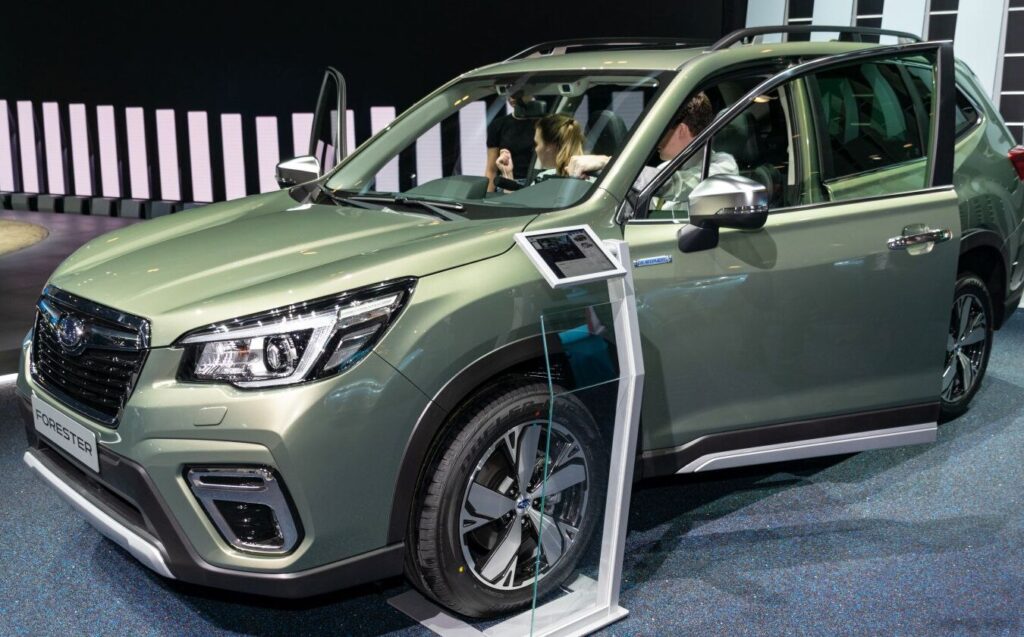
The Subaru Forester V 2.5, equipped with a 2.5-liter naturally aspirated boxer engine producing 182 horsepower and paired with a Lineartronic continuously variable transmission (CVT), was a key variant within the fifth generation Forester lineup (produced from March 2018 to August 2021). This configuration represented a significant portion of Forester sales in North America and other markets, appealing to buyers seeking a practical, reliable, and all-weather capable compact SUV. It occupied a mid-range position within the Forester V series, offering a balance between performance, fuel efficiency, and features. The Forester V itself was built upon the Subaru Global Platform, emphasizing improved safety, rigidity, and driving dynamics compared to its predecessor.
Technical Specifications
| Brand | Subaru |
| Model | Forester |
| Generation | Forester V |
| Type (Engine) | 2.5 (182 Hp) AWD CVT |
| Start of production | March, 2018 |
| End of production | August, 2021 |
| Powertrain Architecture | Internal Combustion engine |
| Body type | SUV, Crossover |
| Seats | 5 |
| Doors | 5 |
| Fuel consumption (combined) | 7.1 l/100 km (33.1 US mpg, 39.8 UK mpg, 14.1 km/l) |
| Fuel Type | Petrol (Gasoline) |
| Power | 182 Hp @ 5800 rpm |
| Power per litre | 72.9 Hp/l |
| Torque | 239 Nm @ 4400 rpm (176.28 lb.-ft. @ 4400 rpm) |
| Engine layout | Front, Longitudinal |
| Engine Model/Code | FB25 |
| Engine displacement | 2498 cm3 (152.44 cu. in.) |
| Number of cylinders | 4 |
| Engine configuration | Boxer |
| Cylinder Bore | 94 mm (3.7 in.) |
| Piston Stroke | 90 mm (3.54 in.) |
| Number of valves per cylinder | 4 |
| Fuel injection system | Direct injection |
| Engine aspiration | Naturally aspirated engine |
| Valvetrain | DOHC |
| Engine oil capacity | 4.2 l (4.44 US qt | 3.7 UK qt) |
| Coolant | 8.5 l (8.98 US qt | 7.48 UK qt) |
| Trunk (boot) space – minimum | 2155 l (76.1 cu. ft.) |
| Fuel tank capacity | 63 l (16.64 US gal | 13.86 UK gal) |
| Length | 4625 mm (182.09 in.) |
| Width | 1816 mm (71.5 in.) |
| Height | 1730 mm (68.11 in.) |
| Wheelbase | 2670 mm (105.12 in.) |
| Ride height (ground clearance) | 221 mm (8.7 in.) |
| Drive wheel | All wheel drive (4×4) |
| Number of gears and type of gearbox | automatic transmission CVT Lineartronic |
| Front brakes | Ventilated discs |
| Rear brakes | Disc |
| Assisting systems | ABS (Anti-lock braking system) |
| Tires size | 225/60 R17; 225/55 R18 |
| Wheel rims size | 17; 18 |
Powertrain & Engine Architecture
The heart of the Forester V 2.5 is the FB25 2.5-liter horizontally-opposed (boxer) four-cylinder engine. This engine is a hallmark of Subaru engineering, known for its inherent balance and smooth operation. The FB25 utilizes direct fuel injection, optimizing combustion efficiency and power delivery. The engine features a dual overhead camshaft (DOHC) valvetrain with four valves per cylinder, further enhancing its breathing and performance. The Lineartronic CVT, a key component of this variant, is a chain-driven continuously variable transmission. Unlike traditional stepped automatic transmissions, the CVT provides a virtually infinite number of gear ratios, allowing the engine to operate at its most efficient point for any given driving condition. This contributes to improved fuel economy and a smoother driving experience. The engine’s longitudinal mounting and symmetrical all-wheel drive system are also defining characteristics of Subaru’s engineering philosophy.
Driving Characteristics
The 182 horsepower and 176 lb-ft of torque produced by the FB25 engine, when channeled through the CVT, delivers adequate, though not exhilarating, performance. Acceleration from 0 to 60 mph typically takes around 8.5-9.5 seconds. The CVT is programmed to simulate stepped gear changes under hard acceleration, providing a more familiar feel for drivers accustomed to traditional automatics. However, in normal driving conditions, the CVT operates seamlessly, prioritizing fuel efficiency. Compared to the optional turbocharged engine available in some Forester trims, the 2.5L naturally aspirated engine offers a more linear power delivery. While the turbocharged engine provides quicker acceleration, the 2.5L is more predictable and easier to modulate, particularly in slippery conditions. The CVT, while efficient, can sometimes feel less responsive than a traditional automatic or manual transmission, especially when attempting quick overtaking maneuvers.
Equipment & Trim Levels
The 2.5L AWD CVT Forester V typically came standard with a comprehensive suite of features. These included Subaru’s EyeSight Driver Assist Technology, encompassing adaptive cruise control, lane departure warning, and automatic emergency braking. Interior amenities generally included a touchscreen infotainment system with Apple CarPlay and Android Auto compatibility, automatic climate control, and comfortable cloth upholstery. Higher trim levels, building upon the 2.5L base, added features such as leather upholstery, a power driver’s seat, a premium audio system, and automatic headlights. Optional extras included a power sunroof, navigation system, and various exterior styling enhancements.
Chassis & Braking
The Forester V utilizes a MacPherson strut front suspension and a double-wishbone rear suspension, providing a comfortable and controlled ride. The suspension is tuned to prioritize comfort and stability, making it well-suited for both on-road and light off-road driving. Braking duties are handled by ventilated discs at the front and solid discs at the rear. Anti-lock braking system (ABS) is standard, enhancing braking performance and stability in emergency situations. The Forester’s symmetrical all-wheel drive system is a key component of its chassis design, providing excellent traction in a variety of conditions. The relatively high ground clearance of 8.7 inches further enhances its off-road capability.
Market Reception & Comparison
The Subaru Forester V 2.5 AWD CVT was generally well-received by automotive critics. It was praised for its practicality, safety features, fuel efficiency, and standard all-wheel drive. Critics noted that the CVT, while efficient, could feel somewhat unrefined compared to traditional automatic transmissions. Compared to other trims in the Forester lineup, the 2.5L offered a more affordable entry point while still providing a capable and well-equipped SUV. The turbocharged engine offered more performance, but at a higher price point. The 2.5L’s fuel economy, averaging around 33 mpg combined, was competitive within its class. Reliability has been generally good, with the FB25 engine proving to be a durable and dependable powerplant.
Legacy
The FB25 engine and Lineartronic CVT combination in the Forester V have proven to be relatively reliable powertrains. While some early CVT units experienced issues, Subaru addressed these concerns with updated designs and software. In the used car market, the Forester V 2.5 AWD CVT remains a popular choice, known for its practicality, safety, and all-weather capability. Its relatively low running costs and strong resale value contribute to its continued appeal. The Forester V solidified Subaru’s reputation as a manufacturer of safe, reliable, and capable SUVs, and the 2.5L variant played a significant role in its success.