
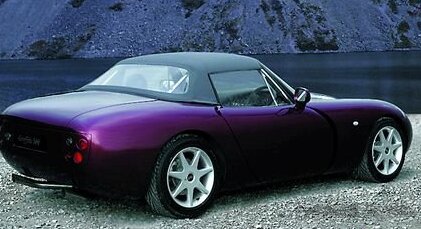
The TVR Griffith 4.3, produced between 1990 and 1993, represents a pivotal moment for the Blackpool-based British sports car manufacturer. This model, built upon the chassis code 1HX0, was instrumental in revitalizing the TVR brand and establishing its reputation for raw performance and distinctive styling. The 4.3-liter V8 variant, delivering 280 horsepower, was the flagship of the Griffith range during its initial production run, offering a compelling alternative to established sports car marques. It quickly became a favorite among enthusiasts seeking a thrilling, driver-focused experience.
Technical Specifications
| Brand | TVR |
| Model | Griffith |
| Generation | Griffith |
| Type (Engine) | 4.3 (280 Hp) |
| Start of production | 1990 |
| End of production | 1993 |
| Powertrain Architecture | Internal Combustion engine |
| Body type | Cabriolet |
| Seats | 2 |
| Doors | 2 |
| Fuel consumption (urban) | 17 l/100 km (13.8 US mpg, 16.6 UK mpg, 5.9 km/l) |
| Fuel consumption (extra urban) | 10 l/100 km (23.5 US mpg, 28.2 UK mpg, 10 km/l) |
| Fuel Type | Petrol (Gasoline) |
| Acceleration 0 – 100 km/h | 4.4 sec |
| Acceleration 0 – 62 mph | 4.4 sec |
| Acceleration 0 – 60 mph | 4.2 sec |
| Maximum speed | 253 km/h (157.21 mph) |
| Weight-to-power ratio | 3.6 kg/Hp, 280 Hp/tonne |
| Weight-to-torque ratio | 2.5 kg/Nm, 398 Nm/tonne |
| Power | 280 Hp @ 5500 rpm |
| Power per litre | 65.5 Hp/l |
| Torque | 398 Nm @ 4000 rpm (293.55 lb.-ft. @ 4000 rpm) |
| Engine layout | Front, Longitudinal |
| Engine displacement | 4275 cm3 (260.88 cu. in.) |
| Number of cylinders | 8 |
| Engine configuration | V-engine |
| Cylinder Bore | 94 mm (3.7 in.) |
| Piston Stroke | 77 mm (3.03 in.) |
| Compression ratio | 8.9:1 |
| Number of valves per cylinder | 2 |
| Fuel injection system | Multi-port manifold injection |
| Engine aspiration | Naturally aspirated engine |
| Engine oil capacity | 5 l (5.28 US qt | 4.4 UK qt) |
| Coolant | 12 l (12.68 US qt | 10.56 UK qt) |
| Kerb Weight | 1000 kg (2204.62 lbs.) |
| Max. weight | 1200 kg (2645.55 lbs.) |
| Max load | 200 kg (440.92 lbs.) |
| Fuel tank capacity | 57 l (15.06 US gal | 12.54 UK gal) |
| Length | 3965 mm (156.1 in.) |
| Width | 1800 mm (70.87 in.) |
| Height | 1200 mm (47.24 in.) |
| Wheelbase | 2285 mm (89.96 in.) |
| Front track | 1460 mm (57.48 in.) |
| Rear track | 1460 mm (57.48 in.) |
| Drivetrain Architecture | Rear wheel drive |
| Drive wheel | Rear wheel drive |
| Number of gears | 5 gears, manual transmission |
| Front suspension | Double wishbone |
| Rear suspension | Double wishbone |
| Front brakes | Ventilated discs |
| Rear brakes | Ventilated discs |
| Assisting systems | ABS (Anti-lock braking system) |
| Steering type | Steering rack and pinion |
| Tires size | 205/55 R16; 225/50 R16 |
Introduction
The Griffith 4.3 was TVR’s answer to the growing demand for a British-built, high-performance sports car. Prior to the Griffith, TVR had a reputation for producing somewhat quirky and often unreliable vehicles. The Griffith aimed to change that perception, offering a more refined and dependable package while retaining the brand’s core values of exhilarating performance and distinctive design. The car’s success was largely due to the adoption of a Rover-sourced V8 engine, a steel spaceframe chassis, and independent suspension. The Griffith’s open-top configuration further enhanced its appeal, providing a visceral driving experience.
Powertrain & Engine Architecture
The heart of the Griffith 4.3 is its 4.3-liter Rover V8 engine. This engine, derived from the Buick-Oldsmobile-Pontiac 3.5-liter V8, was extensively modified by TVR to increase its power output. The 280 horsepower version featured a compression ratio of 8.9:1 and utilized a multi-port fuel injection system. The engine’s robust construction and relatively simple design contributed to its reliability, a significant improvement over previous TVR engines. The engine is mounted longitudinally in the front of the car, driving the rear wheels. The standard transmission was a five-speed manual gearbox, providing precise control and enhancing the driving experience. The engine’s torque curve is relatively flat, delivering strong acceleration throughout the rev range.
Driving Characteristics
The Griffith 4.3 delivers a raw and engaging driving experience. Its lightweight construction (around 2200 lbs) and powerful V8 engine result in impressive acceleration – 0 to 60 mph in approximately 4.2 seconds. The car feels nimble and responsive, with precise steering and well-controlled handling. The suspension, featuring double wishbones at both the front and rear, provides a comfortable ride without sacrificing handling performance. Compared to later, more powerful Griffith variants (like the 5.0-liter), the 4.3 offers a more manageable power delivery, making it a more accessible option for drivers less experienced with high-performance sports cars. While not as brutally fast as its larger-engined siblings, the 4.3 provides ample power for spirited driving on both roads and tracks.
Equipment & Trim Levels
The Griffith 4.3 was relatively sparsely equipped by modern standards, reflecting TVR’s focus on performance over luxury. Standard features included leather seats, a wood-rimmed steering wheel, and basic instrumentation. The interior was functional and driver-focused, with a minimalist design. Optional extras included air conditioning, power windows, and upgraded audio systems. Interior trim options were limited, typically consisting of various leather colors and wood veneer finishes. The Griffith was primarily aimed at enthusiasts who prioritized driving experience over creature comforts.
Chassis & Braking
The Griffith 4.3 utilizes a steel spaceframe chassis, providing a rigid and lightweight platform. This chassis design contributes significantly to the car’s handling prowess. The suspension features independent double wishbones at both the front and rear, with coil springs and adjustable dampers. Braking is provided by ventilated discs on all four wheels, assisted by an anti-lock braking system (ABS). The braking system is effective, providing ample stopping power for spirited driving. The car’s relatively low weight further enhances its braking performance.
Market Reception & Comparison
The Griffith 4.3 was well-received by automotive critics, who praised its performance, handling, and distinctive styling. It was often compared to other British sports cars of the era, such as the Lotus Elise and the Porsche 944. Compared to the later 5.0-liter Griffith, the 4.3 offered a more affordable entry point into the TVR range. While the 5.0-liter provided more power, the 4.3 was considered by some to be a more balanced and enjoyable car to drive. Fuel economy was not a strong point, with typical figures around 17 l/100 km (13.8 US mpg) in urban driving and 10 l/100 km (23.5 US mpg) on the highway.
Legacy
The TVR Griffith 4.3 played a crucial role in establishing TVR as a serious sports car manufacturer. The model’s success paved the way for subsequent Griffith variants and helped to build the brand’s reputation for performance and individuality. Today, the Griffith 4.3 is a sought-after classic car, appreciated by enthusiasts for its raw driving experience and distinctive styling. While maintenance can be challenging due to the car’s age and the limited availability of parts, the Rover V8 engine is generally considered to be reliable. Well-maintained examples command a premium in the used car market, reflecting the car’s enduring appeal and its place in British automotive history.
