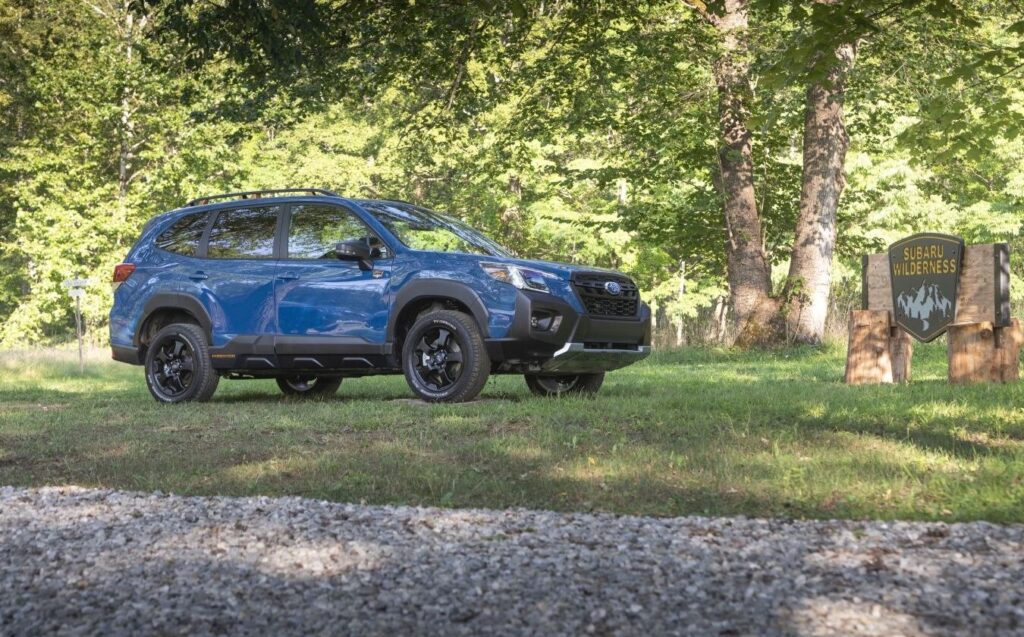
The Subaru Forester V, specifically the facelift model introduced in August 2021, represented a significant update to Subaru’s popular compact SUV. This iteration featured a 1.8-liter direct-injection turbocharged (DIT) engine paired with a Lineartronic continuously variable transmission (CVT) and Subaru’s symmetrical all-wheel drive system. Produced through 2024, this variant aimed to balance fuel efficiency with adequate performance for the everyday driver, slotting into the mid-range of the Forester V lineup. It served as a key offering in markets where Subaru sought to provide a more economical alternative to the larger engine options while maintaining the brand’s reputation for safety and all-weather capability.
Technical Specifications
| Brand | Subaru |
| Model | Forester |
| Generation | Forester V (facelift 2021) |
| Type (Engine) | 1.8 DIT (177 Hp) AWD Lineartronic |
| Start of production | August, 2021 |
| End of production | 2024 |
| Powertrain Architecture | Internal Combustion engine |
| Body type | SUV, Crossover |
| Seats | 5 |
| Doors | 5 |
| Fuel consumption (urban) | 9.7 l/100 km (24.2 US mpg) |
| Fuel consumption (extra urban) | 6.6 l/100 km (35.6 US mpg) |
| Fuel Type | Petrol (Gasoline) |
| Weight-to-power ratio | 8.9 kg/Hp |
| Weight-to-torque ratio | 5.2 kg/Nm |
| Power | 177 Hp @ 5200-5600 rpm |
| Torque | 300 Nm @ 1600-3600 rpm (221.27 lb.-ft.) |
| Engine layout | Front, Longitudinal |
| Engine Model/Code | CB18 |
| Engine displacement | 1795 cm3 (109.54 cu. in.) |
| Number of cylinders | 4 |
| Engine configuration | Boxer |
| Cylinder Bore | 80.6 mm (3.17 in.) |
| Piston Stroke | 88 mm (3.46 in.) |
| Compression ratio | 10.4:1 |
| Number of valves per cylinder | 4 |
| Fuel injection system | Direct injection |
| Engine aspiration | Turbocharger, Intercooler |
| Valvetrain | DOHC, AVCS |
| Kerb Weight | 1570-1590 kg (3461.26 – 3505.35 lbs.) |
| Max. weight | 1865 kg (4111.62 lbs.) |
| Max load | 275-295 kg (606.27 – 650.36 lbs.) |
| Fuel tank capacity | 63 l (16.64 US gal | 13.86 UK gal) |
| Length | 4640 mm (182.68 in.) |
| Width | 1815 mm (71.46 in.) |
| Height | 1715 mm (67.52 in.) |
| Wheelbase | 2670 mm (105.12 in.) |
| Front track | 1565 mm (61.61 in.) |
| Rear track | 1570 mm (61.81 in.) |
| Ride height (ground clearance) | 220 mm (8.66 in.) |
| Minimum turning circle | 10.8 m (35.43 ft.) |
| Drivetrain Architecture | All wheel drive (4×4) |
| Number of gears and type of gearbox | automatic transmission Lineartronic |
| Front suspension | Independent coil spring |
| Rear suspension | Double wishbone |
| Front brakes | Ventilated discs |
| Rear brakes | Ventilated discs |
Powertrain & Engine Architecture
The heart of this Forester variant is the CB18 engine, a 1.8-liter horizontally-opposed (Boxer) four-cylinder gasoline engine. Subaru’s Boxer configuration, known for its low center of gravity, contributes to the vehicle’s stability and handling. The CB18 utilizes direct fuel injection and a single turbocharger with an intercooler to boost power output. The direct injection system allows for precise fuel delivery, improving both efficiency and performance. The engine employs a Dual Active Valve Control System (AVCS) on both the intake and exhaust camshafts, optimizing valve timing for varying engine speeds and loads. This contributes to a broader torque curve and improved responsiveness. The Lineartronic CVT, replacing traditional stepped automatic transmissions, provides a seamless and continuously variable gear ratio. This design prioritizes fuel efficiency and smooth acceleration, though it can sometimes feel less engaging than a conventional automatic.
Driving Characteristics
The 1.8L DIT Forester with the Lineartronic CVT delivers a comfortable and predictable driving experience. While not overtly sporty, the engine provides sufficient power for everyday driving situations, including highway merging and passing. The CVT is programmed to simulate stepped gear changes under hard acceleration, providing a more familiar feel for drivers accustomed to traditional automatics. However, the CVT’s tendency to hold engine RPMs at optimal power levels can sometimes result in a droning sound during acceleration. Compared to the 2.5-liter naturally aspirated engine option, the 1.8L DIT offers slightly less overall power but provides better fuel economy. Against higher-output turbocharged variants, this version naturally lags in outright acceleration, but its lighter weight and efficient CVT contribute to respectable fuel consumption figures.
Equipment & Trim Levels
The 1.8 DIT Lineartronic Forester typically came standard with a comprehensive suite of features. These included Subaru’s EyeSight driver-assist technology, encompassing adaptive cruise control, lane departure warning, and automatic emergency braking. Interior appointments generally featured cloth upholstery, a touchscreen infotainment system with Apple CarPlay and Android Auto compatibility, and automatic climate control. Higher trim levels offered upgrades such as leather upholstery, a premium sound system, power-adjustable driver’s seat, and a sunroof. Optional extras often included navigation systems and various exterior styling enhancements.
Chassis & Braking
The Forester V utilizes a robust chassis with independent suspension all around – coil springs at the front and a double-wishbone setup at the rear. This configuration provides a comfortable ride and good handling characteristics. The 1.8 DIT models typically featured ventilated disc brakes on all four wheels, providing adequate stopping power for the vehicle’s weight. Anti-lock braking system (ABS) and electronic brakeforce distribution (EBD) were standard safety features. Stabilizer bars were fitted to both the front and rear axles to reduce body roll during cornering.
Market Reception & Comparison
The 1.8 DIT Forester was generally well-received by automotive critics as a practical and fuel-efficient option within the compact SUV segment. Reviewers praised its comfortable ride, spacious interior, and standard safety features. However, some criticized the CVT for its lack of engagement and the engine for not feeling particularly powerful. Compared to the 2.5-liter Forester, the 1.8 DIT offered a noticeable improvement in fuel economy, making it an attractive choice for drivers prioritizing efficiency. In terms of reliability, the CB18 engine and Lineartronic CVT have proven to be generally dependable, though regular maintenance, particularly CVT fluid changes, is crucial for long-term durability.
Legacy
The Subaru Forester V (2021-2024) 1.8 DIT Lineartronic has established itself as a solid and dependable used car option. Its combination of fuel efficiency, all-wheel drive capability, and standard safety features continues to appeal to a wide range of buyers. While not the most exciting vehicle to drive, its practicality and reliability make it a sensible choice for families and individuals seeking a versatile and trustworthy SUV. The long-term value of these models is bolstered by Subaru’s reputation for durability and the relatively straightforward maintenance requirements of the CB18 engine and Lineartronic transmission.