
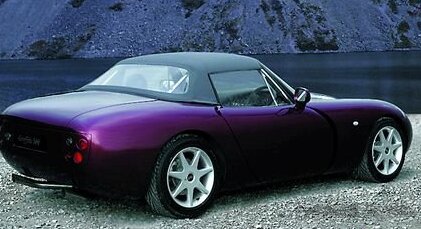
The TVR Griffith 5.0, produced between 1993 and 2000, represents a pivotal model in the history of TVR Engineering, a British manufacturer renowned for its hand-built, high-performance sports cars. The Griffith, named after the Welsh industrialist Richard Griffith who initially invested in the company, was designed as a direct competitor to the Porsche 911, offering comparable performance at a significantly lower price point. The 5.0-liter variant, producing 340 horsepower, was the flagship of the Griffith range, embodying TVR’s commitment to raw power and driver engagement. It was built on a steel spaceframe chassis, a hallmark of TVR construction, and featured a lightweight fiberglass body. The Griffith aimed to deliver a visceral driving experience, prioritizing feel and responsiveness over outright refinement.
Technical Specifications
| Brand | TVR |
| Model | Griffith |
| Generation | Griffith |
| Type (Engine) | 5.0 (340 Hp) |
| Start of production | 1993 |
| End of production | 2000 |
| Powertrain Architecture | Internal Combustion engine |
| Body type | Cabriolet |
| Seats | 2 |
| Doors | 2 |
| Fuel Type | Petrol (Gasoline) |
| Acceleration 0 – 100 km/h | 4.5 sec |
| Acceleration 0 – 62 mph | 4.5 sec |
| Acceleration 0 – 60 mph | 4.3 sec |
| Maximum speed | 271 km/h (168.39 mph) |
| Weight-to-power ratio | 3.1 kg/Hp, 320.8 Hp/tonne |
| Weight-to-torque ratio | 2.2 kg/Nm, 453.8 Nm/tonne |
| Power | 340 Hp @ 5250 rpm |
| Power per litre | 68 Hp/l |
| Torque | 481 Nm @ 3750 rpm (354.77 lb.-ft. @ 3750 rpm) |
| Engine layout | Front, Longitudinal |
| Engine displacement | 4997 cm3 (304.94 cu. in.) |
| Number of cylinders | 8 |
| Engine configuration | V-engine |
| Cylinder Bore | 94 mm (3.7 in.) |
| Piston Stroke | 90 mm (3.54 in.) |
| Compression ratio | 9.5:1 |
| Number of valves per cylinder | 2 |
| Fuel injection system | Multi-port manifold injection |
| Engine aspiration | Naturally aspirated engine |
| Engine oil capacity | 5 l (5.28 US qt | 4.4 UK qt) |
| Coolant | 12 l (12.68 US qt | 10.56 UK qt) |
| Kerb Weight | 1060 kg (2336.9 lbs.) |
| Max. weight | 1280 kg (2821.92 lbs.) |
| Max load | 220 kg (485.02 lbs.) |
| Trunk (boot) space – minimum | 310 l (10.95 cu. ft.) |
| Fuel tank capacity | 57 l (15.06 US gal | 12.54 UK gal) |
| Length | 4050 mm (159.45 in.) |
| Width | 1760 mm (69.29 in.) |
| Height | 1180 mm (46.46 in.) |
| Wheelbase | 2282 mm (89.84 in.) |
| Front track | 1460 mm (57.48 in.) |
| Rear (Back) track | 1470 mm (57.87 in.) |
| Drivetrain Architecture | Rear wheel drive |
| Number of gears and type of gearbox | 5 gears, manual transmission |
| Front suspension | Wishbone |
| Rear suspension | Wishbone |
| Front brakes | Ventilated discs |
| Rear brakes | Disc |
| Assisting systems | ABS (Anti-lock braking system) |
| Steering type | Steering rack and pinion |
| Tires size | 235/50 R16 |
| Wheel rims size | 7.5 J x 16 |
Powertrain & Engine Architecture
The heart of the Griffith 5.0 is its Rover V8 engine, a 4.997-liter (304.94 cubic inch) naturally aspirated unit. This engine, derived from the Buick-Oldsmobile-Pontiac 3.5-liter V8, was extensively modified by TVR over the years. The 340 horsepower version featured a higher compression ratio (9.5:1) and improved cylinder heads, along with a TVR-designed fuel injection system. The engine’s robust bottom end and relatively simple design contributed to its reliability, despite the high power output. The engine is longitudinally mounted, driving the rear wheels. The Griffith 5.0 exclusively came with a five-speed manual transmission, providing a direct connection between the driver and the engine’s power. This transmission was sourced from Tremec, known for its durability and precise shift feel.
Driving Characteristics
The Griffith 5.0 delivers a raw and engaging driving experience. The 340 hp engine provides ample power, resulting in a 0-60 mph time of around 4.3 seconds and a top speed of 168 mph. The car’s relatively lightweight construction (around 2337 lbs) contributes to its nimble handling. The suspension, featuring wishbone setups front and rear, provides a firm but controlled ride. The manual transmission requires a skilled driver to extract the most performance, but it rewards with precise gear changes and a direct feel. Compared to potential future turbocharged or automatic variants, the 5.0 manual offers a more direct and visceral connection to the driving experience. The lack of electronic driver aids means the driver is fully responsible for controlling the car, making it a thrilling but demanding machine.
Equipment & Trim Levels
The Griffith 5.0 was relatively spartan in terms of standard equipment, reflecting TVR’s focus on performance over luxury. Standard features included leather seats, power windows, and central locking. Air conditioning was often an optional extra. Interior trim was typically leather-wrapped, with a wood-trimmed dashboard. Customers could specify a range of options, including upgraded audio systems, different wheel designs, and bespoke interior color schemes. The Griffith wasn’t offered in distinct trim levels; rather, it was largely customizable to the buyer’s preferences. The emphasis was on creating a personalized sports car tailored to the individual driver.
Chassis & Braking
The Griffith’s chassis is a steel spaceframe, providing a rigid and lightweight platform. This construction method allowed TVR to create a strong and safe structure without excessive weight. The suspension utilizes independent wishbones all around, offering a good balance between handling and ride comfort. Braking is provided by ventilated discs at the front and solid discs at the rear, assisted by an anti-lock braking system (ABS). While the braking system was adequate for the car’s performance, it wasn’t as sophisticated as those found in some contemporary sports cars.
Market Reception & Comparison
The TVR Griffith 5.0 was generally well-received by automotive critics, who praised its performance, handling, and value for money. It was often compared favorably to the Porsche 911, offering similar performance at a lower price point. However, the Griffith’s build quality and reliability were sometimes criticized. The car’s hand-built nature meant that quality control could be inconsistent. Fuel economy was also relatively poor, typical for a high-performance V8 sports car. Compared to other Griffith variants, the 5.0 represented the top of the range, offering the highest level of performance and exclusivity. The smaller-engined models (e.g., 4.0-liter) were more affordable but lacked the outright punch of the 5.0.
Legacy
The TVR Griffith 5.0 remains a highly sought-after sports car among enthusiasts. Its combination of raw power, engaging handling, and distinctive styling has made it a classic. While the Rover V8 engine is generally reliable, maintenance can be costly due to the car’s age and the limited availability of parts. The Griffith’s fiberglass body is prone to damage, and finding qualified technicians to work on these cars can be challenging. Despite these drawbacks, the Griffith 5.0 continues to offer a unique and rewarding driving experience, cementing its place as a significant model in British sports car history. The used car market values these cars based on condition, mileage, and originality, with well-maintained examples commanding premium prices.
