
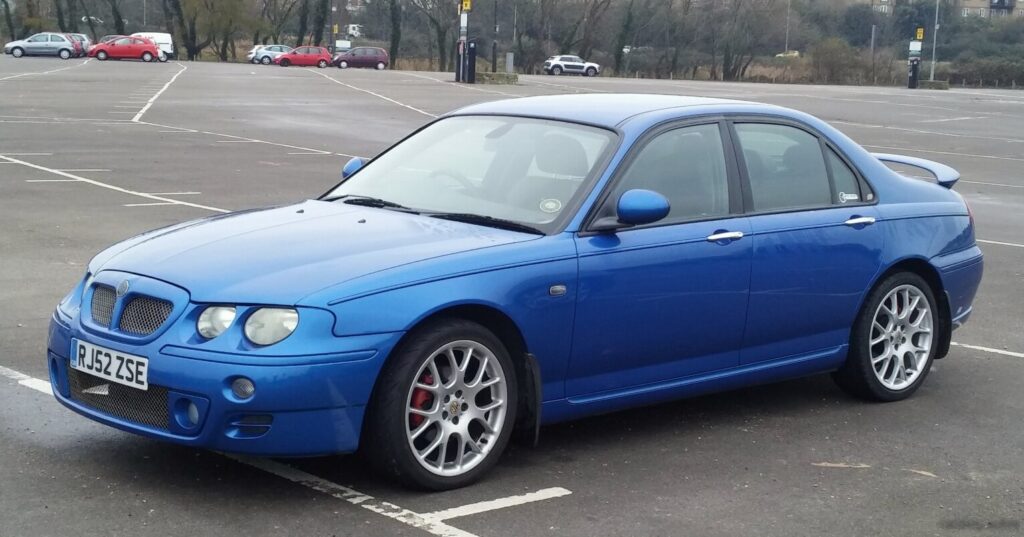
The MG ZT 2.5 i V6 24V, produced between 2001 and 2005, was a flagship sedan offered by MG, then under the ownership of MG Rover. Positioned as a sporting alternative within the Rover 75 platform (internally designated as the X20), the ZT aimed to recapture some of MG’s sporting heritage. The 2.5-liter V6 variant represented a mid-range offering in the ZT lineup, slotting between the 1.8-liter four-cylinder and the high-performance 3.8-liter V8 models. It was primarily marketed in the United Kingdom and Europe, representing a final attempt by MG to establish a presence in the executive car segment.
Technical Specifications
| Brand | MG |
| Model | ZT |
| Generation | ZT |
| Type (Engine) | 2.5 i V6 24V (177 Hp) |
| Start of production | 2001 |
| End of production | 2005 |
| Powertrain Architecture | Internal Combustion engine |
| Body type | Sedan |
| Seats | 5 |
| Doors | 4 |
| Fuel consumption (urban) | 16 l/100 km (14.7 US mpg, 17.7 UK mpg, 6.3 km/l) |
| Fuel consumption (extra urban) | 7.9 l/100 km (29.8 US mpg, 35.8 UK mpg, 12.7 km/l) |
| Fuel consumption (combined) | 10.9 l/100 km (21.6 US mpg, 25.9 UK mpg, 9.2 km/l) |
| Fuel Type | Petrol (Gasoline) |
| Acceleration 0 – 100 km/h | 9.4 sec |
| Acceleration 0 – 62 mph | 9.4 sec |
| Acceleration 0 – 60 mph | 8.9 sec |
| Maximum speed | 215 km/h (133.59 mph) |
| Weight-to-power ratio | 8.5 kg/Hp, 117.2 Hp/tonne |
| Weight-to-torque ratio | 6.3 kg/Nm, 158.9 Nm/tonne |
| Power | 177 Hp @ 6500 rpm |
| Power per litre | 70.9 Hp/l |
| Torque | 240 Nm @ 4000 rpm (177.01 lb.-ft. @ 4000 rpm) |
| Engine layout | Front, Transverse |
| Engine Model/Code | 25K4F |
| Engine displacement | 2497 cm3 (152.38 cu. in.) |
| Number of cylinders | 6 |
| Engine configuration | V-engine |
| Cylinder Bore | 80 mm (3.15 in.) |
| Piston Stroke | 82.8 mm (3.26 in.) |
| Compression ratio | 10.5:1 |
| Number of valves per cylinder | 4 |
| Fuel injection system | Multi-port manifold injection |
| Engine aspiration | Naturally aspirated engine |
| Valvetrain | DOHC |
| Engine oil capacity | 5.2 l (5.49 US qt | 4.58 UK qt) |
| Coolant | 7.5 l (7.93 US qt | 6.6 UK qt) |
| Kerb Weight | 1510 kg (3328.98 lbs.) |
| Max. weight | 2000 kg (4409.25 lbs.) |
| Max load | 490 kg (1080.27 lbs.) |
| Trunk (boot) space – minimum | 432 l (15.26 cu. ft.) |
| Fuel tank capacity | 65 l (17.17 US gal | 14.3 UK gal) |
| Length | 4740 mm (186.61 in.) |
| Width | 1780 mm (70.08 in.) |
| Height | 1410 mm (55.51 in.) |
| Wheelbase | 2746 mm (108.11 in.) |
| Front track | 1505 mm (59.25 in.) |
| Rear (Back) track | 1505 mm (59.25 in.) |
| Drivetrain Architecture | The Internal combustion engine (ICE) drives the front wheels of the vehicle. |
| Drive wheel | Front wheel drive |
| Number of gears and type of gearbox | 5 gears, automatic transmission |
| Front suspension | Spring Strut |
| Rear suspension | Coil spring |
| Front brakes | Ventilated discs |
| Rear brakes | Disc |
| Assisting systems | ABS (Anti-lock braking system) |
| Steering type | Steering rack and pinion |
| Power steering | Hydraulic Steering |
| Tires size | 225/45 R18 |
Powertrain & Engine Architecture
The MG ZT 2.5 i V6 utilized the 25K4F engine, a 2.5-liter naturally aspirated V6. This engine was derived from the Rover KV6 engine family, which itself had roots in a Honda design. The 25K4F featured a 60-degree V-angle, four valves per cylinder, and a dual overhead camshaft (DOHC) configuration. Fuel delivery was handled by a multi-point fuel injection system. The engine produced 177 horsepower at 6500 rpm and 240 Nm (177 lb-ft) of torque at 4000 rpm. The engine was transversely mounted in the front of the vehicle. The transmission was a 5-speed automatic gearbox, offering a more relaxed driving experience compared to the available manual transmission. This automatic was a JATCO unit, known for its smoothness but not necessarily its sportiness.
Driving Characteristics
The 2.5-liter V6 with the automatic transmission provided a comfortable and refined driving experience. Acceleration from 0-60 mph took approximately 8.9 seconds, making it reasonably quick for its time, but noticeably slower than the manual versions or the higher-output 3.8-liter V8. The automatic transmission, while smooth, did detract from the sporty image MG was trying to cultivate. Gear ratios were tuned for comfort and fuel economy rather than outright performance. The engine delivered a usable amount of torque, making it suitable for everyday driving and highway cruising. However, it lacked the responsiveness and excitement of the more powerful ZT variants.
Equipment & Trim Levels
The 2.5 i V6 typically came equipped with a reasonable level of standard features. This included air conditioning, power windows, power steering, central locking, and an RDS stereo system. Interior upholstery was generally cloth, although leather options were available. Trim levels varied, but commonly included features like alloy wheels, front fog lamps, and a trip computer. Optional extras could include a sunroof, upgraded audio systems, and parking sensors. The ZT aimed for a more premium feel than its Rover 75 counterpart, with a slightly more focused interior design and sportier seats.
Chassis & Braking
The MG ZT utilized a modified version of the Rover 75’s platform. The front suspension employed MacPherson struts, while the rear featured a multi-link setup. The 2.5 i V6 model typically featured ventilated disc brakes at the front and solid discs at the rear. Anti-lock Braking System (ABS) was standard. The suspension was tuned to provide a balance between comfort and handling, leaning towards the comfort side for this particular variant. Stabilizer bars were fitted front and rear to reduce body roll, but were generally thinner than those found on the more performance-oriented ZT models.
Market Reception & Comparison
The MG ZT 2.5 i V6 was generally well-received by critics as a comfortable and refined sedan. However, it was often criticized for not fully living up to MG’s sporting image. Compared to the 1.8-liter models, the V6 offered significantly more performance, but at the cost of increased fuel consumption. The 3.8-liter V8 ZT, while considerably more expensive, provided a much more exhilarating driving experience. Fuel economy for the 2.5 i V6 averaged around 21.6 US mpg combined, which was reasonable for a V6 engine of that era. Reliability was generally good, although the KV6 engine family was known to be susceptible to head gasket failures if not properly maintained.
Legacy
The MG ZT, and the 2.5 i V6 variant specifically, represents a poignant chapter in British automotive history. The collapse of MG Rover in 2005 meant that the ZT was a short-lived model. Today, the ZT 2.5 i V6 is a relatively affordable classic car, appealing to enthusiasts seeking a comfortable and stylish British sedan. The 25K4F engine, while not without its potential issues, is generally considered reliable if properly maintained. Parts availability can be a challenge, but a dedicated community of MG Rover owners helps to keep these cars on the road. The ZT 2.5 i V6 remains a reminder of MG’s ambition to create a modern sporting sedan, and a testament to the engineering talent that existed within MG Rover.
