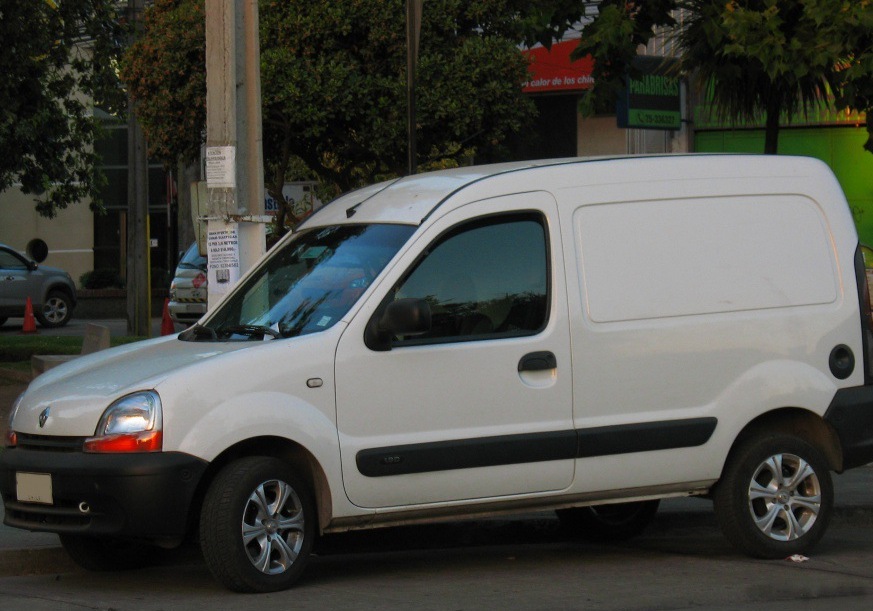
The Renault Kangoo I Express (FC) 1.2, producing 58 horsepower, was a commercially-oriented panel van and a key part of Renault’s light commercial vehicle lineup from 1997 to 2003. Positioned as the entry-level variant of the first-generation Kangoo, it catered to businesses and tradespeople needing a compact, affordable, and practical vehicle. The Kangoo I, built on the X0/B platform, represented Renault’s attempt to create a versatile vehicle that blended the functionality of a van with the driving characteristics of a passenger car. This particular 1.2-liter engine and five-speed manual transmission combination was designed for economy and ease of use, prioritizing low running costs over outright performance.
Technical Specifications
| Brand | Renault |
| Model | Kangoo |
| Generation | Kangoo I Express (FC) |
| Type (Engine) | 1.2 (58 Hp) |
| Start of production | 1997 year |
| End of production | 2003 year |
| Powertrain Architecture | Internal Combustion engine |
| Body type | Minivan |
| Seats | 2 |
| Doors | 3 |
| Fuel consumption (economy) – urban | 8.3 l/100 km (28.3 US mpg, 34 UK mpg, 12 km/l) |
| Fuel consumption (economy) – extra urban | 6.1 l/100 km (38.6 US mpg, 46.3 UK mpg, 16.4 km/l) |
| Fuel consumption (economy) – combined | 6.9 l/100 km (34.1 US mpg, 40.9 UK mpg, 14.5 km/l) |
| CO2 emissions | 163 g/km |
| Fuel Type | Petrol (Gasoline) |
| Acceleration 0 – 100 km/h | 17.2 sec |
| Acceleration 0 – 62 mph | 17.2 sec |
| Acceleration 0 – 60 mph | 16.3 sec |
| Maximum speed | 140 km/h (86.99 mph) |
| Weight-to-power ratio | 18.1 kg/Hp, 55.2 Hp/tonne |
| Weight-to-torque ratio | 11.3 kg/Nm, 88.6 Nm/tonne |
| Power | 58 Hp @ 5250 rpm |
| Power per litre | 50.5 Hp/l |
| Torque | 93 Nm @ 2500 rpm (68.59 lb.-ft. @ 2500 rpm) |
| Engine layout | Front, Transverse |
| Engine Model/Code | D7F |
| Engine displacement | 1149 cm3 (70.12 cu. in.) |
| Number of cylinders | 4 |
| Engine configuration | Inline |
| Cylinder Bore | 69 mm (2.72 in.) |
| Piston Stroke | 76.8 mm (3.02 in.) |
| Compression ratio | 9.6:1 |
| Number of valves per cylinder | 2 |
| Fuel injection system | Multi-port manifold injection |
| Engine aspiration | Naturally aspirated engine |
| Valvetrain | OHC |
| Engine oil capacity | 4 l (4.23 US qt | 3.52 UK qt) |
| Coolant | 4.5 l (4.76 US qt | 3.96 UK qt) |
| Kerb Weight | 1050 kg (2314.85 lbs.) |
| Max. weight | 1600 kg (3527.4 lbs.) |
| Max load | 550 kg (1212.54 lbs.) |
| Trunk (boot) space – maximum | 2750 l (97.12 cu. ft.) |
| Fuel tank capacity | 50 l (13.21 US gal | 11 UK gal) |
| Max. roof load | 100 kg (220.46 lbs.) |
| Permitted trailer load with brakes (12%) | 780 kg (1719.61 lbs.) |
| Permitted trailer load without brakes | 485 kg (1069.24 lbs.) |
| Permitted towbar download | 75 kg (165.35 lbs.) |
| Length | 3995 mm (157.28 in.) |
| Width | 1663 mm (65.47 in.) |
| Width including mirrors | 2015 mm (79.33 in.) |
| Height | 1827 mm (71.93 in.) |
| Wheelbase | 2600 mm (102.36 in.) |
| Front track | 1405 mm (55.31 in.) |
| Rear (Back) track | 1415 mm (55.71 in.) |
| Front overhang | 692 mm (27.24 in.) |
| Rear overhang | 703 mm (27.68 in.) |
| Minimum turning circle | 10.95 m (35.93 ft.) |
| Drivetrain Architecture | The Internal combustion engine (ICE) drives the front wheels of the vehicle. |
| Drive wheel | Front wheel drive |
| Number of gears and type of gearbox | 5 gears, manual transmission |
| Front suspension | Spring Strut |
| Rear suspension | Trailing arm |
| Front brakes | Ventilated discs |
| Rear brakes | Drum |
| Assisting systems | ABS (Anti-lock braking system) |
| Steering type | Steering rack and pinion |
| Power steering | Hydraulic Steering |
| Tires size | 165/70 R14 T |
| Wheel rims size | 5.5J x 14 |
Powertrain & Engine Architecture
The Kangoo I Express 1.2 utilized the Renault D7F engine, a 1.149-liter inline-four cylinder petrol engine. This engine was a mainstay in Renault’s smaller vehicles during the 1990s and early 2000s. It featured a single overhead camshaft (OHC) valvetrain with two valves per cylinder. Fuel delivery was managed by a multi-port fuel injection system, a relatively simple setup designed for reliability and fuel efficiency. The D7F engine wasn’t known for its power output; its 58 horsepower at 5250 rpm and 93 Nm (68.59 lb-ft) of torque at 2500 rpm were modest even for the segment. The engine was transversely mounted, driving the front wheels through a standard five-speed manual transmission. This transmission was chosen for its affordability and simplicity, contributing to the Kangoo’s overall low cost of ownership.
Driving Characteristics
The 1.2-liter Kangoo Express, with its limited horsepower and torque, offered a utilitarian driving experience. Acceleration was slow, taking approximately 17.2 seconds to reach 62 mph (100 km/h). The focus was on practicality rather than performance. The five-speed manual transmission helped to keep the engine in its optimal power band, but frequent downshifts were often necessary, especially when carrying a load or tackling inclines. Compared to the higher-output 1.4-liter or diesel variants, the 1.2 felt noticeably underpowered. However, its lighter weight and simpler mechanicals made it relatively nimble in urban environments. The gear ratios were geared towards maximizing fuel economy, resulting in a relaxed cruising experience at highway speeds, albeit with limited passing power.
Equipment & Trim Levels
The Kangoo I Express 1.2 was typically a sparsely equipped vehicle, reflecting its commercial focus. Standard features generally included a basic dashboard, cloth upholstery, and a driver’s airbag. Power steering was often included, but air conditioning, electric windows, and a radio were usually optional extras. The interior was designed for durability and ease of cleaning, with hard-wearing plastics and a functional layout. Trim levels were minimal, with most variations stemming from optional equipment packages. The emphasis was on providing a basic, reliable workhorse rather than a luxurious vehicle.
Chassis & Braking
The Kangoo I Express featured a relatively simple chassis design. Front suspension utilized a MacPherson strut setup, while the rear employed a trailing arm configuration. This setup provided a reasonable balance between ride comfort and load-carrying capacity. Braking was handled by ventilated discs on the front wheels and drum brakes on the rear. ABS (Anti-lock Braking System) was often included as standard equipment, enhancing safety. The suspension was tuned for practicality, prioritizing stability when carrying a load over sporty handling. The steering was a rack-and-pinion system with hydraulic assistance, providing reasonable maneuverability.
Market Reception & Comparison
The Renault Kangoo I Express 1.2 was generally well-received as an affordable and practical light commercial vehicle. Critics praised its spacious interior, fuel efficiency, and low running costs. However, the 1.2-liter engine was often criticized for its lack of power, particularly when the vehicle was fully loaded. Compared to the 1.4-liter petrol and 1.9-liter diesel variants, the 1.2 offered lower performance but also lower purchase price and fuel consumption. The diesel models were favored by those who prioritized torque and fuel economy, while the 1.4-liter offered a compromise between performance and cost. The 1.2 was best suited for urban delivery work and tradespeople who didn’t require frequent highway driving or heavy load-carrying capabilities.
Legacy
The Renault Kangoo I Express 1.2, while not a performance icon, proved to be a reliable and durable workhorse. The D7F engine, despite its modest output, was generally known for its longevity, provided it was properly maintained. Today, these vehicles are relatively common in the used car market, often found with high mileage but still in serviceable condition. Their affordability and simplicity make them attractive to budget-conscious buyers and those seeking a practical van for light commercial use. The Kangoo I, and particularly the 1.2 variant, helped establish Renault as a major player in the European light commercial vehicle market, paving the way for subsequent generations of the Kangoo.