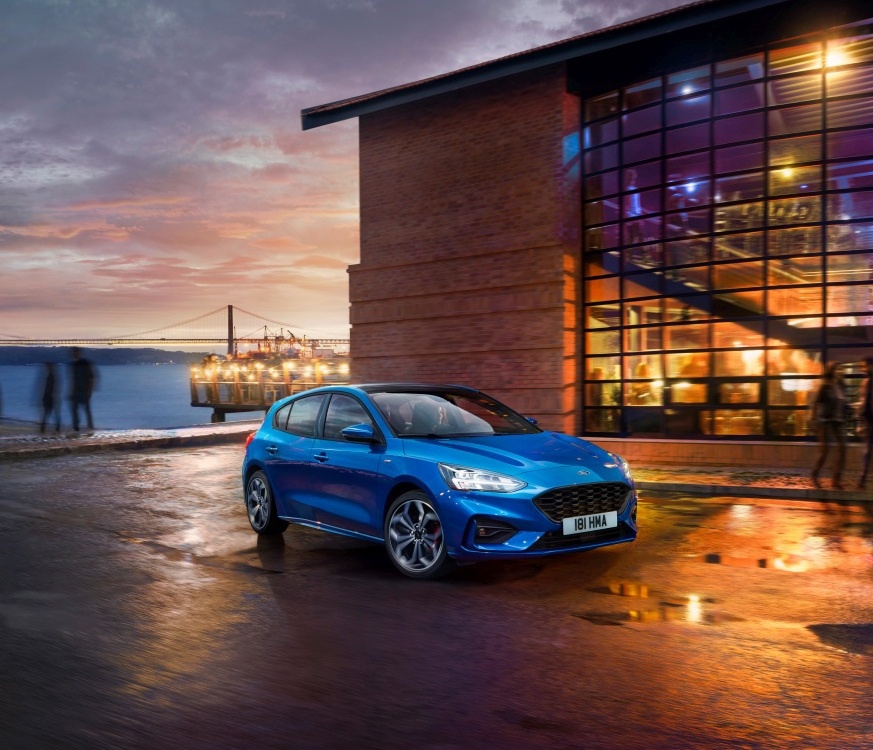
The Ford Focus IV Hatchback 1.0 EcoBoost (125 hp) Automatic represents a significant iteration in Ford’s globally successful Focus line. Introduced in September 2018 and continuing through 2021, this variant occupied a key position within the fourth generation (Mk4) Focus range, built on the C2 platform. It aimed to provide a balance of fuel efficiency, affordability, and practicality for the mainstream European and North American markets. This particular configuration – the 1.0-liter EcoBoost engine paired with an eight-speed automatic transmission – was designed to appeal to buyers prioritizing ease of driving and lower running costs, rather than outright performance.
Technical Specifications
| Brand | Ford |
| Model | Focus |
| Generation | Focus IV Hatchback |
| Type (Engine) | 1.0 EcoBoost (125 Hp) Automatic |
| Start of production | September, 2018 |
| End of production | 2021 |
| Powertrain Architecture | Internal Combustion engine |
| Body type | Hatchback |
| Seats | 5 |
| Doors | 5 |
| Fuel consumption (urban) | 7.1-7.3 l/100 km (33.1 – 32.2 US mpg) |
| Fuel consumption (extra urban) | 4.7-4.9 l/100 km (50 – 48 US mpg) |
| Fuel consumption (combined) | 5.6-5.8 l/100 km (42 – 40.6 US mpg) |
| CO2 emissions | 126-131 g/km |
| Fuel Type | Petrol (Gasoline) |
| Acceleration 0 – 100 km/h | 11.1 sec |
| Acceleration 0 – 62 mph | 11.1 sec |
| Acceleration 0 – 60 mph | 10.5 sec |
| Maximum speed | 195 km/h (121.17 mph) |
| Emission standard | Euro 6 d |
| Weight-to-power ratio | 10.4 kg/Hp |
| Weight-to-torque ratio | 7.6 kg/Nm |
| Power | 125 Hp @ 6000 rpm |
| Torque | 170 Nm @ 1400-4500 rpm (125.39 lb.-ft. @ 1400-4500 rpm) |
| Engine layout | Front, Transverse |
| Engine Model/Code | B7DA |
| Engine displacement | 999 cm3 (60.96 cu. in.) |
| Number of cylinders | 3 |
| Engine configuration | Inline |
| Cylinder Bore | 71.9 mm (2.83 in.) |
| Piston Stroke | 82 mm (3.23 in.) |
| Compression ratio | 10.5:1 |
| Number of valves per cylinder | 4 |
| Fuel injection system | Direct injection |
| Engine aspiration | Turbocharger, Intercooler |
| Engine oil capacity | 4.5 l (4.76 US qt | 3.96 UK qt) |
| Coolant | 5.8 l (6.13 US qt | 5.1 UK qt) |
| Kerb Weight | 1296 kg (2857.19 lbs.) |
| Max. weight | 1905 kg (4199.81 lbs.) |
| Max load | 609 kg (1342.62 lbs.) |
| Trunk (boot) space – minimum | 375 l (13.24 cu. ft.) |
| Trunk (boot) space – maximum | 1354 l (47.82 cu. ft.) |
| Fuel tank capacity | 52 l (13.74 US gal | 11.44 UK gal) |
| Max. roof load | 75 kg (165.35 lbs.) |
| Permitted trailer load with brakes (12%) | 1300 kg (2866.01 lbs.) |
| Permitted trailer load without brakes | 685 kg (1510.17 lbs.) |
| Permitted towbar download | 90 kg (198.42 lbs.) |
| Length | 4378-4387 mm (172.36 – 172.72 in.) |
| Width | 1825 mm (71.85 in.) |
| Width with mirrors folded | 1848 mm (72.76 in.) |
| Width including mirrors | 1979 mm (77.91 in.) |
| Height | 1439-1452 mm (56.65 – 57.17 in.) |
| Wheelbase | 2700 mm (106.3 in.) |
| Front track | 1572 mm (61.89 in.) |
| Rear (Back) track | 1553 mm (61.14 in.) |
| Front overhang | 909 mm (35.79 in.) |
| Rear overhang | 769 mm (30.28 in.) |
| Ride height (ground clearance) | 112-135 mm (4.41 – 5.31 in.) |
| Drag coefficient (Cd) | 0.27 |
| Minimum turning circle (turning diameter) | 11.0 m (36.09 ft.) |
| Drivetrain Architecture | Front wheel drive |
| Number of gears and type of gearbox | 8 gears, automatic transmission |
| Front brakes | Ventilated discs |
| Rear brakes | Disc |
| Assisting systems | ABS (Anti-lock braking system) |
| Steering type | Steering rack and pinion |
| Power steering | Electric Steering |
| Tires size | 195/65 R16; 205/60 R16; 215/50 R17; 235/40 R18 |
| Wheel rims size | 6.5J x 16; 7J x 17; 8J x 18 |
Powertrain & Engine Architecture
The heart of this Focus variant is the Ford 1.0 EcoBoost engine, specifically the B7DA code. This is a three-cylinder, 1.0-liter (999cc) turbocharged gasoline engine. It utilizes direct fuel injection and a single scroll turbocharger with an intercooler to deliver a surprisingly potent 125 horsepower at 6000 rpm and 170 Nm (125 lb-ft) of torque between 1400 and 4500 rpm. The engine features a compression ratio of 10.5:1 and four valves per cylinder. The EcoBoost engine family was designed for efficiency and downsizing, and this 1.0-liter unit is a prime example. Paired with this engine is an eight-speed automatic transmission, replacing the earlier six-speed unit in some markets. This transmission provides smoother shifts and contributes to improved fuel economy compared to a manual gearbox, although at the expense of some driver engagement.
Driving Characteristics
The 1.0 EcoBoost 125 hp automatic Focus delivers adequate, but not exhilarating, performance. Acceleration from 0-60 mph takes around 10.5 seconds, and top speed is 195 km/h (121 mph). The automatic transmission is tuned for fuel efficiency, meaning it will upshift quickly to maintain lower engine speeds. This can sometimes result in the engine feeling strained during overtaking maneuvers or when climbing hills. Compared to the higher-output 1.5 EcoBoost or diesel variants, this version feels noticeably less powerful. However, the readily available low-end torque from the turbocharger makes it perfectly suitable for everyday driving and urban commutes. The gear ratios are optimized for fuel economy, with taller gearing in higher gears.
Equipment & Trim Levels
The 1.0 EcoBoost 125 hp Automatic was typically offered in mid-range trim levels, such as SE, Titanium, and ST-Line. Standard equipment generally included air conditioning, power windows, a touchscreen infotainment system with Bluetooth connectivity, and alloy wheels. Higher trim levels added features like automatic headlights and rain-sensing wipers, a rear-view camera, parking sensors, and upgraded interior upholstery. Optional extras included a panoramic sunroof, navigation system, and advanced driver-assistance systems (ADAS) such as adaptive cruise control and lane-keeping assist.
Chassis & Braking
The Focus IV utilizes a MacPherson strut front suspension and a multi-link rear suspension. The 1.0 EcoBoost Automatic models typically featured a slightly softer suspension setup compared to the sportier ST-Line variants. Braking systems consisted of ventilated discs on the front wheels and solid discs on the rear. ABS (Anti-lock Braking System) was standard. The lighter weight of the 1.0 EcoBoost engine compared to larger engines contributed to a more balanced handling feel, although the electric power steering could feel somewhat artificial to some drivers.
Market Reception & Comparison
The 1.0 EcoBoost Automatic Focus was generally well-received by critics as a practical and economical choice. Fuel economy figures of 5.6-5.8 l/100 km (42-40.6 US mpg) were competitive within its class. However, some reviewers noted the engine could be noisy under hard acceleration and the automatic transmission lacked the responsiveness of a manual gearbox. Compared to the 1.5 EcoBoost, the 1.0 offered lower running costs but less performance. The diesel variants provided even better fuel economy but came with higher maintenance costs and potential emissions concerns.
Legacy
The 1.0 EcoBoost engine has proven to be a relatively reliable unit, although early versions were prone to some issues with timing belt failures. Regular maintenance, including oil changes and timing belt replacement (as per Ford’s recommended schedule), is crucial for long-term reliability. On the used car market, the 1.0 EcoBoost Automatic Focus represents a good value proposition for buyers seeking an affordable and fuel-efficient hatchback. Its compact size, practical interior, and decent equipment levels make it a popular choice for city driving and everyday commuting. While not a performance car, it offers a comfortable and economical driving experience.