
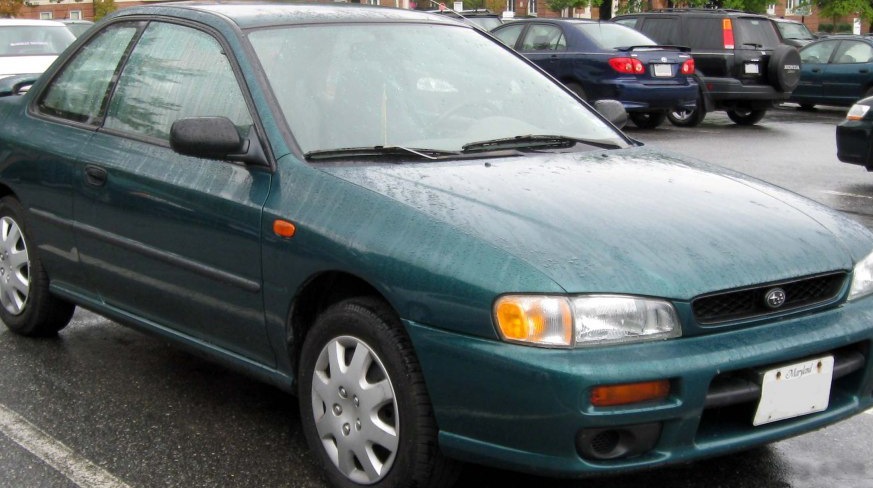
The Subaru Impreza I Coupe (GFC) 2.0, produced between 1998 and 2000, represented a performance-oriented variant within the first generation (GC/GF) Impreza lineup. Positioned as a sporty coupe derivative, it catered to drivers seeking a more engaging experience than the standard sedan or wagon models. This particular version, equipped with a 2.0-liter turbocharged engine producing 280 horsepower and paired with a four-speed automatic transmission, was a relatively rare offering, primarily aimed at markets where coupes held significant appeal. It sat at the top end of the Impreza coupe range, offering a substantial performance upgrade over lower-powered trims.
Technical Specifications
| Brand | Subaru |
| Model | Impreza |
| Generation | Impreza I Coupe (GFC) |
| Type (Engine) | 2.0 (280 Hp) 4WD Automatic |
| Start of production | 1998 |
| End of production | 2000 |
| Powertrain Architecture | Internal Combustion engine |
| Body type | Coupe |
| Seats | 5 |
| Doors | 2 |
| Fuel consumption (urban) | 17 l/100 km (13.8 US mpg, 16.6 UK mpg, 5.9 km/l) |
| Fuel consumption (extra urban) | 10 l/100 km (23.5 US mpg, 28.2 UK mpg, 10 km/l) |
| Fuel Type | Petrol (Gasoline) |
| Maximum speed | 220 km/h (136.7 mph) |
| Weight-to-power ratio | 4.4 kg/Hp, 225.8 Hp/tonne |
| Weight-to-torque ratio | 3.7 kg/Nm, 272.6 Nm/tonne |
| Power | 280 Hp @ 6500 rpm |
| Power per litre | 140.4 Hp/l |
| Torque | 338 Nm @ 5000 rpm (249.3 lb.-ft. @ 5000 rpm) |
| Engine layout | Front, Longitudinal |
| Engine Model/Code | EJ20 T |
| Engine displacement | 1994 cm3 (121.68 cu. in.) |
| Number of cylinders | 4 |
| Engine configuration | Boxer |
| Cylinder Bore | 92 mm (3.62 in.) |
| Piston Stroke | 75 mm (2.95 in.) |
| Compression ratio | 8.1:1 |
| Number of valves per cylinder | 4 |
| Fuel injection system | Multi-port manifold injection |
| Engine aspiration | Turbocharger |
| Valvetrain | OHC |
| Engine oil capacity | 4.5 l (4.76 US qt | 3.96 UK qt) |
| Kerb Weight | 1240 kg (2733.73 lbs.) |
| Trunk (boot) space (minimum) | 314 l (11.09 cu. ft.) |
| Fuel tank capacity | 50 l (13.21 US gal | 11 UK gal) |
| Length | 4350 mm (171.26 in.) |
| Width | 1690 mm (66.54 in.) |
| Height | 1400 mm (55.12 in.) |
| Wheelbase | 2520 mm (99.21 in.) |
| Front track | 1465 mm (57.68 in.) |
| Rear track | 1455 mm (57.28 in.) |
| Drive wheel | All wheel drive (4×4) |
| Number of gears and type of gearbox | 4 gears, automatic transmission |
| Front suspension | Transverse stabilizer |
| Rear suspension | Transverse stabilizer |
| Front brakes | Ventilated discs |
| Rear brakes | Disc |
| Assisting systems | ABS (Anti-lock braking system) |
| Steering type | Steering rack and pinion |
| Power steering | Hydraulic Steering |
| Tires size | 205/50 R16 |
| Wheel rims size | 16 |
Powertrain & Engine Architecture
The heart of the Impreza Coupe 2.0 was the EJ20T engine, a 1994cc, horizontally-opposed (boxer) four-cylinder. This engine was a staple of Subaru’s performance models, known for its smooth operation and inherent balance. The ‘T’ designation indicated the presence of a turbocharger, significantly boosting power output. The EJ20T utilized multi-port fuel injection and a single overhead camshaft (OHC) valvetrain. The turbocharger system employed an intercooler to reduce intake air temperature, improving efficiency and preventing pre-ignition. The four-speed automatic transmission was designed to handle the engine’s torque, but its gear ratios were optimized for a balance between acceleration and fuel economy rather than outright performance. The automatic transmission, while offering convenience, wasn’t as responsive as the available five-speed manual.
Driving Characteristics
The 280 hp output, coupled with the all-wheel-drive system, provided the Impreza Coupe 2.0 with brisk acceleration. However, the automatic transmission did introduce some lag compared to the manual version. The all-wheel-drive system provided excellent traction, particularly in adverse weather conditions, making the car feel planted and secure. The suspension, featuring transverse stabilizers, offered a reasonably firm ride, prioritizing handling over comfort. While not as sharp as dedicated sports cars, the Impreza Coupe 2.0 provided a confident and engaging driving experience. The automatic transmission’s shift points were programmed for smooth transitions, but lacked the driver control offered by a manual gearbox.
Equipment & Trim Levels
The Impreza Coupe 2.0 typically came equipped with features such as power windows, power locks, and air conditioning as standard. Higher trim levels could include options like a sunroof, upgraded audio systems, and leather upholstery. The interior design was functional and driver-focused, with supportive seats and a straightforward dashboard layout. The specific trim level determined the level of interior refinement, with the 2.0 automatic often featuring a more comprehensive equipment list than base models. Alloy wheels were also standard, enhancing the car’s sporty appearance.
Chassis & Braking
The Impreza Coupe utilized a MacPherson strut front suspension and a double-wishbone rear suspension, both incorporating transverse stabilizers to reduce body roll. The braking system consisted of ventilated discs at the front and solid discs at the rear, providing adequate stopping power for the car’s weight and performance. Anti-lock brakes (ABS) were standard, enhancing safety and control during emergency braking situations. The all-wheel-drive system distributed power to all four wheels, improving traction and stability.
Market Reception & Comparison
The Impreza Coupe 2.0 Automatic received generally positive reviews, with critics praising its performance and all-weather capability. However, the automatic transmission was often criticized for detracting from the driving experience compared to the manual version. Fuel economy was also a concern, with the turbocharged engine and all-wheel-drive system resulting in relatively high consumption figures (17 l/100km urban, 10 l/100km extra urban). Compared to the naturally aspirated Impreza models, the 2.0 offered a significant performance boost, but at the cost of increased fuel consumption and potentially higher maintenance costs. Compared to the WRX models, the automatic offered a more relaxed driving experience, but lacked the WRX’s raw performance and aggressive styling.
Legacy
The Subaru Impreza I Coupe 2.0 (GFC) 2.0 Automatic, while not as common as other Impreza variants, has gained a following among enthusiasts. The EJ20T engine is known for its durability and potential for modification. However, like all turbocharged engines, it requires regular maintenance and careful driving to ensure longevity. Today, well-maintained examples are sought after by collectors and Subaru enthusiasts. The car represents a unique blend of performance, practicality, and all-weather capability, making it a desirable classic for those seeking a distinctive and engaging driving experience. Finding parts can be challenging, but a dedicated aftermarket supports the Impreza platform.
