
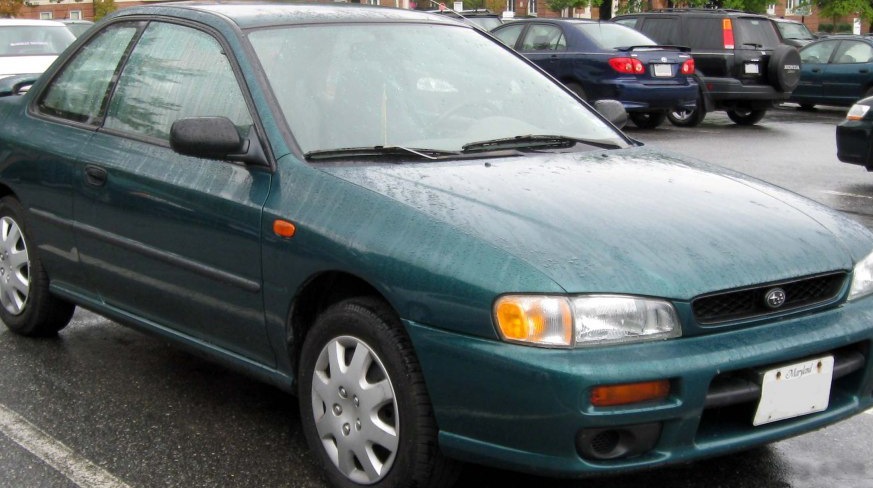
The Subaru Impreza Coupe (GFC), produced between 1996 and 2000, represented a distinct and sporty iteration of Subaru’s popular compact model. Positioned as a more driver-focused alternative to the Impreza sedan and wagon, the coupe offered a unique blend of performance and practicality. The 2.0 Turbo variant, generating 211 horsepower, was the flagship model within the GFC range, appealing to enthusiasts seeking a capable and engaging driving experience. It was built on the GC platform, sharing its underpinnings with other Subaru models of the era, but distinguished itself through its two-door configuration and more aggressive styling.
Technical Specifications
| Brand | Subaru |
| Model | Impreza |
| Generation | Impreza I Coupe (GFC) |
| Type | 2.0 Turbo (211 Hp) 4WD |
| Start of production | 1996 |
| End of production | 2000 |
| Powertrain Architecture | Internal Combustion engine |
| Body type | Coupe |
| Seats | 5 |
| Doors | 2 |
| Fuel Type | Petrol (Gasoline) |
| Power | 211 Hp @ 5600 rpm |
| Power per litre | 105.8 Hp/l |
| Torque | 290 Nm @ 4000 rpm / 213.89 lb.-ft. @ 4000 rpm |
| Engine layout | Front, Longitudinal |
| Engine Model/Code | EJ20 T |
| Engine displacement | 1994 cm3 / 121.68 cu. in. |
| Number of cylinders | 4 |
| Engine configuration | Boxer |
| Cylinder Bore | 92 mm / 3.62 in. |
| Piston Stroke | 75 mm / 2.95 in. |
| Compression ratio | 8:1 |
| Number of valves per cylinder | 4 |
| Fuel injection system | Multi-port manifold injection |
| Engine aspiration | Turbocharger |
| Valvetrain | DOHC |
| Engine oil capacity | 4.5 l / 4.76 US qt | 3.96 UK qt |
| Trunk (boot) space – minimum | 365 l / 12.89 cu. ft. |
| Length | 4350 mm / 171.26 in. |
| Width | 1690 mm / 66.54 in. |
| Height | 1410 mm / 55.51 in. |
| Wheelbase | 2520 mm / 99.21 in. |
| Front track | 1470 mm / 57.87 in. |
| Rear (Back) track | 1450 mm / 57.09 in. |
| Drive wheel | All wheel drive (4×4) |
| Number of gears and type of gearbox | 5 gears, manual transmission |
| Front suspension | Wishbone |
| Rear suspension | Several levers and rods |
| Front brakes | Ventilated discs |
| Rear brakes | Disc |
| Assisting systems | ABS (Anti-lock braking system) |
| Steering type | Steering rack and pinion |
| Power steering | Hydraulic Steering |
Powertrain & Engine Architecture
The heart of the Impreza Coupe 2.0 Turbo was the EJ20T engine, a 1994cc, horizontally-opposed (boxer) four-cylinder. This engine configuration, a Subaru hallmark, provided a low center of gravity, contributing to the car’s balanced handling. The EJ20T featured a single turbocharger with an intercooler, boosting power output to 211 hp at 5600 rpm and 290 Nm (213.89 lb-ft) of torque at 4000 rpm. Fuel delivery was managed by a multi-port fuel injection system. The engine utilized a dual overhead camshaft (DOHC) valvetrain with four valves per cylinder, optimizing airflow for improved performance. The engine’s 8:1 compression ratio was a compromise between performance and reliability when used with the turbocharger. The standard transmission was a robust 5-speed manual, perfectly suited to the engine’s characteristics. The engine block itself was constructed from cast iron, providing durability, while the cylinder head was aluminum alloy to reduce weight. The turbocharger was a Mitsubishi TD04, a common unit for the era, known for its relatively quick spool-up time.
Driving Characteristics
The 2.0 Turbo Coupe offered a significantly more engaging driving experience than lower-spec Impreza models. The turbocharger provided a noticeable surge of power, particularly in the mid-range, making overtaking and spirited driving enjoyable. While not as raw or focused as the later WRX and STI models, the 2.0 Turbo delivered a respectable level of performance for its time. The all-wheel-drive system provided excellent traction, especially in inclement weather, enhancing stability and confidence. The 5-speed manual transmission offered precise shifts and allowed the driver to fully exploit the engine’s powerband. Compared to a hypothetical naturally aspirated Impreza Coupe, the 2.0 Turbo offered substantially more acceleration and a more responsive feel. The gear ratios were tuned for a balance of acceleration and highway cruising, with a relatively short final drive to maximize off-the-line performance. The steering, while hydraulic, wasn’t overly assisted, providing good feedback to the driver.
Equipment & Trim Levels
The Impreza Coupe 2.0 Turbo was generally well-equipped for its era. Standard features typically included power windows, power locks, air conditioning, and a decent audio system. Interior upholstery was usually cloth, though leather options were sometimes available. The dashboard layout was functional and driver-focused, with clear instrumentation. Optional extras could include a sunroof, upgraded audio systems, and alloy wheels. The trim level was generally considered the top-of-the-line for the Impreza Coupe range, offering a more premium experience than the base models. Some models also featured a limited-slip differential in addition to the all-wheel-drive system, further enhancing handling capabilities. The interior plastics, while durable, were typical of Japanese cars of the 1990s – functional but not particularly luxurious.
Chassis & Braking
The Impreza Coupe featured a MacPherson strut front suspension and a multi-link rear suspension, providing a good balance of ride comfort and handling precision. The all-wheel-drive system utilized a viscous limited-slip center differential, distributing power between the front and rear axles as needed. Braking duties were handled by ventilated discs at the front and solid discs at the rear. Anti-lock brakes (ABS) were standard, enhancing safety and control during hard braking. The chassis was relatively lightweight, contributing to the car’s agility. The suspension was tuned to provide a comfortable ride without sacrificing handling performance. Stabilizer bars were fitted to both the front and rear axles to reduce body roll during cornering. The brake calipers were single-piston units, adequate for the car’s weight and performance.
Market Reception & Comparison
The Impreza Coupe 2.0 Turbo was generally well-received by automotive critics. It was praised for its performance, handling, and all-wheel-drive system. Some reviewers noted that the turbocharger could exhibit a degree of lag, but this was a common characteristic of turbo engines of that era. Compared to other coupes in its class, such as the Honda Civic Coupe or Toyota Celica, the Impreza offered a unique combination of performance and all-weather capability. Fuel economy was reasonable for a turbocharged vehicle, but not exceptional, typically achieving around 22-26 mpg in mixed driving. Reliability was generally good, although turbocharger maintenance was a consideration. Owners reported that regular oil changes and careful warm-up procedures were crucial for maintaining turbocharger health.
Legacy
The Subaru Impreza Coupe 2.0 Turbo holds a special place in the hearts of many Subaru enthusiasts. It represented a significant step forward in terms of performance and technology for the Impreza model line. While it has been superseded by newer and more powerful Impreza variants, the GFC Coupe remains a desirable classic car. The EJ20T engine, in particular, is highly regarded for its potential for modification and tuning. Today, well-maintained examples of the 2.0 Turbo Coupe are becoming increasingly collectible, and the powertrain, while aging, is known to be relatively durable with proper maintenance. Finding parts can be a challenge, but a dedicated aftermarket support network exists for Subaru enthusiasts. The car’s enduring appeal lies in its blend of practicality, performance, and the unique character of the Subaru boxer engine and all-wheel-drive system.
