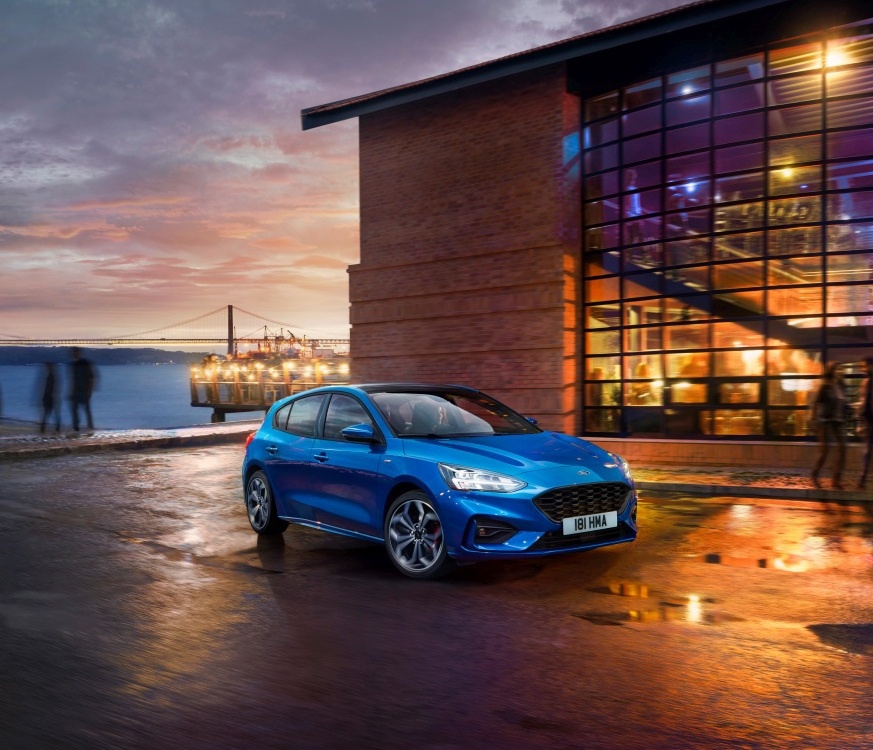
The Ford Focus IV Hatchback 1.5 EcoBlue (95 hp) represents an entry-level diesel offering within the fourth generation of Ford’s globally successful Focus compact car. Introduced in September 2018 and continuing through 2021, this variant was primarily aimed at European markets where diesel engines remained popular due to their fuel efficiency and suitability for long-distance driving. Positioned as the most economical option in the Focus IV range, it catered to buyers prioritizing fuel costs over outright performance. It was built on the C2 platform, also known as the 1HX0/A3 platform, shared with other Ford models and designed for improved rigidity and driving dynamics.
Technical Specifications
| Brand | Ford |
| Model | Focus |
| Generation | Focus IV Hatchback |
| Type (Engine) | 1.5 EcoBlue (95 Hp) |
| Start of production | September, 2018 |
| End of production | 2021 |
| Powertrain Architecture | Internal Combustion engine |
| Body type | Hatchback |
| Seats | 5 |
| Doors | 5 |
| Fuel consumption (urban) | 3.8-3.9 l/100 km (61.9 – 60.3 US mpg) |
| Fuel consumption (extra urban) | 3.3-3.5 l/100 km (71.3 – 67.2 US mpg) |
| Fuel consumption (combined) | 3.5-3.6 l/100 km (67.2 – 65.3 US mpg) |
| CO2 emissions | 91-95 g/km |
| Fuel Type | Diesel |
| Acceleration 0 – 100 km/h | 11.4 sec |
| Acceleration 0 – 62 mph | 11.4 sec |
| Acceleration 0 – 60 mph | 10.8 sec |
| Maximum speed | 183 km/h (113.71 mph) |
| Emission standard | Euro 6 d |
| Weight-to-power ratio | 13.6 kg/Hp |
| Weight-to-torque ratio | 4.3 kg/Nm |
| Power | 95 Hp @ 3600 rpm |
| Torque | 300 Nm @ 1750-2000 rpm (221.27 lb.-ft. @ 1750-2000 rpm) |
| Engine layout | Front, Transverse |
| Engine Model/Code | Z2DA |
| Engine displacement | 1500 cm3 (91.54 cu. in.) |
| Number of cylinders | 4 |
| Engine configuration | Inline |
| Cylinder Bore | 75 mm (2.95 in.) |
| Piston Stroke | 84.8 mm (3.34 in.) |
| Compression ratio | 16.4:1 |
| Number of valves per cylinder | 4 |
| Fuel injection system | Diesel Commonrail |
| Engine aspiration | Turbocharger, Intercooler |
| Valvetrain | DOHC |
| Engine oil capacity | 6.2 l (6.55 US qt | 5.46 UK qt) |
| Coolant | 6.7 l (7.08 US qt | 5.9 UK qt) |
| Kerb Weight | 1288 kg (2839.55 lbs.) |
| Max. weight | 1895 kg (4177.76 lbs.) |
| Max load | 607 kg (1338.21 lbs.) |
| Trunk (boot) space – minimum | 375 l (13.24 cu. ft.) |
| Trunk (boot) space – maximum | 1354 l (47.82 cu. ft.) |
| Fuel tank capacity | 47 l (12.42 US gal | 10.34 UK gal) |
| Max. roof load | 75 kg (165.35 lbs.) |
| Permitted trailer load with brakes (12%) | 1200 kg (2645.55 lbs.) |
| Permitted trailer load without brakes | 680 kg (1499.14 lbs.) |
| Permitted towbar download | 90 kg (198.42 lbs.) |
| Length | 4378 mm (172.36 in.) |
| Width | 1825 mm (71.85 in.) |
| Width with mirrors folded | 1848 mm (72.76 in.) |
| Width including mirrors | 1979 mm (77.91 in.) |
| Height | 1454 mm (57.24 in.) |
| Wheelbase | 2700 mm (106.3 in.) |
| Front track | 1572 mm (61.89 in.) |
| Rear (Back) track | 1553 mm (61.14 in.) |
| Front overhang | 909 mm (35.79 in.) |
| Rear overhang | 769 mm (30.28 in.) |
| Ride height (ground clearance) | 112-135 mm (4.41 – 5.31 in.) |
| Drag coefficient (Cd) | 0.27 |
| Minimum turning circle (turning diameter) | 11.0 m (36.09 ft.) |
| Drivetrain | Front wheel drive |
| Number of gears and type of gearbox | 6 gears, manual transmission |
| Front brakes | Ventilated discs |
| Rear brakes | Disc |
| Tires size | 195/65 R16; 205/60 R16; 215/50 R17; 235/40 R18 |
| Wheel rims size | 6.5J x 16; 7J x 17; 8J x 18 |
Powertrain & Engine Architecture
The 1.5 EcoBlue engine, designated with the code Z2DA, is a member of Ford’s EcoBlue family of diesel engines. This engine utilizes a cast iron block with an aluminum cylinder head, incorporating a turbocharger with an intercooler to enhance power and efficiency. The engine employs a common-rail direct fuel injection system, operating at a high pressure of 2,000 bar, for precise fuel delivery and optimized combustion. The DOHC (Double Overhead Camshaft) valvetrain with four valves per cylinder contributes to improved breathing and overall engine performance. The 95 hp version of the 1.5 EcoBlue produces 300 Nm (221 lb-ft) of torque between 1750 and 2000 rpm, prioritizing low-end grunt for everyday drivability. The engine was typically paired with a six-speed manual transmission, although a six-speed automatic transmission was also available as an option. The automatic transmission was a conventional torque converter type, chosen for its smoothness and reliability rather than outright performance.
Driving Characteristics
The 1.5 EcoBlue 95 hp engine, when coupled with the manual transmission, provided adequate performance for typical commuting and highway driving. Acceleration from 0-60 mph took around 10.8 seconds, which wasn’t particularly brisk but sufficient for most drivers. The engine’s strength lay in its mid-range torque, making overtaking at highway speeds relatively effortless. The automatic transmission, while offering convenience, did slightly diminish performance due to its inherent efficiency losses. Gear changes were generally smooth, but the transmission wasn’t as responsive as some of the more modern dual-clutch transmissions available in other Focus variants. Fuel economy was a key selling point, with combined figures averaging around 65-67 mpg (US), making it an attractive option for high-mileage drivers.
Equipment & Trim Levels
The 1.5 EcoBlue 95 hp variant typically served as the entry point to the Focus IV range. Standard equipment generally included air conditioning, power windows, a basic audio system with Bluetooth connectivity, and a suite of safety features such as ABS, ESP (Electronic Stability Program), and multiple airbags. Higher trim levels, such as Zetec and Titanium, added features like alloy wheels, a touchscreen infotainment system, cruise control, and parking sensors. Interior upholstery was typically cloth, with options for upgraded materials on higher trims. Optional extras included a panoramic sunroof, heated seats, and a premium sound system.
Chassis & Braking
The Focus IV utilized a MacPherson strut front suspension and a multi-link rear suspension, providing a good balance between ride comfort and handling. The 1.5 EcoBlue models typically featured smaller diameter wheels (16 or 17 inches) compared to higher-performance variants, contributing to a slightly softer ride. Braking systems consisted of ventilated discs at the front and solid discs at the rear. ABS (Anti-lock Braking System) and ESP (Electronic Stability Program) were standard, enhancing safety and stability during braking and cornering.
Market Reception & Comparison
The 1.5 EcoBlue 95 hp Focus was generally well-received by critics for its fuel efficiency and affordability. However, it was often criticized for its lack of outright performance compared to higher-powered Focus models, such as those equipped with the 1.0 EcoBoost petrol engine or the 1.5 EcoBlue with 120 hp. Compared to the 1.0 EcoBoost, the diesel offered superior fuel economy and torque, but at the expense of refinement and responsiveness. The 1.5 EcoBlue 120 hp variant provided a noticeable performance upgrade, making it a more appealing option for drivers who prioritized power. Reliability was generally good, although some owners reported issues with the diesel particulate filter (DPF) system, particularly on vehicles primarily used for short journeys.
Legacy
The Ford Focus IV 1.5 EcoBlue 95 hp remains a popular choice in the used car market, particularly for buyers seeking an economical and reliable compact hatchback. The engine has proven to be reasonably durable, although regular maintenance, including timely DPF regeneration, is crucial. The availability of affordable spare parts and a widespread dealer network contribute to its continued appeal. While not the most exciting version of the Focus IV, it represents a practical and fuel-efficient option for everyday driving, and its affordability makes it an attractive proposition for budget-conscious buyers.