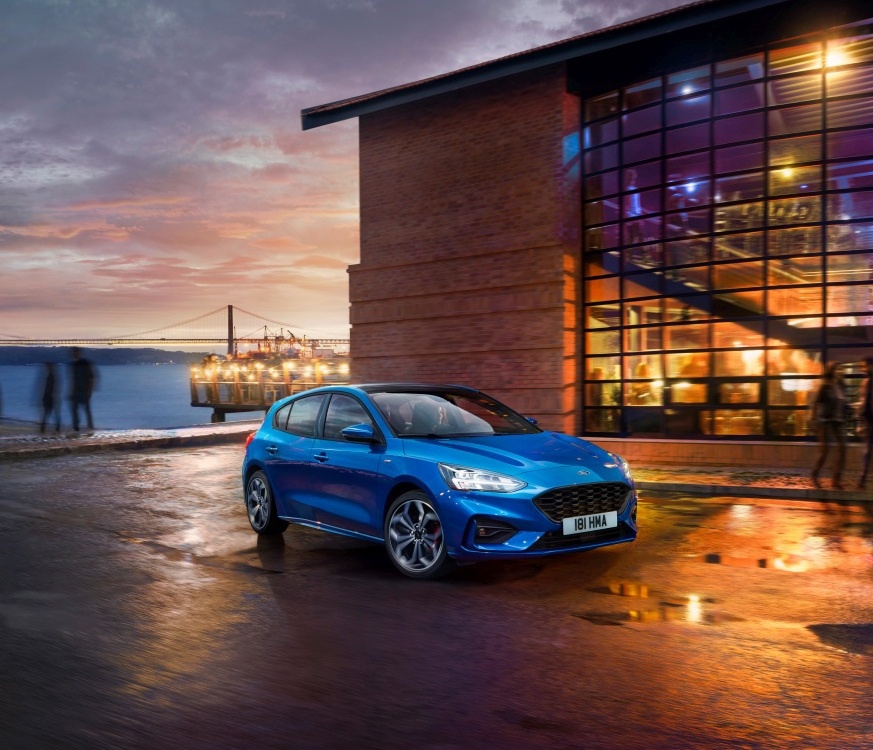
The Ford Focus IV Hatchback 1.5 EcoBoost (182 hp) represents a significant iteration in Ford’s globally successful Focus line, produced from September 2018 through 2021. This variant occupied a mid-to-upper position within the fourth-generation Focus (Mk4) range, offering a balance of performance, fuel efficiency, and modern technology. It was primarily aimed at the European market, where the Focus consistently ranked among the best-selling compact cars. The 1.5 EcoBoost engine was a key component of Ford’s strategy to offer downsized, turbocharged engines delivering improved fuel economy without sacrificing driving enjoyment. This model is part of the larger Focus Mk4 family, built on the C2 platform, which also underpinned the Ford C-Max and Kuga.
Technical Specifications
| Brand | Ford |
| Model | Focus |
| Generation | Focus IV Hatchback |
| Type (Engine) | 1.5 EcoBoost (182 Hp) |
| Start of production | September, 2018 |
| End of production | 2021 |
| Powertrain Architecture | Internal Combustion engine |
| Body type | Hatchback |
| Seats | 5 |
| Doors | 5 |
| Fuel consumption (urban) | 7.0-7.1 l/100 km (33.6 – 33.1 US mpg, 40.4 – 39.8 UK mpg, 14.3 – 14.1 km/l) |
| Fuel consumption (extra urban) | 4.6-4.7 l/100 km (51.1 – 50 US mpg, 61.4 – 60.1 UK mpg, 21.7 – 21.3 km/l) |
| Fuel consumption (combined) | 5.5 l/100 km (42.8 US mpg, 51.4 UK mpg, 18.2 km/l) |
| CO2 emissions | 124-126 g/km |
| Fuel Type | Petrol (Gasoline) |
| Acceleration 0 – 100 km/h | 8.3 sec |
| Acceleration 0 – 62 mph | 8.3 sec |
| Acceleration 0 – 60 mph | 7.9 sec |
| Maximum speed | 222 km/h (137.94 mph) |
| Emission standard | Euro 6 d |
| Weight-to-power ratio | 7.1 kg/Hp, 140.6 Hp/tonne |
| Weight-to-torque ratio | 5.4 kg/Nm, 185.5 Nm/tonne |
| Power | 182 Hp @ 6000 rpm |
| Power per litre | 121.6 Hp/l |
| Torque | 240 Nm @ 1600 rpm (177.01 lb.-ft. @ 1600 rpm) |
| Engine layout | Front, Transverse |
| Engine Model/Code | Y1DA |
| Engine displacement | 1497 cm3 (91.35 cu. in.) |
| Number of cylinders | 3 |
| Engine configuration | Inline |
| Cylinder Bore | 84 mm (3.31 in.) |
| Piston Stroke | 90 mm (3.54 in.) |
| Compression ratio | 11:1 |
| Number of valves per cylinder | 4 |
| Fuel injection system | Direct injection |
| Engine aspiration | Turbocharger, Intercooler |
| Valvetrain | DOHC |
| Engine oil capacity | 5.05 l (5.34 US qt | 4.44 UK qt) |
| Coolant | 5.55 l (5.86 US qt | 4.88 UK qt) |
| Kerb Weight | 1294 kg (2852.78 lbs.) |
| Max. weight | 1890 kg (4166.74 lbs.) |
| Max load | 596 kg (1313.96 lbs.) |
| Trunk (boot) space – minimum | 375 l (13.24 cu. ft.) |
| Trunk (boot) space – maximum | 1354 l (47.82 cu. ft.) |
| Fuel tank capacity | 52 l (13.74 US gal | 11.44 UK gal) |
| Max. roof load | 75 kg (165.35 lbs.) |
| Permitted trailer load with brakes (12%) | 1700 kg (3747.86 lbs.) |
| Permitted trailer load without brakes | 680 kg (1499.14 lbs.) |
| Permitted towbar download | 90 kg (198.42 lbs.) |
| Length | 4378-4387 mm (172.36 – 172.72 in.) |
| Width | 1825 mm (71.85 in.) |
| Width with mirrors folded | 1848 mm (72.76 in.) |
| Width including mirrors | 1979 mm (77.91 in.) |
| Height | 1439-1452 mm (56.65 – 57.17 in.) |
| Wheelbase | 2700 mm (106.3 in.) |
| Front track | 1572 mm (61.89 in.) |
| Rear (Back) track | 1553 mm (61.14 in.) |
| Front overhang | 909 mm (35.79 in.) |
| Rear overhang | 769 mm (30.28 in.) |
| Ride height (ground clearance) | 112-135 mm (4.41 – 5.31 in.) |
| Drag coefficient (Cd) | 0.27 |
| Minimum turning circle (turning diameter) | 11.0 m (36.09 ft.) |
| Drivetrain Architecture | The Internal combustion engine (ICE) drives the front wheels of the vehicle. |
| Drive wheel | Front wheel drive |
| Number of gears and type of gearbox | 6 gears, manual transmission |
| Front brakes | Ventilated discs |
| Rear brakes | Disc |
| Assisting systems | ABS (Anti-lock braking system) |
| Steering type | Steering rack and pinion |
| Power steering | Electric Steering |
| Tires size | 195/65 R16; 205/60 R16; 215/50 R17; 235/40 R18 |
| Wheel rims size | 6.5J x 16; 7J x 17; 8J x 18 |
Powertrain & Engine Architecture
The heart of this Focus variant is the 1.5-liter EcoBoost inline-three cylinder engine, designated with the code Y1DA. This engine utilizes direct fuel injection and a single turbocharger with an intercooler to deliver a respectable 182 horsepower at 6000 rpm and 240 Nm (177 lb-ft) of torque at 1600 rpm. The engine’s aluminum block and cylinder head contribute to its relatively lightweight design. The engine features a dual overhead camshaft (DOHC) valvetrain with four valves per cylinder, optimizing airflow for improved performance. The 6-speed manual transmission was standard, providing precise gear changes and a direct connection to the engine. Ford’s EcoBoost technology focused on combining turbocharging with direct injection and variable valve timing to maximize efficiency and power output from a smaller displacement engine.
Driving Characteristics
The 1.5 EcoBoost 182 hp Focus offered a noticeable step up in performance compared to lower-powered variants. Acceleration from 0-60 mph took approximately 7.9 seconds, making it a competitive performer in its class. The turbocharger provides a good amount of low-end torque, making it responsive in everyday driving situations. However, the three-cylinder engine does exhibit some inherent vibrations, which are noticeable at idle and low speeds. The 6-speed manual transmission is well-matched to the engine’s powerband, allowing drivers to keep the engine in its optimal torque range. Compared to the 1.0 EcoBoost models, the 1.5 offered a more refined driving experience with less need to constantly downshift for overtaking maneuvers.
Equipment & Trim Levels
The 1.5 EcoBoost 182 hp variant typically came equipped as part of the higher trim levels, such as ST-Line or Titanium. Standard features included air conditioning, power windows, power mirrors, a touchscreen infotainment system with Apple CarPlay and Android Auto compatibility, and a suite of safety features including ABS, electronic stability control, and multiple airbags. Optional extras included a panoramic sunroof, leather upholstery, heated front seats, and a premium sound system. The ST-Line trim added sporty styling cues such as a unique body kit, sports suspension, and alloy wheels.
Chassis & Braking
The Focus IV utilized an independent front suspension with MacPherson struts and a multi-link rear suspension. This setup provided a good balance of ride comfort and handling precision. The front brakes were ventilated discs, while the rear brakes were solid discs. The steering was an electric power-assisted rack and pinion system, offering precise and responsive steering feel. Stabilizer bars were fitted to both the front and rear axles to reduce body roll during cornering. The suspension tuning was generally geared towards providing a comfortable ride for everyday driving, while still offering engaging handling characteristics.
Market Reception & Comparison
The 1.5 EcoBoost 182 hp Focus received generally positive reviews from automotive critics. It was praised for its strong performance, good fuel economy, and comfortable ride. However, some critics noted the engine’s inherent vibrations and the slightly firm ride quality of the ST-Line trim. Compared to the 1.0 EcoBoost models, the 1.5 offered a more refined and powerful driving experience, but at a slightly higher price point. The 1.5 EcoBoost was also a more compelling option than the diesel variants for drivers who prioritized performance and refinement over ultimate fuel economy.
Legacy
The 1.5 EcoBoost engine proved to be a reliable and durable powertrain when properly maintained. While some early examples experienced issues with the timing belt tensioner, these were addressed with updated parts. Today, used examples of the 1.5 EcoBoost Focus are readily available and offer a good value proposition for buyers seeking a well-equipped and enjoyable-to-drive compact hatchback. Regular maintenance, including oil changes and timing belt replacements, is crucial to ensure the long-term reliability of this powertrain. The Focus IV, and particularly the 1.5 EcoBoost variant, remains a popular choice in the used car market due to its blend of practicality, performance, and technology.