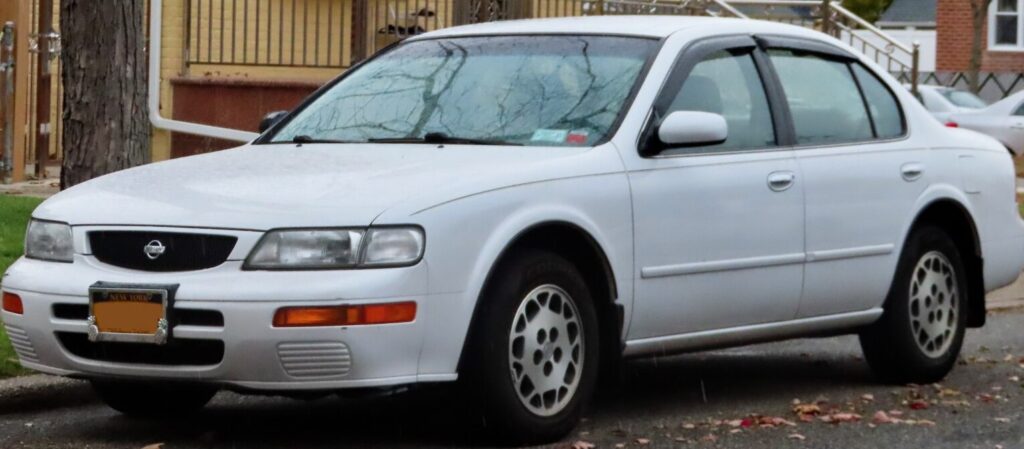
The Nissan Maxima QX IV, produced between 1995 and 2000, marked a significant step forward for Nissan’s flagship sedan. Falling within the A32 chassis generation, this Maxima aimed to deliver a blend of sporty handling and a comfortable ride, appealing to a broad range of drivers in North America, its primary market. The 2.5-liter V6 24V engine, producing 190 horsepower, was a key offering, positioned as a strong performer balancing power and fuel efficiency. While a four-cylinder engine was available in some international markets, the V6 was the dominant choice for American consumers.
Technical Specifications
| Brand | Nissan |
| Model | Maxima |
| Generation | Maxima QX IV (A32) |
| Type (Engine) | 2.5 V6 24V (190 Hp) |
| Start of production | 1995 |
| End of production | 2000 |
| Powertrain Architecture | Internal Combustion engine |
| Body type | Sedan |
| Seats | 5 |
| Doors | 4 |
| Fuel consumption (urban) | 14 l/100 km (16.8 US mpg) |
| Fuel consumption (extra urban) | 8 l/100 km (29.4 US mpg) |
| Fuel Type | Petrol (Gasoline) |
| Maximum speed | 210 km/h (130.49 mph) |
| Weight-to-power ratio | 7.1 kg/Hp |
| Weight-to-torque ratio | 5.7 kg/Nm |
| Power | 190 Hp @ 6400 rpm |
| Power per litre | 76.1 Hp/l |
| Torque | 235 Nm @ 4000 rpm (173.33 lb.-ft. @ 4000 rpm) |
| Engine layout | Front, Transverse |
| Engine displacement | 2496 cm3 (152.32 cu. in.) |
| Number of cylinders | 6 |
| Engine configuration | V-engine |
| Cylinder Bore | 85 mm (3.35 in.) |
| Piston Stroke | 73.3 mm (2.89 in.) |
| Compression ratio | 10:1 |
| Number of valves per cylinder | 4 |
| Fuel injection system | Multi-port manifold injection |
| Engine aspiration | Naturally aspirated engine |
| Valvetrain | DOHC |
| Kerb Weight | 1340 kg (2954.19 lbs.) |
| Trunk (boot) space (minimum) | 440 l (15.54 cu. ft.) |
| Fuel tank capacity | 70 l (18.49 US gal | 15.4 UK gal) |
| Length | 4770 mm (187.8 in.) |
| Width | 1770 mm (69.69 in.) |
| Height | 1420 mm (55.91 in.) |
| Wheelbase | 2700 mm (106.3 in.) |
| Front track | 1520 mm (59.84 in.) |
| Rear (Back) track | 1500 mm (59.06 in.) |
| Drivetrain Architecture | Front wheel drive |
| Drive wheel | Front wheel drive |
| Number of gears and type of gearbox | 5 gears, manual transmission |
| Front suspension | Independent type McPherson |
| Rear suspension | Coil spring |
| Front brakes | Ventilated discs |
| Rear brakes | Disc |
| Assisting systems | ABS (Anti-lock braking system) |
| Steering type | Steering rack and pinion |
| Power steering | Hydraulic Steering |
| Tires size | 205/65 R15 |
Powertrain & Engine Architecture
The core of the 1995-2000 Maxima QX IV was the VK30DE engine, a 2.5-liter V6. This engine featured a 60-degree V-angle, contributing to smoother power delivery and reduced vibrations. The VK30DE utilized multi-port fuel injection, directly injecting fuel into each intake port for optimized combustion. A double overhead camshaft (DOHC) valvetrain with four valves per cylinder enhanced volumetric efficiency, helping to achieve the engine’s 190 horsepower output. The standard transmission was a 5-speed manual, giving drivers direct control over the engine’s power. The engine’s design emphasized reliability and relatively low maintenance costs, making it a practical choice for daily driving. The engine block was constructed from cast iron for durability, while the cylinder heads were aluminum alloy to reduce weight.
Driving Characteristics
The 2.5L V6 paired with the 5-speed manual transmission delivered a responsive driving experience. Acceleration was brisk, with the engine providing ample torque throughout the rev range. The gear ratios were well-matched to the engine’s power curve, enabling confident passing maneuvers and comfortable highway cruising. Compared to later, more powerful Maxima iterations, this version offered a more balanced feel, prioritizing drivability over outright performance. While not as quick as some competitors, the Maxima QX IV provided a comfortable and engaging driving experience. The steering felt precise, and the suspension effectively absorbed bumps while maintaining reasonable body control. The engine sound was refined for a V6, offering a pleasant driving experience.
Equipment & Trim Levels
The Maxima QX IV offered a comprehensive set of standard features, even in its base configuration. These typically included power windows, power locks, air conditioning, and an AM/FM stereo. Higher trim levels added features such as a sunroof, leather upholstery, upgraded sound systems, and alloy wheels. The interior design was functional and comfortable, with a focus on ergonomics. The dashboard layout was straightforward and easy to use, providing drivers with clear access to essential controls. Optional extras included a Bose audio system and automatic climate control. The seats were generally comfortable, providing adequate support for long drives.
Chassis & Braking
The Maxima QX IV employed an independent McPherson strut front suspension and a coil spring rear suspension. This setup provided a comfortable ride while maintaining good handling characteristics. The front brakes were ventilated discs, offering excellent stopping power, while the rear brakes were solid discs. An anti-lock braking system (ABS) was standard, enhancing safety and control during emergency braking situations. The steering was rack-and-pinion with hydraulic power assist, providing precise and responsive steering feel. The chassis was designed to minimize noise, vibration, and harshness (NVH), contributing to a refined driving experience.
Market Reception & Comparison
The 1995-2000 Nissan Maxima QX IV was generally well-received by automotive critics. It was praised for its comfortable ride, spacious interior, and reliable V6 engine. Fuel economy was considered respectable for its class, averaging around 20-25 mpg in mixed driving conditions. Compared to other mid-size sedans of the time, such as the Honda Accord and Toyota Camry, the Maxima offered a more sporty driving experience and a more distinctive styling. However, some critics noted that the interior materials weren’t quite as luxurious as those found in some of its competitors. The Maxima was often seen as a more driver-focused alternative to the more comfort-oriented Camry and Accord.
Legacy
The Nissan Maxima QX IV (A32) 2.5 V6 24V remains a popular choice among used car buyers. The VK30DE engine is known for its durability and reliability, and with proper maintenance, it can provide many years of trouble-free service. Parts availability is generally good, and repair costs are relatively reasonable. The Maxima QX IV represents a sweet spot in the Maxima lineage, offering a blend of comfort, performance, and reliability that continues to appeal to drivers today. It’s often viewed as a well-rounded and dependable vehicle, capable of providing years of reliable transportation. The A32 Maxima helped solidify Nissan’s reputation for building reliable and enjoyable sedans in the North American market.