
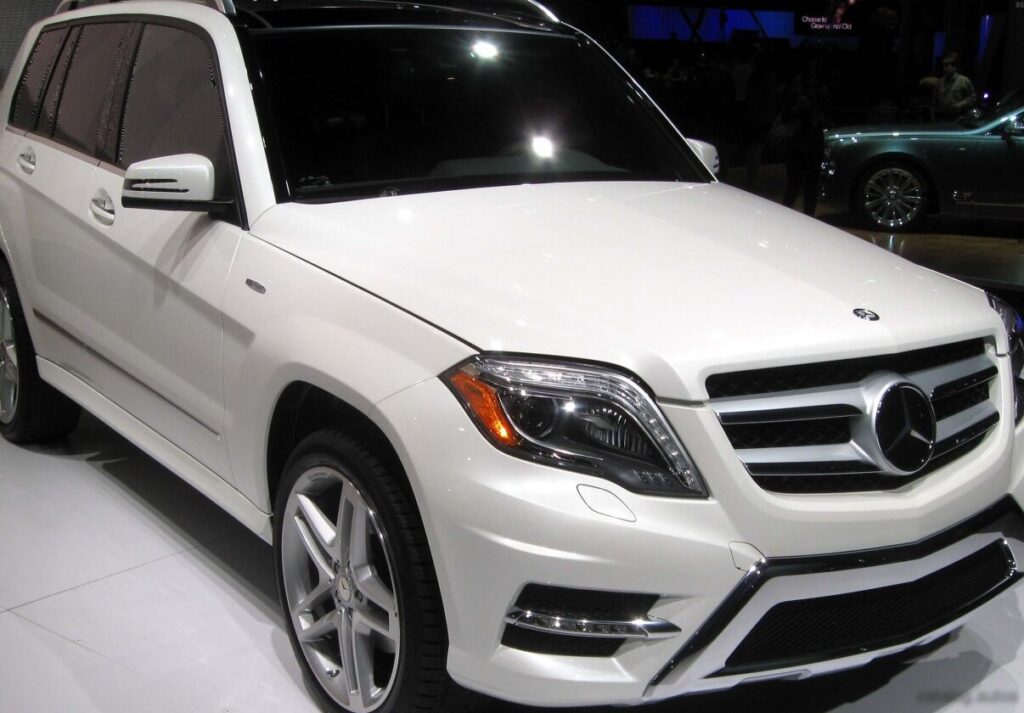
The Mercedes-Benz GLK 200 CDI, produced from June 2012 to June 2015, represents a diesel-powered entry point into the X204 GLK facelift range. Positioned as a more fuel-efficient alternative to its gasoline counterparts, the GLK 200 CDI aimed to appeal to European buyers seeking a compact luxury SUV with lower running costs. This variant combined a 2.1-liter four-cylinder diesel engine with the 7G-TRONIC PLUS seven-speed automatic transmission, offering a balance between practicality and Mercedes-Benz refinement. It was a key model in a segment increasingly focused on diesel efficiency, competing with offerings from BMW and Audi.
Technical Specifications
| Brand | Mercedes-Benz |
| Model | GLK |
| Generation | GLK (X204, facelift 2012) |
| Type (Engine) | GLK 200 CDI (143 Hp) 7G-TRONIC PLUS |
| Start of production | June, 2012 |
| End of production | June, 2015 |
| Powertrain Architecture | Internal Combustion engine |
| Body type | SUV |
| Seats | 5 |
| Doors | 5 |
| Fuel consumption (urban) | 6.4-6.8 l/100 km (36.8 – 34.6 US mpg) |
| Fuel consumption (extra urban) | 5.1-5.5 l/100 km (46.1 – 42.8 US mpg) |
| Fuel consumption (combined) | 5.6-6 l/100 km (42 – 39.2 US mpg) |
| CO2 emissions | 145-156 g/km |
| Fuel Type | Diesel |
| Acceleration 0 – 100 km/h | 10.8 sec |
| Acceleration 0 – 62 mph | 10.8 sec |
| Acceleration 0 – 60 mph | 10.3 sec |
| Maximum speed | 190 km/h (118.06 mph) |
| Emission standard | Euro 5 |
| Weight-to-power ratio | 12.4 kg/Hp |
| Weight-to-torque ratio | 5.1 kg/Nm |
| Power | 143 Hp @ 3200-4600 rpm |
| Torque | 350 Nm @ 1200-2800 rpm (258.15 lb.-ft.) |
| Engine layout | Front, Longitudinal |
| Engine Model/Code | OM 651.916 |
| Engine displacement | 2143 cm3 (130.77 cu. in.) |
| Number of cylinders | 4 |
| Engine configuration | Inline |
| Cylinder Bore | 83 mm (3.27 in.) |
| Piston Stroke | 99 mm (3.9 in.) |
| Compression ratio | 16.2:1 |
| Number of valves per cylinder | 4 |
| Fuel injection system | Diesel Commonrail |
| Engine aspiration | Turbocharger, Intercooler |
| Valvetrain | DOHC |
| Engine oil capacity | 6.5 l (6.87 US qt | 5.72 UK qt) |
| Coolant capacity | 10 l (10.57 US qt | 8.8 UK qt) |
| Kerb Weight | 1770 kg (3902.18 lbs.) |
| Max. weight | 2420 kg (5335.19 lbs.) |
| Max load | 650 kg (1433 lbs.) |
| Trunk (boot) space – minimum | 450 l (15.89 cu. ft.) |
| Trunk (boot) space – maximum | 1550 l (54.74 cu. ft.) |
| Fuel tank capacity | 59 l (15.59 US gal | 12.98 UK gal) |
| Max. roof load | 75 kg (165.35 lbs.) |
| Permitted trailer load (braked) | 2400 kg (5291.09 lbs.) |
| Permitted trailer load (unbraked) | 750 kg (1653.47 lbs.) |
| Permitted towbar download | 80 kg (176.37 lbs.) |
| Length | 4536 mm (178.58 in.) |
| Width | 1840 mm (72.44 in.) |
| Width including mirrors | 2016 mm (79.37 in.) |
| Height | 1669 mm (65.71 in.) |
| Wheelbase | 2755 mm (108.46 in.) |
| Front track | 1574 mm (61.97 in.) |
| Rear track | 1597 mm (62.87 in.) |
| Ride height (ground clearance) | 188 mm (7.4 in.) |
| Drag coefficient (Cd) | 0.34 |
| Minimum turning circle | 11.65 m (38.22 ft.) |
| Front brakes | Ventilated discs, 330 mm |
| Rear brakes | Ventilated discs, 300 mm |
| Gearbox | 7 gears, automatic transmission G-TRONIC PLUS |
Powertrain & Engine Architecture
The GLK 200 CDI was powered by the OM651.916 2.1-liter inline-four cylinder diesel engine. This engine was a mainstay in the Mercedes-Benz lineup, known for its durability and fuel efficiency. It featured a common rail direct injection system, delivering fuel at extremely high pressure for optimized combustion. A turbocharger with an intercooler further enhanced performance, providing increased air intake to the engine. The engine utilized a double overhead camshaft (DOHC) valvetrain with four valves per cylinder, contributing to its efficient operation. The 7G-TRONIC PLUS automatic transmission, a seven-speed unit, was specifically tuned to complement the diesel engine’s torque characteristics. This transmission offered smooth shifts and helped maximize fuel economy. The engine also incorporated a particulate filter to reduce emissions, meeting Euro 5 standards.
Driving Characteristics
The GLK 200 CDI, with its 143 horsepower and 350 Nm (258 lb-ft) of torque, offered adequate performance for everyday driving. Acceleration from 0 to 100 km/h (0-62 mph) took around 10.8 seconds, which was noticeably slower than the more powerful GLK 280 or GLK 350 models. However, the diesel engine’s strong low-end torque made it feel more responsive in typical urban and highway scenarios. The 7G-TRONIC PLUS transmission contributed to a comfortable driving experience, with well-spaced gear ratios. Compared to manual transmission versions of the same engine, the automatic offered convenience but slightly reduced fuel economy. The focus was on relaxed cruising and fuel efficiency rather than sporty performance.
Equipment & Trim Levels
The GLK 200 CDI typically came standard with features such as automatic climate control, a multi-function steering wheel, and a basic audio system. Interior upholstery was generally cloth, with leather options available as an upgrade. Standard safety features included ABS, ESP, and multiple airbags. Optional extras included a sunroof, navigation system, upgraded audio, parking sensors, and heated seats. The trim level could vary depending on the market, but generally, the 200 CDI represented the entry-level offering, with more luxurious features reserved for higher-spec models.
Chassis & Braking
The GLK 200 CDI utilized an independent suspension system, with McPherson struts at the front and a multi-link setup at the rear. This provided a comfortable ride quality, absorbing bumps and irregularities in the road surface effectively. Stabilizer bars were fitted to both axles to reduce body roll during cornering. The braking system consisted of ventilated disc brakes on all four wheels, providing adequate stopping power. ABS (Anti-lock Braking System) was standard, enhancing safety during emergency braking situations.
Market Reception & Comparison
The GLK 200 CDI was generally well-received by critics for its fuel efficiency and comfortable ride. However, some reviewers noted its relatively modest performance compared to its gasoline-powered siblings. In terms of fuel economy, the 200 CDI significantly outperformed the GLK 280 and GLK 350, making it an attractive option for drivers prioritizing running costs. Reliability was generally good, with the OM651 engine proving to be a durable unit. Compared to competitors like the BMW X3 and Audi Q5, the GLK 200 CDI offered a competitive package, particularly in terms of value for money.
Legacy
The GLK 200 CDI, and the OM651 engine it employed, have proven to be relatively reliable in the long term. While diesel engines can be more expensive to maintain due to the complexity of their emissions control systems (such as the particulate filter), the OM651 is generally considered a robust and durable engine. On the used car market, the GLK 200 CDI remains a popular choice for buyers seeking a fuel-efficient and comfortable compact luxury SUV. Its relatively low running costs and proven reliability continue to make it an appealing option, even as newer models have emerged.
