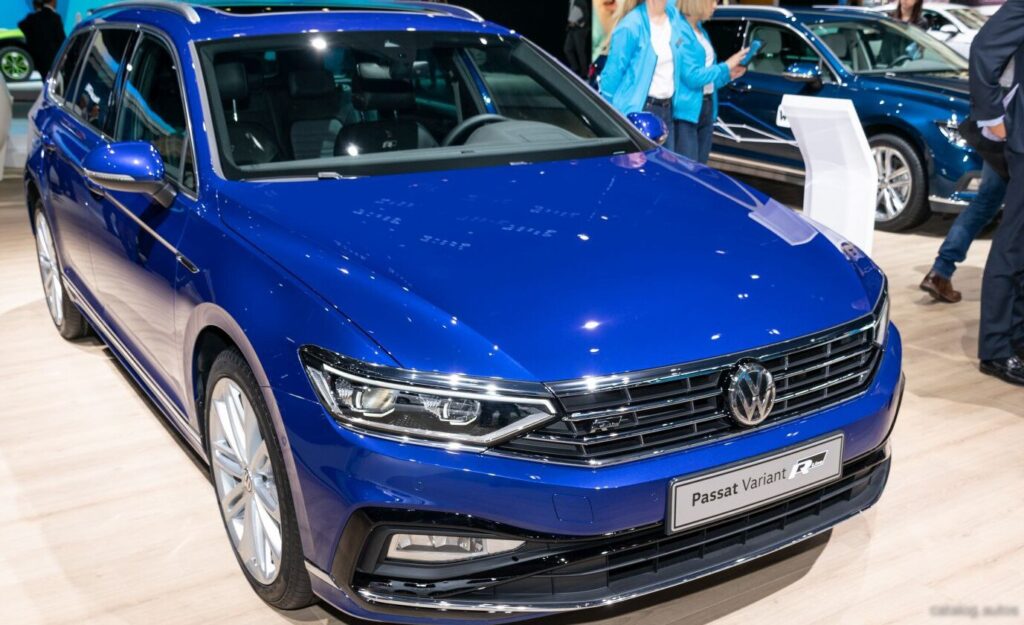
The Volkswagen Passat Variant (B8, facelift 2019) 1.5 TSI (150 hp) ACT represents a significant iteration of Volkswagen’s popular mid-size wagon, produced from September 2019 through 2023. Positioned as a mainstream offering within the B8 Passat range – which underwent a substantial facelift in 2019 – this variant aimed to balance fuel efficiency, practicality, and reasonable performance for the European market. It builds upon the foundation of the B8 platform (shared with the Skoda Superb and SEAT Passat), offering a spacious interior and large cargo capacity characteristic of the Passat nameplate. The “ACT” designation signifies Volkswagen’s Active Cylinder Technology, a fuel-saving feature that deactivates two cylinders under light load conditions. This model primarily targeted families and drivers seeking a versatile and economical vehicle for long-distance travel and everyday use.
Technical Specifications
| Brand | Volkswagen |
| Model | Passat |
| Generation | Passat Variant (B8, facelift 2019) |
| Type (Engine) | 1.5 TSI (150 Hp) ACT |
| Start of production | September, 2019 |
| End of production | 2023 |
| Powertrain Architecture | Internal Combustion engine |
| Body type | Station wagon (estate) |
| Seats | 5 |
| Doors | 5 |
| Fuel consumption at Low speed (WLTP) | 8 l/100 km (29.4 US mpg, 35.3 UK mpg, 12.5 km/l) |
| Fuel consumption at Medium speed (WLTP) | 5.9 l/100 km (39.9 US mpg, 47.9 UK mpg, 16.9 km/l) |
| Fuel consumption at high speed (WLTP) | 5.2 l/100 km (45.2 US mpg, 54.3 UK mpg, 19.2 km/l) |
| Fuel consumption at very high speed (WLTP) | 6.3 l/100 km (37.3 US mpg, 44.8 UK mpg, 15.9 km/l) |
| Combined fuel consumption (WLTP) | 6.1 l/100 km (38.6 US mpg, 46.3 UK mpg, 16.4 km/l) |
| CO2 emissions (WLTP) | 139 g/km |
| Fuel consumption (economy) – urban (NEDC) | 6.7-6.8 l/100 km (35.1 – 34.6 US mpg, 42.2 – 41.5 UK mpg, 14.9 – 14.7 km/l) |
| Fuel consumption (economy) – extra urban (NEDC) | 4.5-4.7 l/100 km (52.3 – 50 US mpg, 62.8 – 60.1 UK mpg, 22.2 – 21.3 km/l) |
| Fuel consumption (economy) – combined (NEDC) | 5.3-5.5 l/100 km (44.4 – 42.8 US mpg, 53.3 – 51.4 UK mpg, 18.9 – 18.2 km/l) |
| CO2 emissions (NEDC) | 120-125 g/km |
| Fuel Type | Petrol (Gasoline) |
| Acceleration 0 – 100 km/h | 8.9 sec |
| Acceleration 0 – 62 mph | 8.9 sec |
| Acceleration 0 – 60 mph | 8.5 sec |
| Maximum speed | 214 km/h (132.97 mph) |
| Emission standard | EURO 6d – TEMP – EVAP – ISC |
| Weight-to-power ratio | 9.3 kg/Hp, 107.9 Hp/tonne |
| Weight-to-torque ratio | 5.6 kg/Nm, 179.9 Nm/tonne |
| Power | 150 Hp @ 5000-6000 rpm |
| Power per litre | 100.1 Hp/l |
| Torque | 250 Nm @ 1500-3500 rpm (184.39 lb.-ft. @ 1500-3500 rpm) |
| Engine layout | Front, Transverse |
| Engine Model/Code | DPCA |
| Engine displacement | 1498 cm3 (91.41 cu. in.) |
| Number of cylinders | 4 |
| Engine configuration | Inline |
| Number of valves per cylinder | 4 |
| Fuel injection system | Direct injection |
| Engine aspiration | Turbocharger, Intercooler |
| Engine oil capacity | 4.3 l (4.54 US qt | 3.78 UK qt) |
| Kerb Weight | 1390 kg (3064.43 lbs.) |
| Max. weight | 2050 kg (4519.48 lbs.) |
| Max load | 660 kg (1455.05 lbs.) |
| Trunk (boot) space – minimum | 650 l (22.95 cu. ft.) |
| Trunk (boot) space – maximum | 1780 l (62.86 cu. ft.) |
| Fuel tank capacity | 66 l (17.44 US gal | 14.52 UK gal) |
| Max. roof load | 100 kg (220.46 lbs.) |
| Permitted trailer load with brakes (8%) | 1900 kg (4188.78 lbs.) |
| Permitted trailer load with brakes (12%) | 1600 kg (3527.4 lbs.) |
| Permitted trailer load without brakes | 730 kg (1609.37 lbs.) |
| Permitted towbar download | 90 kg (198.42 lbs.) |
| Length | 4773-4889 mm (187.91 – 192.48 in.) |
| Width | 1832 mm (72.13 in.) |
| Width including mirrors | 2083 mm (82.01 in.) |
| Height | 1516 mm (59.69 in.) |
| Wheelbase | 2786 mm (109.69 in.) |
| Front track | 1578-1586 mm (62.13 – 62.44 in.) |
| Rear (Back) track | 1564-1572 mm (61.57 – 61.89 in.) |
| Minimum turning circle (turning diameter) | 11.7 m (38.39 ft.) |
| Drivetrain Architecture | The Internal combustion engine (ICE) drives the front wheels of the vehicle. |
| Drive wheel | Front wheel drive |
| Number of gears and type of gearbox | 6 gears, manual transmission |
| Front brakes | Ventilated discs |
| Rear brakes | Disc |
| Assisting systems | ABS (Anti-lock braking system) |
| Steering type | Steering rack and pinion |
| Power steering | Electric Steering |
| Tires size | 215/60 R16; 215/55 R17 |
| Wheel rims size | 6.5 J x 16; 7J x 17 |
Powertrain & Engine Architecture
The heart of this Passat Variant is the 1.5 TSI (DPCA) engine, a turbocharged, direct-injection four-cylinder petrol engine. This engine is part of Volkswagen’s EA211 family, known for its compact design and efficiency. The 1498cc displacement belies its output, thanks to turbocharging and direct injection. The engine utilizes a Miller cycle for improved thermal efficiency, contributing to lower fuel consumption. A key feature is the Active Cylinder Technology (ACT), which shuts down cylinders 2 and 3 during low-load cruising to further reduce fuel consumption. The fuel injection system is a sophisticated direct injection system operating at high pressure, ensuring precise fuel delivery and optimized combustion. The engine’s valvetrain features variable valve timing on both intake and exhaust sides, allowing for optimized performance across the rev range. The engine is transversely mounted at the front of the vehicle. The standard transmission is a 6-speed manual gearbox, designed for smooth shifting and efficient power delivery. A 7-speed DSG (Dual Clutch Gearbox) was also available as an option.
Driving Characteristics
The 150 hp 1.5 TSI engine, paired with the 6-speed manual transmission, provides adequate performance for everyday driving. Acceleration from 0-60 mph takes approximately 8.5 seconds, and top speed is rated at 133 mph. While not a sports-oriented setup, the engine delivers a usable 250 Nm (184 lb-ft) of torque between 1500 and 3500 rpm, providing sufficient pulling power for overtaking and highway cruising. The manual gearbox offers precise shifts, and the gear ratios are well-matched to the engine’s powerband. Compared to the more powerful 2.0 TSI variants, this engine feels less responsive, particularly at higher speeds. However, it excels in fuel economy, making it a practical choice for drivers prioritizing efficiency. The ACT system is largely seamless in operation, though some drivers may notice a slight vibration when cylinders are deactivated.
Equipment & Trim Levels
The 1.5 TSI ACT variant typically came equipped as a mid-range trim level, offering a good balance of features and affordability. Standard equipment generally included air conditioning, a touchscreen infotainment system with Apple CarPlay and Android Auto compatibility, alloy wheels, and a suite of safety features such as ABS, ESC, and multiple airbags. Higher trim levels added features like leather upholstery, a larger touchscreen display, navigation system, adaptive cruise control, and parking sensors. Interior upholstery was typically cloth, with optional leather upgrades available. Dashboard configuration was consistent across the B8 facelift range, featuring a modern and ergonomic design.
Chassis & Braking
The Passat Variant B8 utilizes a MacPherson strut front suspension and a multi-link rear suspension, providing a comfortable and controlled ride. The suspension is tuned for a balance between comfort and handling, making it suitable for both city driving and long-distance journeys. Braking duties are handled by ventilated discs at the front and solid discs at the rear. ABS (Anti-lock Braking System) and ESC (Electronic Stability Control) are standard features, enhancing safety and stability. Stabilizer bars are fitted to both the front and rear axles to reduce body roll during cornering.
Market Reception & Comparison
The 1.5 TSI ACT variant of the Passat Variant was generally well-received by critics for its fuel efficiency and practicality. It offered a compelling alternative to diesel-powered models, particularly in light of increasing scrutiny surrounding diesel emissions. Compared to the 2.0 TSI variants, the 1.5 TSI offered lower running costs but sacrificed some performance. Against competitors like the Ford Mondeo Estate and Skoda Superb Estate, the Passat Variant stood out for its spacious interior, comfortable ride, and refined interior. Fuel economy figures were competitive, typically achieving around 38-46 mpg (WLTP combined cycle).
Legacy
The 1.5 TSI engine has proven to be a relatively reliable powertrain, although some early models experienced issues with particulate filter clogging. Regular maintenance, including oil changes and filter replacements, is crucial for long-term reliability. On the used car market, the 1.5 TSI Passat Variant represents a good value proposition, offering a spacious, practical, and fuel-efficient wagon at a reasonable price. Its blend of comfort, practicality, and efficiency continues to make it a popular choice for families and drivers seeking a versatile vehicle.