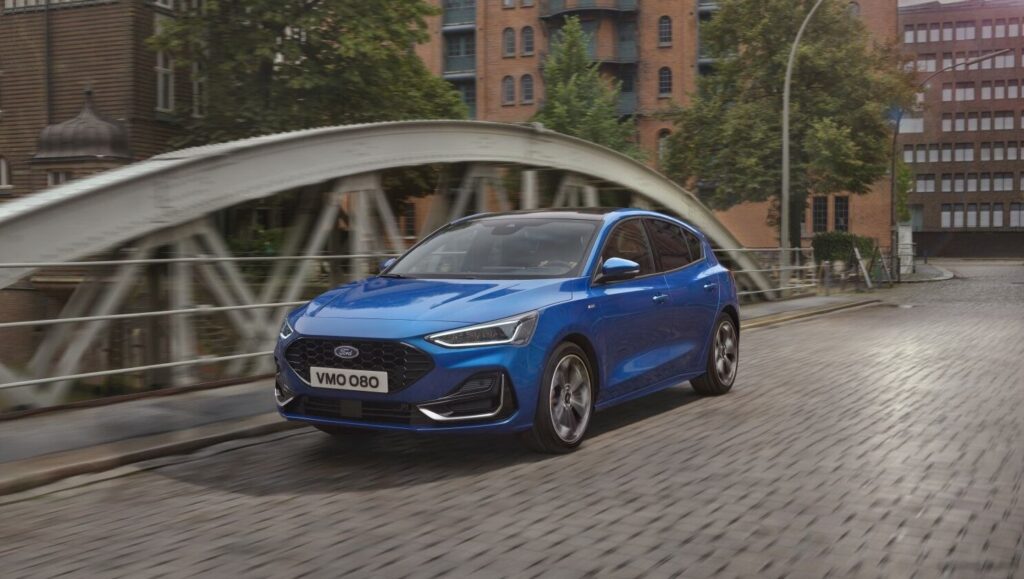
The Ford Focus IV, specifically the facelifted model introduced in 2022, represented a significant evolution of Ford’s globally successful compact hatchback. Among the engine options available, the 1.0 EcoBoost 125 horsepower Mild Hybrid with the PowerShift dual-clutch transmission occupied a key position in the lineup, aimed at buyers prioritizing fuel efficiency and ease of use. Production of this variant began in January 2022 and continued through the model year, fitting into the broader fourth-generation Focus (Mk4) which utilized the C2 platform. This particular configuration was positioned as a mid-range offering, bridging the gap between the base engine options and the more performance-oriented trims.
Technical Specifications
| Brand | Ford |
| Model | Focus |
| Generation | Focus IV Hatchback (facelift 2022) |
| Type (Engine) | 1.0 EcoBoost (125 Hp) Mild Hybrid PowerShift |
| Start of production | January, 2022 |
| Fuel consumption at Low speed (WLTP) | 7-7.8 l/100 km (33.6 – 30.2 US mpg, 40.4 – 36.2 UK mpg, 14.3 – 12.8 km/l) |
| Fuel consumption at Medium speed (WLTP) | 5-6.1 l/100 km (47 – 38.6 US mpg, 56.5 – 46.3 UK mpg, 20 – 16.4 km/l) |
| Fuel consumption at high speed (WLTP) | 4.6-5.6 l/100 km (51.1 – 42 US mpg, 61.4 – 50.4 UK mpg, 21.7 – 17.9 km/l) |
| Fuel consumption at very high speed (WLTP) | 5.6-7.3 l/100 km (42 – 32.2 US mpg, 50.4 – 38.7 UK mpg, 17.9 – 13.7 km/l) |
| Combined fuel consumption (WLTP) | 5.4-6.6 l/100 km (43.6 – 35.6 US mpg, 52.3 – 42.8 UK mpg, 18.5 – 15.2 km/l) |
| CO2 emissions (WLTP) | 122-149 g/km |
| Fuel Type | Petrol (Gasoline) |
| Acceleration 0 – 100 km/h | 10.2 sec |
| Acceleration 0 – 62 mph | 10.2 sec |
| Acceleration 0 – 60 mph | 9.7 sec |
| Maximum speed | 195 km/h (121.17 mph) |
| Emission standard | Euro 6d-ISC-FCM |
| Weight-to-power ratio | 10.5 kg/Hp, 95.3 Hp/tonne |
| Weight-to-torque ratio | 7.7 kg/Nm, 129.6 Nm/tonne |
| Electric motor power | 16 Hp |
| Power | 125 Hp @ 6000 rpm |
| Torque | 170 Nm @ 1400-4500 rpm (125.39 lb.-ft. @ 1400-4500 rpm) |
| Engine displacement | 999 cm3 (60.96 cu. in.) |
| Number of cylinders | 3 |
| Cylinder Bore | 71.9 mm (2.83 in.) |
| Piston Stroke | 82 mm (3.23 in.) |
| Compression ratio | 10.5:1 |
| Engine oil capacity | 4.5 l (4.76 US qt | 3.96 UK qt) |
| Coolant | 5.8 l (6.13 US qt | 5.1 UK qt) |
| Kerb Weight | 1312 kg (2892.46 lbs.) |
| Max. weight | 1910 kg (4210.83 lbs.) |
| Max load | 598 kg (1318.36 lbs.) |
| Trunk (boot) space – minimum | 392 l (13.84 cu. ft.) |
| Trunk (boot) space – maximum | 1354 l (47.82 cu. ft.) |
| Fuel tank capacity | 52 l (13.74 US gal | 11.44 UK gal) |
| Length | 4382-4392 mm (172.52 – 172.91 in.) |
| Width | 1825 mm (71.85 in.) |
| Height | 1459-1471 mm (57.44 – 57.91 in.) |
| Wheelbase | 2700 mm (106.3 in.) |
| Number of gears | 7 |
| Type of gearbox | automatic transmission PowerShift |
Powertrain & Engine Architecture
The heart of this Focus variant is the 1.0 EcoBoost engine, specifically the B7DC code. This is a three-cylinder, turbocharged gasoline engine featuring direct fuel injection and a sophisticated variable valve timing system (Ti-VCT). The addition of mild-hybrid technology involves a small electric motor integrated into the transmission, providing a power assist during acceleration and enabling start-stop functionality for improved fuel economy. The electric motor contributes an additional 16 horsepower. The engine’s compact size and lightweight construction contribute to the Focus’s overall balanced handling. The PowerShift transmission is a 7-speed dual-clutch transmission (DCT) known for its quick shifts and efficiency. It operates similarly to a manual transmission but without the need for a clutch pedal, offering both automatic and manual shifting modes.
Driving Characteristics
The 1.0 EcoBoost 125 hp/PowerShift combination delivers a respectable, if not exhilarating, driving experience. Acceleration from 0-60 mph takes approximately 9.7 seconds, making it suitable for everyday commuting and highway driving. The PowerShift transmission provides smooth and responsive gear changes, although some drivers have noted occasional hesitation at low speeds. The engine’s torque peak of 170 Nm (125 lb-ft) is available from 1400-4500 rpm, providing adequate pulling power for overtaking maneuvers. Compared to the higher-output 1.5 EcoBoost variants, this engine offers less outright performance, but it compensates with superior fuel economy. The mild-hybrid system provides a subtle boost during acceleration, enhancing responsiveness without significantly altering the driving character.
Equipment & Trim Levels
The 1.0 EcoBoost 125 hp Mild Hybrid typically came equipped with a solid set of standard features. These generally included air conditioning, a touchscreen infotainment system with Apple CarPlay and Android Auto compatibility, alloy wheels, and a suite of safety features such as lane-keeping assist and automatic emergency braking. Higher trim levels offered upgrades such as a larger touchscreen, heated seats, a panoramic sunroof, and premium upholstery. Interior materials were generally of good quality for the segment, with a focus on practicality and durability. Optional extras included a premium sound system and parking assistance features.
Chassis & Braking
The Focus IV utilizes an independent McPherson strut suspension at the front and an independent multi-link suspension at the rear, providing a comfortable and controlled ride. The chassis is relatively lightweight, contributing to the car’s agile handling. Braking duties are handled by ventilated discs at the front and solid discs at the rear. Anti-lock braking system (ABS) and electronic stability control (ESC) are standard features, enhancing safety and stability. The steering is electric power-assisted, offering a precise and responsive feel.
Market Reception & Comparison
The 1.0 EcoBoost 125 hp Mild Hybrid PowerShift variant of the Focus was generally well-received by automotive critics. It was praised for its fuel efficiency, comfortable ride, and well-equipped interior. However, some reviewers noted that the engine could feel strained when fully loaded or driving uphill. Compared to the diesel variants, this engine offered lower torque but reduced emissions. Against competitors like the Volkswagen Golf and Opel Astra, the Focus offered a compelling combination of value, practicality, and driving dynamics. Fuel economy figures consistently placed it among the best in its class.
Legacy
The 1.0 EcoBoost engine has proven to be a reliable and durable powertrain, although the PowerShift transmission has been subject to some reported issues in earlier iterations. Proper maintenance, including regular oil changes and transmission fluid services, is crucial for ensuring long-term reliability. In the used car market, this variant of the Focus represents a good value proposition, offering a blend of fuel efficiency, practicality, and modern features. Its continued popularity is a testament to its overall quality and appeal.