
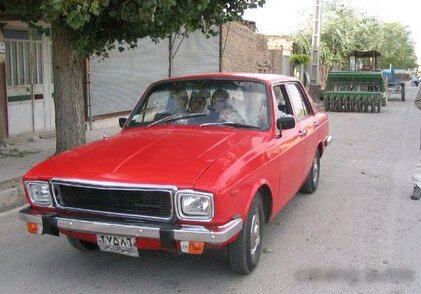
Technical Specifications
| Brand | Paykan |
| Model | Saloon |
| Generation | Saloon |
| Type (Engine) | 1.8 (73 Hp) |
| Start of production | 1989 year |
| End of production | 2005 year |
| Powertrain Architecture | Internal Combustion engine |
| Body type | Sedan |
| Seats | 5 |
| Doors | 4 |
| Fuel consumption (economy) – urban | 11 l/100 km (21.4 US mpg, 25.7 UK mpg, 9.1 km/l) |
| Fuel consumption (economy) – extra urban | 8 l/100 km (29.4 US mpg, 35.3 UK mpg, 12.5 km/l) |
| Fuel Type | Petrol (Gasoline) |
| Maximum speed | 155 km/h (96.31 mph) |
| Weight-to-power ratio | 12.6 kg/Hp, 79.3 Hp/tonne |
| Weight-to-torque ratio | 6.8 kg/Nm, 146.7 Nm/tonne |
| Power | 73 Hp @ 5250 rpm |
| Power per litre | 40.6 Hp/l |
| Torque | 135 Nm @ 2750 rpm (99.57 lb.-ft. @ 2750 rpm) |
| Engine layout | Front, Longitudinal |
| Engine displacement | 1796 cm3 (109.6 cu. in.) |
| Number of cylinders | 4 |
| Engine configuration | Inline |
| Cylinder Bore | 84 mm (3.31 in.) |
| Piston Stroke | 81 mm (3.19 in.) |
| Compression ratio | 8.8:1 |
| Number of valves per cylinder | 2 |
| Fuel injection system | Carburettor |
| Engine aspiration | Naturally aspirated engine |
| Kerb Weight | 920 kg (2028.25 lbs.) |
| Max. weight | 1380 kg (3042.38 lbs.) |
| Max load | 460 kg (1014.13 lbs.) |
| Trunk (boot) space – minimum | 510 l (18.01 cu. ft.) |
| Fuel tank capacity | 45 l (11.89 US gal | 9.9 UK gal) |
| Length | 4270 mm (168.11 in.) |
| Width | 1620 mm (63.78 in.) |
| Height | 1420 mm (55.91 in.) |
| Wheelbase | 2500 mm (98.43 in.) |
| Front track | 1320 mm (51.97 in.) |
| Rear (Back) track | 1320 mm (51.97 in.) |
| Drivetrain Architecture | The Internal combustion engine (ICE) drives the rear wheels of the vehicle. |
| Drive wheel | Rear wheel drive |
| Number of gears and type of gearbox | 4 gears, manual transmission |
| Front suspension | Coil spring |
| Rear suspension | Coil spring |
| Front brakes | Disc |
| Rear brakes | Drum |
| Tires size | 155/85 R13 |
The Paykan Saloon 1.8, producing 73 horsepower, was a mainstay of Iranian automotive production from 1989 to 2005. Derived from the original Paykan, which itself was based on the British Rootes Arrow, the 1.8-liter variant represented a significant portion of the model’s sales during its extended production run. Positioned as a relatively affordable and practical family sedan, it served as a crucial vehicle in Iran’s domestic market, offering a balance between cost, space, and basic transportation. This particular engine and transmission combination was often considered the entry-level offering within the Paykan Saloon range, appealing to budget-conscious buyers.
Powertrain & Engine Architecture
The Paykan Saloon 1.8 utilized a 1796cc inline-four cylinder engine. This engine, while a direct descendant of the Rootes design, underwent modifications and local production over the years. The 73 horsepower output was achieved at 5250 rpm, with a torque figure of 135 Nm (99.57 lb-ft) delivered at 2750 rpm. Critically, this engine employed a carburettor fuel injection system, a technology considered dated by the late 1980s and early 1990s, but one that was relatively simple to maintain and repair within the Iranian context. The engine featured a two-valve per cylinder configuration and a compression ratio of 8.8:1. The engine was mounted longitudinally in the front of the vehicle, driving the rear wheels. The standard transmission was a four-speed manual gearbox, offering a fairly basic driving experience.
Driving Characteristics
The 1.8-liter engine, paired with the four-speed manual transmission, provided adequate, but not exhilarating, performance. Acceleration was modest, and the car felt somewhat underpowered when fully loaded or climbing hills. The gear ratios were spaced to prioritize fuel economy over outright speed. Compared to potential higher-output variants (which were not commonly available), the 1.8 offered a smoother, more relaxed driving experience. The rear-wheel-drive configuration provided a degree of handling balance, but the relatively soft suspension and narrow tires limited cornering grip. The carbureted engine could sometimes exhibit flat spots during acceleration, and throttle response wasn’t particularly sharp.
Equipment & Trim Levels
The Paykan Saloon 1.8 was typically equipped with basic amenities. Standard features generally included cloth upholstery, a simple dashboard layout with analog gauges, and manual windows and door locks. Air conditioning was often an optional extra, as were features like a radio/cassette player. The interior trim was functional rather than luxurious, reflecting the car’s affordable positioning. Higher trim levels, if available, might have included upgraded upholstery, a more comprehensive instrument cluster, and additional comfort features, but the core 1.8 model remained relatively spartan.
Chassis & Braking
The Paykan Saloon utilized a body-on-frame construction, a design characteristic of its origins. The front suspension consisted of coil springs, while the rear also employed coil springs. Braking was accomplished via disc brakes on the front wheels and drum brakes on the rear. The braking system was adequate for normal driving conditions, but lacked the stopping power and modulation of more modern systems. The tires, typically 155/85 R13, were relatively narrow, contributing to a less secure feel on wet or uneven surfaces. Stabilizer bars were often absent or minimal, further contributing to body roll during cornering.
Market Reception & Comparison
The Paykan Saloon 1.8 was widely accepted in the Iranian market due to its affordability, spaciousness, and relative reliability. Critics often pointed to its outdated technology and basic features, but acknowledged its practicality and suitability for the country’s road conditions. Compared to other vehicles available in Iran at the time, the Paykan offered a compelling value proposition. Fuel economy was reasonable for its class, averaging around 11 liters per 100km in urban driving and 8 liters per 100km on the highway. Maintenance costs were relatively low, thanks to the simplicity of the engine and the widespread availability of spare parts.
Legacy
The Paykan Saloon 1.8, and the Paykan platform as a whole, holds a significant place in Iranian automotive history. Despite its age and technological limitations, the powertrain proved to be reasonably durable and capable of withstanding the demands of Iranian roads. In the used car market, these Paykans remain relatively common and affordable, often serving as a first car for young drivers or as a reliable workhorse for those on a tight budget. While no longer in production, the Paykan’s legacy continues through its enduring presence on Iranian roads and its cultural significance as a symbol of a bygone era of domestic automotive manufacturing. The simplicity of the engine and transmission means that skilled mechanics can still keep these vehicles running for years to come, though finding original parts can become increasingly challenging.
