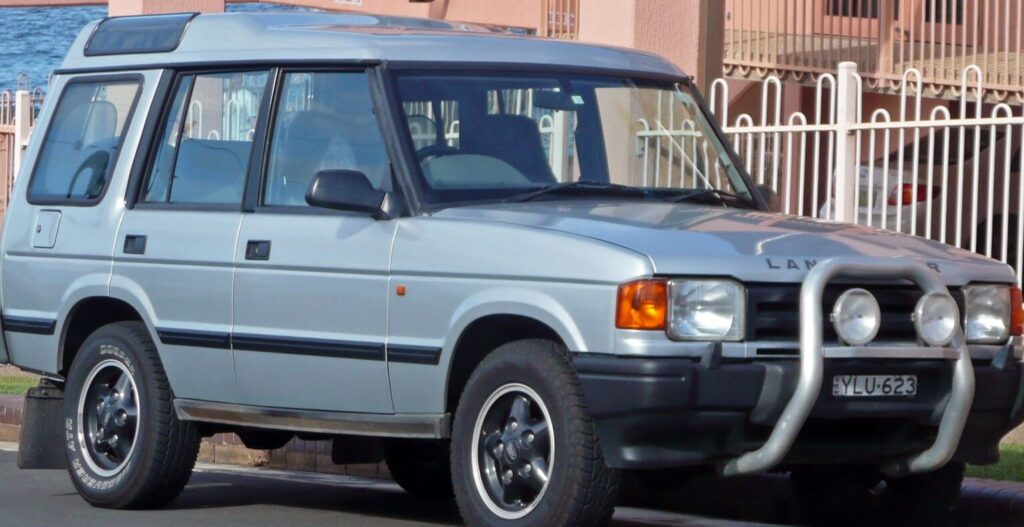
The Land Rover Discovery I 2.0i 4WD, produced between 1995 and 1998, represented an entry point into the iconic Discovery range. Positioned as a more accessible option within the first generation (Series I, internally designated as LJ), it aimed to broaden the appeal of the Discovery beyond the more expensive and powerful six-cylinder models. This variant utilized a 2.0-liter inline four-cylinder engine, paired with a five-speed manual transmission, and offered Land Rover’s renowned four-wheel-drive capability in a relatively affordable package. It was primarily sold in European and select Commonwealth markets, where smaller displacement engines were favored due to taxation and fuel economy considerations.
Technical Specifications
| Brand | Land Rover |
| Model | Discovery |
| Generation | Discovery I |
| Type (Engine) | 2.0i (134 Hp) 4WD |
| Start of production | 1995 |
| End of production | 1998 |
| Powertrain Architecture | Internal Combustion engine |
| Body type | SUV |
| Seats | 5 |
| Doors | 3 |
| Fuel consumption (combined) | 14.9 l/100 km |
| Fuel consumption (US mpg) | 15.8 US mpg |
| Fuel consumption (UK mpg) | 19 UK mpg |
| Fuel consumption (km/l) | 6.7 km/l |
| Fuel Type | Petrol (Gasoline) |
| Acceleration 0 – 100 km/h | 15.3 sec |
| Acceleration 0 – 62 mph | 15.3 sec |
| Acceleration 0 – 60 mph | 14.5 sec |
| Maximum speed | 157 km/h (97.56 mph) |
| Weight-to-power ratio | 15.1 kg/Hp |
| Weight-to-torque ratio | 6.5 kg/Nm |
| Power | 134 Hp @ 4750 rpm |
| Power per litre | 67.2 Hp/l |
| Torque | 312 Nm @ 3100 rpm (230.12 lb.-ft. @ 3100 rpm) |
| Engine layout | Front, Longitudinal |
| Engine Model/Code | T16 |
| Engine displacement | 1994 cm3 (121.68 cu. in.) |
| Number of cylinders | 4 |
| Engine configuration | Inline |
| Number of valves per cylinder | 2 |
| Fuel injection system | Multi-port manifold injection |
| Engine aspiration | Naturally aspirated |
| Engine oil capacity | 4.9 l (5.18 US qt | 4.31 UK qt) |
| Coolant capacity | 10 l (10.57 US qt | 8.8 UK qt) |
| Kerb Weight | 2020 kg (4453.34 lbs) |
| Max. weight | 2720 kg (5996.57 lbs) |
| Max load | 700 kg (1543.24 lbs) |
| Trunk (boot) space – minimum | 1290 l (45.56 cu. ft.) |
| Trunk (boot) space – maximum | 1970 l (69.57 cu. ft.) |
| Fuel tank capacity | 89 l (23.51 US gal | 19.58 UK gal) |
| Length | 4524 mm (178.11 in) |
| Width | 1810 mm (71.26 in) |
| Height | 1960 mm (77.17 in) |
| Wheelbase | 2540 mm (100 in) |
| Front track | 1486 mm (58.5 in) |
| Rear track | 1486 mm (58.5 in) |
| Drive wheel | All wheel drive (4×4) |
| Number of gears | 5 |
| Gearbox type | Manual transmission |
| Front suspension | Rigid axle suspension |
| Rear suspension | Rigid axle suspension |
| Front brakes | Ventilated discs |
| Rear brakes | Disc |
| Assisting systems | ABS (Anti-lock braking system) |
| Power steering | Hydraulic Steering |
| Tires size | 205/80 R16 |
Powertrain & Engine Architecture
The heart of the Discovery I 2.0i is the T16 engine, a 1994cc inline four-cylinder unit. This engine, while not a Land Rover design originally, was sourced from Rover Group’s collaboration with Honda. It features a relatively simple, naturally aspirated configuration with a single overhead camshaft (SOHC) operating two valves per cylinder. Fuel delivery is managed by a multi-port fuel injection system, providing adequate, though not exceptional, performance. The engine’s design prioritized durability and ease of maintenance over outright power. The five-speed manual transmission, a robust unit, provided a direct connection between the engine and the four-wheel-drive system. The transmission’s gear ratios were tuned for off-road capability, sacrificing some on-road acceleration.
Driving Characteristics
The 2.0i Discovery I offered a distinctly different driving experience compared to its V8 and 2.5-liter TDI siblings. Acceleration was noticeably slower, with a 0-60 mph time of around 14.5 seconds. The engine required frequent gear changes to maintain momentum, particularly when laden or tackling inclines. However, the lower weight of the four-cylinder engine, compared to the V8, contributed to improved handling and a more nimble feel. The four-wheel-drive system, a key Land Rover attribute, provided excellent traction in challenging conditions. The manual transmission allowed for greater driver control, especially when navigating difficult terrain. It wasn’t a fast car, but it was capable and surprisingly comfortable for long journeys.
Equipment & Trim Levels
The 2.0i trim typically represented the base level of the Discovery I range. Standard equipment included power steering, central locking, and basic instrumentation. Interior upholstery was generally cloth, with a functional, rather than luxurious, design. Optional extras, such as air conditioning, sunroof, and upgraded audio systems, were available, but often specified at extra cost. The dashboard layout was typical of the early 1990s, with a clear and straightforward design. The emphasis was on practicality and durability, rather than opulent features.
Chassis & Braking
The Discovery I utilized a body-on-frame construction, providing a robust and durable platform. Suspension consisted of a rigid axle setup at both the front and rear, offering excellent articulation for off-road use. Front brakes were ventilated discs, providing adequate stopping power, while rear brakes were solid discs. ABS (Anti-lock Braking System) was often included as standard, enhancing safety. The chassis was designed to handle the stresses of both on-road and off-road driving, making it a versatile vehicle.
Market Reception & Comparison
The 2.0i Discovery I was generally well-received as an affordable entry point into the Discovery range. Critics acknowledged its off-road capability and practicality, but often noted its lack of outright performance. Compared to the V8 models, the 2.0i offered significantly lower fuel consumption, making it a more economical choice for everyday use. Against the 2.5 TDI, it offered a smoother, quieter driving experience, but lacked the diesel’s low-end torque. It appealed to buyers who prioritized affordability and fuel economy over outright performance.
Legacy
The Discovery I 2.0i, while not the most sought-after variant today, holds a place in Land Rover history as a crucial model that broadened the appeal of the Discovery. The T16 engine, while not known for its longevity in some applications, proved reasonably reliable in the Discovery, provided it was properly maintained. Today, these vehicles are increasingly sought after by enthusiasts and collectors, particularly those looking for a classic Land Rover experience at a relatively affordable price. Parts availability is generally good, although some specific components may be becoming increasingly scarce. The 2.0i Discovery I remains a testament to Land Rover’s commitment to building capable and versatile vehicles.