
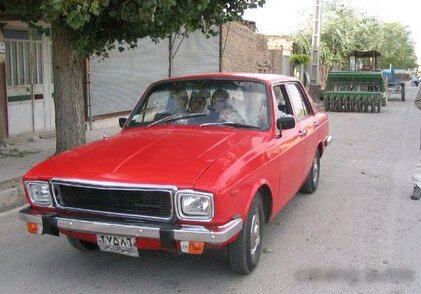
The Paykan Saloon 1.8 (96 hp) represents a significant iteration of Iran’s domestically produced vehicle, built from 2001 to 2010. Derived from the original Paykan, which itself was based on the British Rootes Arrow, the Saloon 1.8 aimed to modernize the aging platform with a more powerful engine and updated features. This variant occupied a mid-range position within the Paykan lineup, offering a balance between affordability and performance, appealing to a broad segment of the Iranian automotive market. It was a crucial model for Khodro, Iran’s largest vehicle manufacturer, during a period of increasing demand for locally produced automobiles.
Technical Specifications
| Brand | Paykan |
| Model | Saloon |
| Generation | Saloon |
| Type (Engine) | 1.8 (96 Hp) |
| Start of production | 2001 year |
| End of production | 2010 year |
| Powertrain Architecture | Internal Combustion engine |
| Body type | Sedan |
| Seats | 5 |
| Doors | 4 |
| Fuel consumption (economy) – urban | 10 l/100 km (23.5 US mpg, 28.2 UK mpg, 10 km/l) |
| Fuel consumption (economy) – extra urban | 8 l/100 km (29.4 US mpg, 35.3 UK mpg, 12.5 km/l) |
| Fuel Type | Petrol (Gasoline) |
| Acceleration 0 – 100 km/h | 15 sec |
| Acceleration 0 – 62 mph | 15 sec |
| Acceleration 0 – 60 mph | 14.3 sec |
| Maximum speed | 175 km/h (108.74 mph) |
| Weight-to-power ratio | 9.5 kg/Hp, 104.9 Hp/tonne |
| Weight-to-torque ratio | 6.1 kg/Nm, 163.9 Nm/tonne |
| Power | 96 Hp @ 6000 rpm |
| Power per litre | 54.5 Hp/l |
| Torque | 150 Nm @ 2750 rpm (110.63 lb.-ft. @ 2750 rpm) |
| Engine layout | Front, Transverse |
| Engine Model/Code | XU 7 JPK |
| Engine displacement | 1761 cm3 (107.46 cu. in.) |
| Number of cylinders | 4 |
| Engine configuration | Inline |
| Cylinder Bore | 83 mm (3.27 in.) |
| Piston Stroke | 81.4 mm (3.2 in.) |
| Compression ratio | 8.5:1 |
| Number of valves per cylinder | 2 |
| Fuel injection system | Multi-port manifold injection |
| Engine aspiration | Naturally aspirated engine |
| Valvetrain | SOHC |
| Kerb Weight | 915 kg (2017.23 lbs.) |
| Max. weight | 1380 kg (3042.38 lbs.) |
| Max load | 465 kg (1025.15 lbs.) |
| Fuel tank capacity | 70 l (18.49 US gal | 15.4 UK gal) |
| Length | 4502 mm (177.24 in.) |
| Width | 1735 mm (68.31 in.) |
| Height | 1462 mm (57.56 in.) |
| Wheelbase | 2671 mm (105.16 in.) |
| Front track | 1448 mm (57.01 in.) |
| Ride height (ground clearance) | 123 mm (4.84 in.) |
| Minimum turning circle (turning diameter) | 14.40 m (47.24 ft.) |
| Drivetrain Architecture | The Internal combustion engine (ICE) drives the front wheels of the vehicle. |
| Drive wheel | Front wheel drive |
| Number of gears and type of gearbox | 5 gears, manual transmission |
| Front suspension | Coil spring |
| Rear suspension | Coil spring |
| Front brakes | Ventilated discs |
| Rear brakes | Disc |
| Assisting systems | ABS (Anti-lock braking system) |
| Steering type | Steering rack and pinion |
| Tires size | 175/70 R14 |
| Wheel rims size | 14 |
INTRODUCTION
The Paykan Saloon 1.8 (96 hp) was a key model in the final years of Paykan production, representing an attempt to modernize a design that had remained largely unchanged for decades. Building upon the foundation of the original Paykan, which debuted in 1967, the Saloon 1.8 incorporated the XU7 JPK engine, a Peugeot-derived 1.8-liter inline-four. This engine provided a noticeable power increase over earlier Paykan models, improving both acceleration and highway cruising ability. The Saloon 1.8 aimed to appeal to families and commuters seeking a reliable and affordable vehicle, and it became a common sight on Iranian roads throughout the 2000s.
Powertrain & Engine Architecture
The heart of the Paykan Saloon 1.8 is the XU7 JPK engine, a 1761cc inline-four cylinder unit. This engine is a licensed version of the Peugeot XU7 engine, and it features a single overhead camshaft (SOHC) valvetrain with two valves per cylinder. The engine utilizes multi-port fuel injection, a significant upgrade from the carbureted systems found in earlier Paykan models. This improved fuel delivery contributed to better fuel efficiency and reduced emissions. The XU7 JPK produces 96 horsepower at 6000 rpm and 150 Nm (110.63 lb-ft) of torque at 2750 rpm. The engine is transversely mounted in the front of the vehicle, driving the front wheels. The standard transmission was a five-speed manual, although an automatic transmission was also offered, albeit less commonly. The automatic transmission, while providing convenience, generally resulted in slightly reduced acceleration and fuel economy.
Driving Characteristics
The Paykan Saloon 1.8, with its 96 hp and five-speed manual transmission, offered a modest but adequate driving experience. Acceleration to 100 km/h (62 mph) took approximately 15 seconds, which was competitive with other vehicles in its price range in the Iranian market. The engine provided sufficient power for everyday driving, including navigating city streets and climbing moderate hills. The five-speed gearbox allowed drivers to keep the engine in its optimal power band, improving responsiveness. Compared to the lower-powered Paykan variants, the 1.8 offered a more relaxed highway cruising experience. However, it wasn’t a particularly sporty vehicle; the focus was on practicality and affordability. The automatic transmission version, while offering ease of use, noticeably dulled acceleration and increased fuel consumption. The suspension, while simple, provided a reasonably comfortable ride, absorbing bumps and imperfections in the road surface.
Equipment & Trim Levels
The Paykan Saloon 1.8 typically came equipped with basic but functional features. Standard equipment included cloth upholstery, a simple dashboard layout, and manual windows and door locks. Air conditioning was often an optional extra, as were power steering and a radio/cassette player. Higher trim levels, though not extensively differentiated, might include upgraded interior materials and additional convenience features. The interior design was functional rather than luxurious, reflecting the vehicle’s focus on affordability. Safety features were limited, typically consisting of seatbelts and, in later models, an anti-lock braking system (ABS).
Chassis & Braking
The Paykan Saloon 1.8 utilized a body-on-frame construction, a design characteristic of the original Rootes Arrow platform. The suspension consisted of coil springs at all four corners. The front suspension featured independent coil springs, while the rear suspension employed a solid axle with coil springs. Braking duties were handled by ventilated discs at the front and discs at the rear. The inclusion of ABS in later models improved braking performance and safety. The steering system was a rack and pinion setup, providing reasonably precise steering control. The tires were typically 175/70 R14, offering a balance between ride comfort and handling.
Market Reception & Comparison
The Paykan Saloon 1.8 was generally well-received in the Iranian market, offering a significant improvement in performance over earlier Paykan models. Critics praised the increased power and improved fuel efficiency of the 1.8-liter engine. Compared to other vehicles in its price range, the Paykan 1.8 offered a spacious interior and a relatively comfortable ride. However, it was often criticized for its outdated design and limited safety features. Compared to the lower-powered Paykan variants, the 1.8 commanded a higher price but offered a more refined driving experience. The automatic transmission version was less popular due to its reduced performance and higher fuel consumption. The Paykan 1.8 competed with other locally produced vehicles, such as the Samand, as well as imported models.
Legacy
The Paykan Saloon 1.8 represents a significant chapter in Iranian automotive history. While production ceased in 2010, the Paykan remains a common sight on Iranian roads, testament to its durability and affordability. The XU7 JPK engine proved to be a reliable powerplant, and many Paykan 1.8 models continue to operate with minimal maintenance. In the used car market, the Paykan 1.8 is valued for its simplicity, affordability, and readily available spare parts. Although it lacks the modern features and safety equipment of contemporary vehicles, the Paykan Saloon 1.8 holds a nostalgic appeal for many Iranians, representing a bygone era of domestic automotive production.
