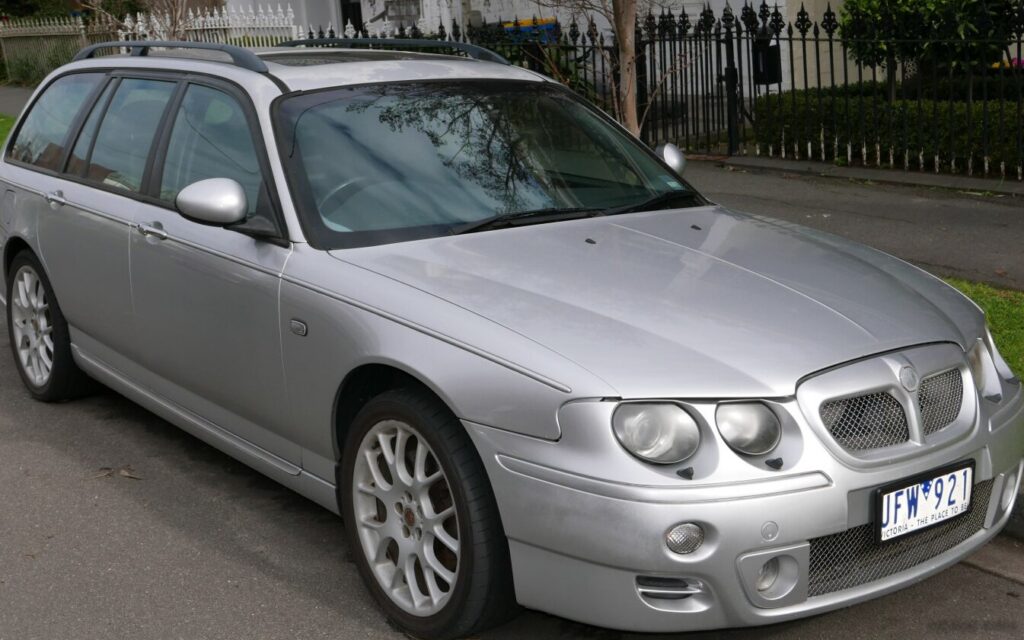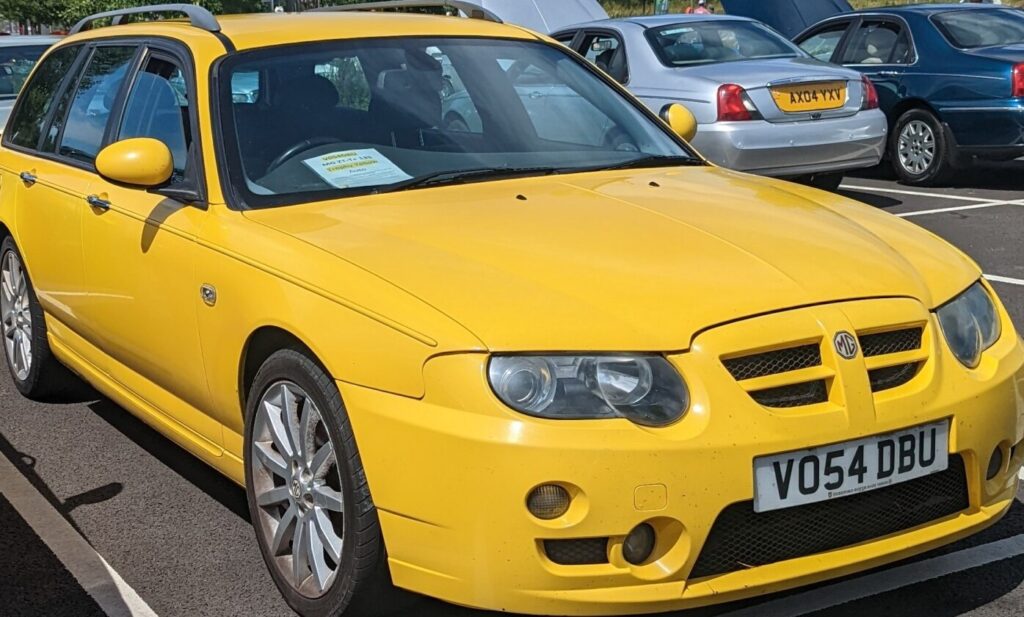
The MG ZT-T 2.0 CDTi Automatic, produced during the 2004-2005 model years, represents a somewhat niche offering within the final generation of MG’s ZT range. The “T” designation signifies the estate (station wagon) body style, and this particular variant combined a 2.0-liter common rail diesel engine producing 116 horsepower with a five-speed automatic transmission. Positioned as a practical, if not overtly sporty, option, it aimed to provide a balance of fuel efficiency and usability for family buyers. The ZT-T facelift, introduced in 2004, brought subtle styling revisions and refinements to the original design, building upon the foundation of the Rover 75 platform – itself a descendant of the Honda Accord. This model was primarily sold in the UK and European markets, representing a final attempt by MG to establish itself as a viable automotive brand.
Technical Specifications
| Brand | MG |
| Model | ZT |
| Generation | ZT-T (facelift 2004) |
| Type (Engine) | 2.0 CDTi (116 Hp) Automatic |
| Start of production | 2004 |
| End of production | 2005 |
| Powertrain Architecture | Internal Combustion engine |
| Body type | Station wagon (estate) |
| Seats | 5 |
| Doors | 5 |
| Fuel consumption (urban) | 10 l/100 km (23.5 US mpg, 28.2 UK mpg, 10 km/l) |
| Fuel consumption (extra urban) | 5.2 l/100 km (45.2 US mpg, 54.3 UK mpg, 19.2 km/l) |
| Fuel consumption (combined) | 6.9 l/100 km (34.1 US mpg, 40.9 UK mpg, 14.5 km/l) |
| CO2 emissions | 190 g/km |
| Fuel Type | Diesel |
| Acceleration 0 – 60 mph | 12.6 sec |
| Maximum speed | 180 km/h (111.85 mph) |
| Emission standard | Euro 3 |
| Weight-to-power ratio | 14 kg/Hp, 71.6 Hp/tonne |
| Weight-to-torque ratio | 6.2 kg/Nm, 160.5 Nm/tonne |
| Power | 116 Hp @ 4000 rpm |
| Power per litre | 59.5 Hp/l |
| Torque | 260 Nm @ 2000 rpm (191.77 lb.-ft. @ 2000 rpm) |
| Maximum engine speed | 4900 rpm |
| Engine layout | Front, Transverse |
| Engine Model/Code | M47R / 204D2 |
| Engine displacement | 1951 cm3 (119.06 cu. in.) |
| Number of cylinders | 4 |
| Engine configuration | Inline |
| Cylinder Bore | 84 mm (3.31 in.) |
| Piston Stroke | 88 mm (3.46 in.) |
| Compression ratio | 18:1 |
| Number of valves per cylinder | 4 |
| Fuel injection system | Diesel Commonrail |
| Engine aspiration | Turbocharger, Intercooler |
| Valvetrain | DOHC |
| Engine oil capacity | 6.8 l (7.19 US qt | 5.98 UK qt) |
| Coolant | 8.2 l (8.66 US qt | 7.21 UK qt) |
| Kerb Weight | 1620-1705 kg (3571.49 – 3758.88 lbs.) |
| Max. weight | 2120 kg (4673.8 lbs.) |
| Max load | 415-500 kg (914.92 – 1102.31 lbs.) |
| Trunk (boot) space – minimum | 400 l (14.13 cu. ft.) |
| Trunk (boot) space – maximum | 1222 l (43.15 cu. ft.) |
| Fuel tank capacity | 65 l (17.17 US gal | 14.3 UK gal) |
| Max. roof load | 100 kg (220.46 lbs.) |
| Permitted trailer load with brakes (12%) | 1600 kg (3527.4 lbs.) |
| Permitted trailer load without brakes | 750 kg (1653.47 lbs.) |
| Permitted towbar download | 100 kg (220.46 lbs.) |
| Length | 4791 mm (188.62 in.) |
| Width | 1778 mm (70 in.) |
| Height | 1428 mm (56.22 in.) |
| Wheelbase | 2746 mm (108.11 in.) |
| Drivetrain Architecture | The Internal combustion engine (ICE) drives the front wheels of the vehicle. |
| Drive wheel | Front wheel drive |
| Number of gears and type of gearbox | 5 gears, automatic transmission |
| Front suspension | Independent, type McPherson with coil spring and anti-roll bar |
| Rear suspension | Independent multi-link spring suspension with stabilizer |
| Front brakes | Ventilated discs |
| Rear brakes | Disc |
| Assisting systems | ABS (Anti-lock braking system) |
| Steering type | Steering rack and pinion |
| Power steering | Hydraulic Steering |
| Tires size | 225/45 R18 |
| Wheel rims size | 7.5J x 18 |
Powertrain & Engine Architecture
The heart of the ZT-T 2.0 CDTi Automatic is the M47R engine, a 1951cc four-cylinder diesel. This engine, developed by BMW (and later licensed to MG), utilizes common rail direct injection, a technology that significantly improved fuel efficiency and reduced noise compared to earlier diesel designs. The 204D2 engine code specifically denotes the variant fitted to the ZT-T. A turbocharger with an intercooler is employed to boost power output, delivering 116 horsepower at 4000 rpm and a more substantial 260 Nm (191.77 lb-ft) of torque at just 2000 rpm. The five-speed automatic transmission, while providing convenience, was not known for its particularly rapid shifts. It was a conventional hydraulic automatic, lacking the responsiveness of more modern electronically controlled units. The engine’s DOHC (Double Overhead Camshaft) valvetrain and four valves per cylinder contribute to its breathing efficiency.
Driving Characteristics
The 2.0 CDTi Automatic ZT-T offered a comfortable, if not exhilarating, driving experience. The automatic transmission, while smooth in normal driving, could feel somewhat sluggish when attempting quicker overtakes or climbing hills. The relatively low horsepower output meant acceleration from 0-60 mph took a leisurely 12.6 seconds. However, the engine’s strong low-end torque made it perfectly adequate for everyday driving and hauling loads. Compared to the more powerful V6 variants, the 2.0 CDTi Automatic prioritized fuel economy and practicality over outright performance. Manual transmission versions of the 2.0 CDTi felt more responsive, allowing the driver to better utilize the available power. The gear ratios in the automatic were geared towards economy, rather than maximizing acceleration.
Equipment & Trim Levels
The ZT-T 2.0 CDTi Automatic typically came equipped with a reasonable level of standard features. This included air conditioning, electric front windows, central locking, and an RDS stereo. Interior upholstery was generally cloth, although leather options were available at extra cost. Dashboard trim was typically wood or metallic effect. Optional extras included alloy wheels, a sunroof, and upgraded audio systems. The trim level often dictated the level of equipment, with higher-spec models offering more luxurious appointments.
Chassis & Braking
The ZT-T’s chassis utilized independent suspension all around – McPherson struts at the front and a multi-link setup at the rear. This provided a reasonably comfortable ride, although the car’s weight (1620-1705 kg) could be felt in corners. Front brakes were ventilated discs, while the rear brakes were solid discs. ABS (Anti-lock Braking System) was standard. Stabilizer bars were fitted front and rear to reduce body roll. The suspension setup was tuned for a balance between comfort and handling, leaning more towards the former.
Market Reception & Comparison
The MG ZT-T 2.0 CDTi Automatic received mixed reviews. Critics praised its practicality, fuel economy (around 34.1 US mpg combined), and comfortable ride. However, the automatic transmission was often criticized for its lack of responsiveness. Compared to other estate cars in its class, such as the Ford Mondeo Estate or Vauxhall/Opel Vectra Estate, the ZT-T offered a more distinctive and arguably more stylish design. However, it often lagged behind in terms of performance and refinement. Reliability was also a concern, as MG’s financial difficulties during this period impacted build quality and parts availability.
Legacy
The MG ZT-T 2.0 CDTi Automatic, while not a sales success, represents a final chapter in MG’s history. The M47R engine, while not without its issues, proved to be reasonably durable when properly maintained. Today, these cars are relatively rare and are sought after by MG enthusiasts. Common issues include problems with the turbocharger, fuel injectors, and the automatic transmission. However, parts are still available, and the car’s relatively simple mechanical design makes it accessible for home mechanics. The ZT-T 2.0 CDTi Automatic offers a unique blend of British styling, German engineering, and practical estate car versatility, making it a potentially rewarding – if somewhat challenging – classic car ownership experience.