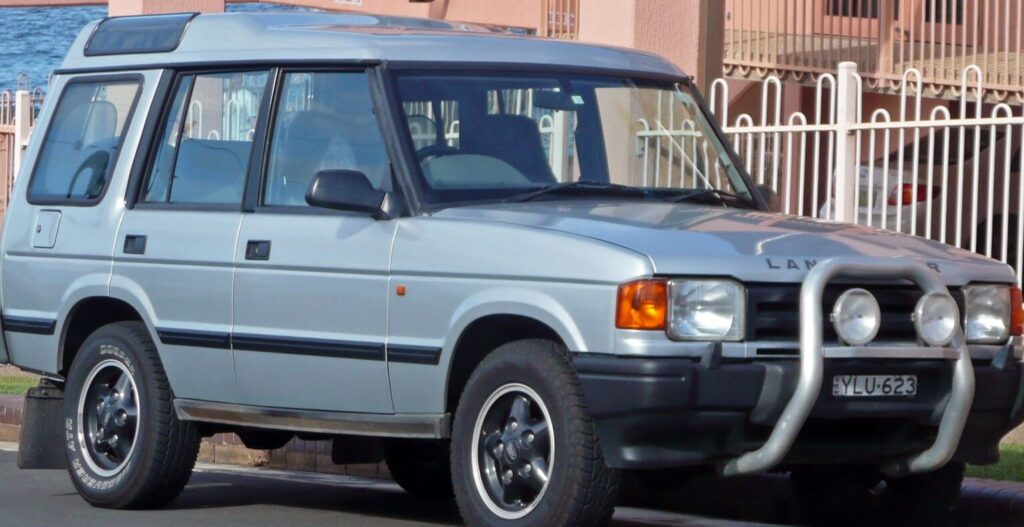
The Land Rover Discovery I 2.0i 4WD Automatic, produced between 1995 and 1998, represented an entry point into the iconic Discovery range. Positioned as a more accessible option within the first generation (Series I) of the Discovery, which spanned from 1989 to 1994, this variant aimed to broaden the appeal of the vehicle. It utilized the 1HX0/A3 platform shared with the Range Rover, offering a blend of off-road capability and family practicality. The 2.0i model was primarily aimed at European markets, where smaller displacement engines were favored due to taxation and fuel costs, and offered a more economical alternative to the larger, more powerful engines available in the Discovery lineup.
Technical Specifications
| Brand | Land Rover |
| Model | Discovery |
| Generation | Discovery I |
| Type (Engine) | 2.0i (134 Hp) 4WD Automatic |
| Start of production | 1995 |
| End of production | 1998 |
| Powertrain Architecture | Internal Combustion engine |
| Body type | SUV |
| Seats | 5 |
| Doors | 3 |
| Fuel consumption (combined) | 14.9 l/100 km |
| Fuel consumption (US mpg) | 15.8 US mpg |
| Fuel consumption (UK mpg) | 19 UK mpg |
| Fuel consumption (km/l) | 6.7 km/l |
| Fuel Type | Petrol (Gasoline) |
| Acceleration 0 – 100 km/h | 15.3 sec |
| Acceleration 0 – 62 mph | 15.3 sec |
| Acceleration 0 – 60 mph | 14.5 sec |
| Maximum speed | 157 km/h (97.56 mph) |
| Weight-to-power ratio | 15.1 kg/Hp |
| Weight-to-torque ratio | 6.5 kg/Nm |
| Power | 134 Hp @ 4750 rpm |
| Power per litre | 67.2 Hp/l |
| Torque | 312 Nm @ 3100 rpm (230.12 lb.-ft. @ 3100 rpm) |
| Engine layout | Front, Longitudinal |
| Engine Model/Code | T16 |
| Engine displacement | 1994 cm3 (121.68 cu. in.) |
| Number of cylinders | 4 |
| Engine configuration | Inline |
| Number of valves per cylinder | 2 |
| Fuel injection system | Multi-port manifold injection |
| Engine aspiration | Naturally aspirated engine |
| Engine oil capacity | 4.9 l (5.18 US qt | 4.31 UK qt) |
| Coolant capacity | 10 l (10.57 US qt | 8.8 UK qt) |
| Kerb Weight | 2020 kg (4453.34 lbs) |
| Max. weight | 2720 kg (5996.57 lbs) |
| Max load | 700 kg (1543.24 lbs) |
| Trunk (boot) space – minimum | 1290 l (45.56 cu. ft) |
| Trunk (boot) space – maximum | 1970 l (69.57 cu. ft) |
| Fuel tank capacity | 89 l (23.51 US gal | 19.58 UK gal) |
| Length | 4524 mm (178.11 in) |
| Width | 1810 mm (71.26 in) |
| Height | 1960 mm (77.17 in) |
| Wheelbase | 2540 mm (100 in) |
| Front track | 1486 mm (58.5 in) |
| Rear track | 1486 mm (58.5 in) |
| Drive wheel | All wheel drive (4×4) |
| Number of gears | 4 |
| Gearbox type | Automatic transmission |
| Front suspension | Rigid axle suspension |
| Rear suspension | Rigid axle suspension |
| Front brakes | Ventilated discs |
| Rear brakes | Disc |
| Assisting systems | ABS (Anti-lock braking system) |
| Power steering | Hydraulic Steering |
| Tires size | 205/80 R16 |
Powertrain & Engine Architecture
The 2.0i Discovery I utilized the T16 engine, a 1994cc inline-four cylinder petrol engine. This engine, while not a Land Rover design originally, was sourced from Rover Group and was a common powerplant in various British Leyland and Rover vehicles. It featured a naturally aspirated configuration with a single overhead camshaft (SOHC) and two valves per cylinder. Fuel delivery was managed by a multi-port fuel injection system, contributing to improved efficiency compared to earlier carbureted engines. The engine produced 134 horsepower at 4750 rpm and 312 Nm (230 lb-ft) of torque at 3100 rpm. The automatic transmission was a four-speed unit, providing relatively smooth shifts but impacting overall performance and fuel economy. This transmission was chosen to appeal to buyers prioritizing ease of use over outright speed.
Driving Characteristics
The 2.0i Automatic Discovery I offered a comfortable, if not particularly brisk, driving experience. The four-speed automatic transmission, while convenient, resulted in a noticeable difference in acceleration compared to the five-speed manual versions or the more powerful V8 models. The 0-60 mph time of around 14.5 seconds reflects this. The gear ratios were optimized for everyday driving and towing, but lacked the responsiveness of the manual gearbox. The engine’s torque delivery was adequate for most situations, but required the transmission to downshift frequently when tackling steep inclines or when fully loaded. Off-road, the 2.0i retained the Discovery’s inherent capability thanks to its four-wheel drive system, but the lower power output meant it wasn’t as adept at maintaining momentum in challenging terrain.
Equipment & Trim Levels
The 2.0i Automatic typically represented the entry-level trim within the Discovery I range. Standard equipment included power steering, central locking, and an AM/FM radio. Interior upholstery was generally cloth, and the dashboard featured a relatively basic layout. Optional extras included air conditioning, electric windows, and a sunroof. The trim level was often identified by relatively simple badging and a focus on practicality rather than luxury. Compared to higher-spec models, the 2.0i often lacked features like leather upholstery, wood trim, and more advanced audio systems.
Chassis & Braking
The Discovery I chassis featured a robust ladder-frame construction, providing excellent durability and off-road capability. Suspension consisted of a rigid axle setup at both the front and rear, utilizing coil springs and shock absorbers. The 2.0i models typically featured ventilated disc brakes at the front and disc brakes at the rear, providing adequate stopping power for the vehicle’s weight. Anti-lock braking system (ABS) was standard, enhancing safety. Stabilizer bars were fitted to both axles to reduce body roll during cornering, although the Discovery’s high center of gravity still resulted in noticeable lean.
Market Reception & Comparison
The 2.0i Automatic Discovery I received mixed reviews. Critics acknowledged its affordability and practicality, but often criticized its lack of performance. Compared to the V8 models, the 2.0i felt significantly underpowered, particularly when fully loaded or towing. Fuel economy, while better than the V8, was still relatively poor at around 15.8 US mpg. The 2.5-liter turbodiesel offered a better balance of performance and economy, making it a popular alternative. However, the 2.0i appealed to buyers who prioritized lower purchase price and running costs over outright performance.
Legacy
The 2.0i Discovery I, while not the most sought-after variant, has developed a loyal following among enthusiasts. The T16 engine, while not known for its longevity, is relatively simple to maintain and repair. The automatic transmission, if properly serviced, can prove reliable. Today, these vehicles are often found in the hands of collectors and off-road enthusiasts who appreciate their affordability and classic Land Rover charm. Rust remains the biggest enemy of these vehicles, and finding well-maintained examples is becoming increasingly difficult. The 2.0i represents a unique chapter in the Discovery’s history, offering a more accessible entry point into the world of Land Rover ownership.