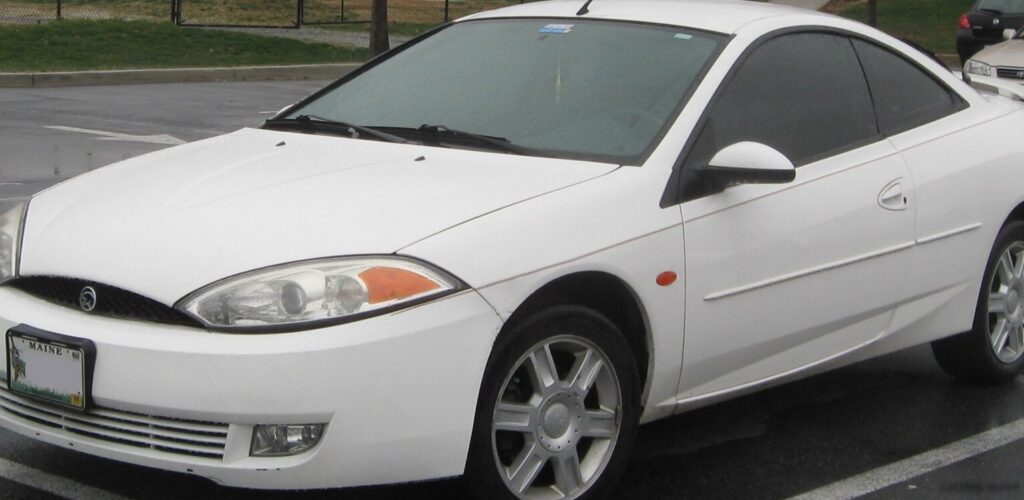
The Mercury Cougar VIII, produced between 1998 and 2002, represented the final generation of the Cougar model before its discontinuation. Positioned as a sporty coupe, it aimed to recapture some of the spirit of the original Cougar while offering a more modern driving experience. This generation, based on the Ford CD2 platform (shared with the Mazda 626 and Ford Mondeo), was primarily sold in the North American market. The 2.0L 16V variant, producing 126 horsepower, served as the entry-level engine option, offering a balance of affordability and reasonable performance. It occupied the lower end of the Cougar VIII lineup, below the more powerful V6 models.
Technical Specifications
| Brand | Mercury |
| Model | Cougar |
| Generation | Cougar VIII |
| Type (Engine) | 2.0 16V (126 Hp) |
| Start of production | 1998 |
| End of production | 2002 |
| Powertrain Architecture | Internal Combustion engine |
| Body type | Coupe |
| Seats | 4 |
| Doors | 3 |
| Fuel consumption (urban) | 9.8 l/100 km (24 US mpg) |
| Fuel consumption (extra urban) | 6.9 l/100 km (34.1 US mpg) |
| Fuel Type | Petrol (Gasoline) |
| Acceleration 0 – 100 km/h | 10 sec |
| Acceleration 0 – 62 mph | 10 sec |
| Acceleration 0 – 60 mph | 9.5 sec |
| Maximum speed | 210 km/h (130.49 mph) |
| Weight-to-power ratio | 10.3 kg/Hp |
| Weight-to-torque ratio | 7.3 kg/Nm |
| Power | 126 Hp @ 5500 rpm |
| Power per litre | 63.4 Hp/l |
| Torque | 177 Nm @ 4000 rpm (130.55 lb.-ft. @ 4000 rpm) |
| Engine layout | Front, Transverse |
| Engine Model/Code | Zetec |
| Engine displacement | 1988 cm3 (121.32 cu. in.) |
| Number of cylinders | 4 |
| Engine configuration | Inline |
| Cylinder Bore | 84.8 mm (3.34 in.) |
| Piston Stroke | 88 mm (3.46 in.) |
| Compression ratio | 9.6:1 |
| Number of valves per cylinder | 4 |
| Fuel injection system | Multi-port manifold injection |
| Engine aspiration | Naturally aspirated engine |
| Valvetrain | DOHC |
| Engine oil capacity | 4.3 l (4.54 US qt | 3.78 UK qt) |
| Coolant | 6.5 l (6.87 US qt | 5.72 UK qt) |
| Kerb Weight | 1300 kg (2866.01 lbs.) |
| Trunk (boot) space – minimum | 410 l (14.48 cu. ft.) |
| Fuel tank capacity | 60 l (15.85 US gal | 13.2 UK gal) |
| Length | 4700 mm (185.04 in.) |
| Width | 1770 mm (69.69 in.) |
| Height | 1320 mm (51.97 in.) |
| Wheelbase | 2700 mm (106.3 in.) |
| Front track | 1505 mm (59.25 in.) |
| Rear (Back) track | 1490 mm (58.66 in.) |
| Drivetrain Architecture | Front wheel drive |
| Number of gears | 5 |
| Gearbox type | Manual transmission |
| Front suspension | Spring Strut |
| Rear suspension | Spring Strut |
| Front brakes | Ventilated discs |
| Rear brakes | Drum |
| Assisting systems | ABS (Anti-lock braking system) |
| Steering type | Steering rack and pinion |
| Power steering | Hydraulic Steering |
| Tires size | 205/60 R15 |
Powertrain & Engine Architecture
The heart of the Cougar VIII 2.0 was the Zetec engine, a 1.998-liter inline-four cylinder powerplant. This engine, part of Ford’s Zetec family, featured a double overhead camshaft (DOHC) valvetrain with four valves per cylinder, contributing to its relatively high output for its displacement. The engine utilized multi-port fuel injection for precise fuel delivery. The 2.0L Zetec in the Cougar VIII produced 126 horsepower at 5500 rpm and 177 Nm (130.55 lb-ft) of torque at 4000 rpm. This variant was exclusively offered with a five-speed manual transmission, providing drivers with direct control over the engine’s power. The transmission was a standard front-wheel-drive configuration, typical for vehicles in this class.
Driving Characteristics
The 2.0L Cougar VIII offered a reasonably engaging driving experience, though it wasn’t a performance leader. Acceleration from 0 to 60 mph took around 9.5 seconds, making it competitive with other coupes in its price range. The five-speed manual transmission allowed drivers to keep the engine in its optimal power band, providing adequate acceleration for everyday driving. Compared to the V6-powered Cougars, the 2.0L felt less powerful, particularly during highway passing maneuvers. However, the lighter weight of the 2.0L engine contributed to slightly better handling and fuel economy. The gear ratios were tuned for a balance of acceleration and fuel efficiency, with a relatively tall fifth gear for comfortable cruising.
Equipment & Trim Levels
The 2.0L Cougar VIII typically came with a standard equipment list that included air conditioning, power windows and locks, and an AM/FM stereo. Interior upholstery was typically cloth, with a relatively simple dashboard layout. Optional extras included a premium sound system, alloy wheels, and a sunroof. The trim level for the 2.0L was generally considered the base model, offering a more affordable entry point into the Cougar lineup. It lacked some of the luxury features found in the higher-trim V6 models.
Chassis & Braking
The Cougar VIII utilized a MacPherson strut front suspension and a multi-link rear suspension, providing a comfortable ride and decent handling characteristics. The front brakes were ventilated discs, offering good stopping power, while the rear brakes were drum brakes, a cost-saving measure for the base model. Anti-lock braking system (ABS) was standard, enhancing safety. The steering was a rack-and-pinion system with hydraulic power assistance, providing responsive and precise steering feel. The suspension was tuned for a balance of comfort and handling, leaning towards the comfort side for everyday driving.
Market Reception & Comparison
The 2.0L Cougar VIII received mixed reviews. Critics generally praised its styling and comfortable ride, but noted that the 2.0L engine lacked the power to truly deliver a sporty driving experience. Compared to the V6 models, the 2.0L offered better fuel economy – around 24 mpg city and 34 mpg highway – but at the expense of performance. The 2.0L was often seen as a more sensible choice for buyers prioritizing fuel efficiency and affordability over outright speed. It competed with other entry-level coupes such as the Honda Civic Coupe and the Nissan Sentra Coupe.
Legacy
The Mercury Cougar VIII, including the 2.0L variant, has become a relatively affordable classic car. The Zetec engine is known for its reliability, although regular maintenance is crucial. Common issues include oil leaks and occasional sensor failures. The 2.0L manual transmission is generally considered durable. Today, the Cougar VIII 2.0L represents an accessible entry point into the world of classic coupes, offering a stylish and relatively reliable driving experience for those seeking a nostalgic alternative to modern vehicles. Parts availability is decent, though some specific trim pieces may be difficult to find. The Cougar VIII, while not a high-performance icon, remains a fondly remembered vehicle for many enthusiasts.