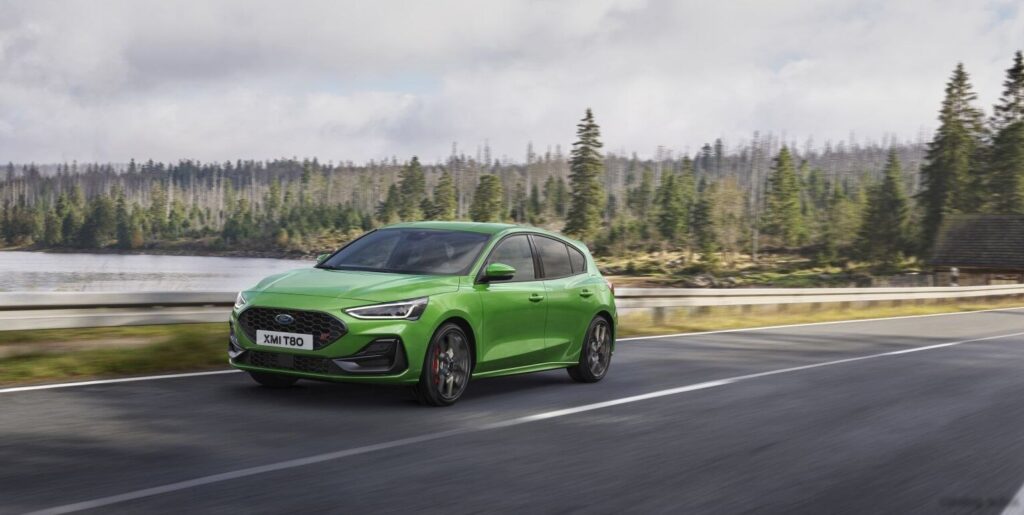
The Ford Focus IV facelift, introduced in January 2022, represented a significant refresh of the fourth-generation Focus, a compact hatchback that had become a mainstay in the European and North American markets. Within the facelifted range, the ST 2.3 EcoBoost model occupied the performance-oriented top tier. This variant, boasting 280 horsepower, was designed to appeal to driving enthusiasts seeking a blend of practicality and spirited performance. It built upon the success of the previous Focus ST models, aiming to deliver a more refined and technologically advanced hot hatch experience. The 2022 ST 2.3 EcoBoost primarily targeted the European market, with limited availability in North America.
Technical Specifications
| Brand | Ford |
| Model | Focus |
| Generation | Focus IV Hatchback (facelift 2022) |
| Type (Engine) | ST 2.3 EcoBoost (280 Hp) |
| Start of production | January, 2022 |
| Powertrain Architecture | Internal Combustion engine |
| Body type | Hatchback |
| Seats | 5 |
| Doors | 5 |
| Fuel consumption at Low speed (WLTP) | 12.7-13.1 l/100 km (18.5 – 18 US mpg, 22.2 – 21.6 UK mpg, 7.9 – 7.6 km/l) |
| Fuel consumption at Medium speed (WLTP) | 7.5-8 l/100 km (31.4 – 29.4 US mpg, 37.7 – 35.3 UK mpg, 13.3 – 12.5 km/l) |
| Fuel consumption at high speed (WLTP) | 6.6-7 l/100 km (35.6 – 33.6 US mpg, 42.8 – 40.4 UK mpg, 15.2 – 14.3 km/l) |
| Fuel consumption at very high speed (WLTP) | 7.6-7.8 l/100 km (30.9 – 30.2 US mpg, 37.2 – 36.2 UK mpg, 13.2 – 12.8 km/l) |
| Combined fuel consumption (WLTP) | 8-8.3 l/100 km (29.4 – 28.3 US mpg, 35.3 – 34 UK mpg, 12.5 – 12 km/l) |
| CO2 emissions (WLTP) | 183-189 g/km |
| Fuel Type | Petrol (Gasoline) |
| Acceleration 0 – 100 km/h | 5.7 sec |
| Acceleration 0 – 62 mph | 5.7 sec |
| Acceleration 0 – 60 mph | 5.4 sec |
| Maximum speed | 250 km/h (155.34 mph) |
| Emission standard | Euro 6d-ISC-FCM |
| Weight-to-power ratio | 5.1 kg/Hp, 194.9 Hp/tonne |
| Weight-to-torque ratio | 3.4 kg/Nm, 292.3 Nm/tonne |
| Power | 280 Hp @ 5500 rpm |
| Power per litre | 123.8 Hp/l |
| Torque | 420 Nm @ 3000-4000 rpm (309.78 lb.-ft. @ 3000-4000 rpm) |
| Engine layout | Front, Transverse |
| Engine Model/Code | N3DA |
| Engine displacement | 2261 cm3 (137.97 cu. in.) |
| Number of cylinders | 4 |
| Engine configuration | Inline |
| Cylinder Bore | 87.6 mm (3.45 in.) |
| Piston Stroke | 94 mm (3.7 in.) |
| Compression ratio | 10:1 |
| Number of valves per cylinder | 4 |
| Fuel injection system | Direct injection |
| Engine aspiration | Turbocharger, Intercooler |
| Valvetrain | DOHC, Ti-VCT |
| Engine oil capacity | 5.3 l (5.6 US qt | 4.66 UK qt) |
| Coolant | 7.2 l (7.61 US qt | 6.34 UK qt) |
| Kerb Weight | 1437 kg (3168.04 lbs.) |
| Max. weight | 2020 kg (4453.34 lbs.) |
| Max load | 583 kg (1285.29 lbs.) |
| Trunk (boot) space – minimum | 358 l (12.64 cu. ft.) |
| Trunk (boot) space – maximum | 1320 l (46.62 cu. ft.) |
| Fuel tank capacity | 52 l (13.74 US gal | 11.44 UK gal) |
| Max. roof load | 75 kg (165.35 lbs.) |
| Permitted trailer load with brakes (12%) | 1600 kg (3527.4 lbs.) |
| Permitted trailer load without brakes | 750 kg (1653.47 lbs.) |
| Permitted towbar download | 90 kg (198.42 lbs.) |
| Length | 4393 mm (172.95 in.) |
| Width | 1825 mm (71.85 in.) |
| Width with mirrors folded | 1848 mm (72.76 in.) |
| Width including mirrors | 1979 mm (77.91 in.) |
| Height | 1454 mm (57.24 in.) |
| Wheelbase | 2700 mm (106.3 in.) |
| Front track | 1567 mm (61.69 in.) |
| Rear (Back) track | 1556 mm (61.26 in.) |
| Front overhang | 913 mm (35.94 in.) |
| Rear overhang | 780 mm (30.71 in.) |
| Ride height (ground clearance) | 120 mm (4.72 in.) |
| Minimum turning circle (turning diameter) | 11 m (36.09 ft.) |
| Drivetrain Architecture | The Internal combustion engine (ICE) drives the front wheels of the vehicle. |
| Drive wheel | Front wheel drive |
| Number of gears and type of gearbox | 6 gears, manual transmission |
| Front suspension | Independent type McPherson |
| Rear suspension | Independent multi-link suspension |
| Front brakes | Ventilated discs, 330×27 mm |
| Rear brakes | Disc, 302×11 mm |
| Assisting systems | ABS (Anti-lock braking system) |
| Steering type | Steering rack and pinion |
| Power steering | Electric Steering |
| Tires size | 235/40 R18; 235/35 R19 |
| Wheel rims size | 8J x 18; 8J x 19 |
INTRODUCTION
The Ford Focus IV facelift ST 2.3 EcoBoost, launched in 2022, represents the pinnacle of performance for the fourth-generation Focus hatchback. Positioned as the flagship model, it offered a substantial upgrade over the standard Focus trims, targeting enthusiasts who desired a more engaging driving experience. The “ST” designation, historically signifying Ford’s performance models, was carried forward, building on a legacy of sporty compacts. This variant was primarily aimed at the European market, where the hot hatch segment is particularly popular, though limited numbers were available in North America. The 2.3-liter EcoBoost engine, a key component of the ST, had previously seen duty in the Ford Mustang and other performance applications, ensuring a robust and capable powerplant.
Powertrain & Engine Architecture
At the heart of the Focus ST 2.3 EcoBoost lies the N3DA 2.3-liter inline-four cylinder engine. This engine is a turbocharged, direct-injection unit, benefiting from Ford’s EcoBoost technology. The engine produces 280 horsepower at 5500 rpm and 420 Nm (309.78 lb.-ft.) of torque between 3000 and 4000 rpm. The direct injection system, coupled with a twin-scroll turbocharger and an intercooler, contributes to both power output and efficiency. The engine features a DOHC (Double Overhead Camshaft) valvetrain with Ti-VCT (Twin Independent Variable Camshaft Timing), allowing for optimized valve control across the engine’s operating range. The engine’s transverse mounting and front-wheel-drive configuration are typical for this class of vehicle. The 6-speed manual transmission was standard, providing drivers with precise control over gear selection. The engine oil capacity is 5.3 liters (5.6 US qt | 4.66 UK qt) and requires a specification adhering to Ford’s standards. The engine also incorporates a start/stop system and a particulate filter to meet stringent emissions regulations.
Driving Characteristics
The Focus ST 2.3 EcoBoost delivers a noticeably more engaging driving experience compared to lower-powered Focus variants. The 280 hp output, combined with the readily available torque, results in brisk acceleration – 0-60 mph in approximately 5.4 seconds. The manual transmission allows for precise gear changes, enhancing driver involvement. The chassis is tuned for sporty handling, with a stiffer suspension setup compared to standard models. The steering is responsive and provides good feedback. While the front-wheel-drive configuration can exhibit some torque steer under hard acceleration, the limited-slip differential (standard on the ST) helps mitigate this effect, improving traction and cornering ability. The gear ratios are optimized for performance, providing strong acceleration in each gear. Compared to a hypothetical Focus with a smaller engine and automatic transmission, the ST offers significantly more power and a more dynamic driving experience, albeit with a trade-off in fuel economy.
Equipment & Trim Levels
The Focus ST 2.3 EcoBoost came generously equipped as standard. Key features included sport seats with enhanced bolstering, a unique ST body kit (including a rear spoiler and aggressive front bumper), and alloy wheels. The interior typically featured a dark color scheme with contrasting stitching. Infotainment was provided by Ford’s SYNC system, with a touchscreen display and smartphone integration. Optional extras included a Bang & Olufsen sound system, a sunroof, and various driver-assistance technologies such as adaptive cruise control and lane-keeping assist. The ST trim level was positioned as the premium offering within the Focus range, offering a more comprehensive feature set than the base or mid-range models.
Chassis & Braking
The Focus ST 2.3 EcoBoost features an independent McPherson strut suspension at the front and an independent multi-link suspension at the rear, optimized for handling and ride comfort. The suspension components are stiffer than those found on standard Focus models, reducing body roll and improving responsiveness. Braking duties are handled by ventilated discs at the front (330×27 mm) and solid discs at the rear (302×11 mm). The anti-lock braking system (ABS) is standard, providing enhanced stopping power and control. The electric power steering system offers precise and responsive steering feel.
Market Reception & Comparison
The Focus ST 2.3 EcoBoost generally received positive reviews from automotive critics. Praise was directed towards its powerful engine, engaging handling, and well-equipped interior. Some critics noted the potential for torque steer, but the limited-slip differential helped to minimize this issue. Compared to rivals such as the Volkswagen Golf GTI and the Hyundai i30 N, the Focus ST offered a compelling combination of performance and value. Fuel economy, while not exceptional, was reasonable for a performance hatchback. Reliability reports have been generally positive, with the EcoBoost engine proving to be a durable and dependable unit.
Legacy
The Ford Focus IV facelift ST 2.3 EcoBoost represents a high point in the Focus’s performance lineage. The 2.3-liter EcoBoost engine has proven to be a robust and tunable powerplant, making it a popular choice for aftermarket modifications. On the used car market, these models hold their value relatively well, reflecting their desirability among driving enthusiasts. While the Focus has been discontinued in North America, the ST variant remains a sought-after performance hatchback in Europe, known for its blend of practicality, performance, and driving enjoyment.