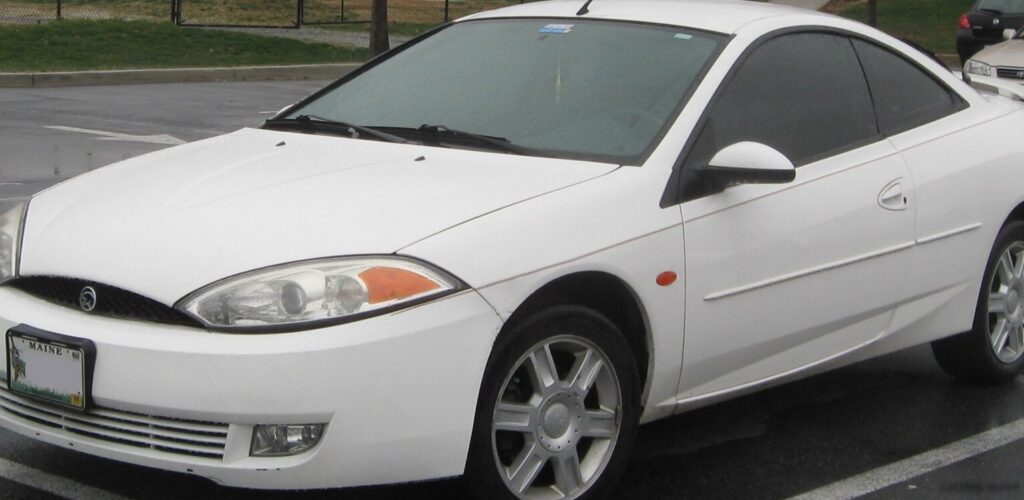
The Mercury Cougar VIII, produced between 1998 and 2002, represented the eighth generation of the Cougar model. Positioned as a sporty coupe within the Mercury lineup, it aimed to recapture some of the spirit of the original Cougar while offering modern features and styling. This generation, built on the Ford CD2 platform (shared with the Ford Contour and Mazda 626), was primarily marketed in North America. The 2.5-liter V6 24V variant, producing 173 horsepower, served as a mid-range offering, bridging the gap between the base engine and potential higher-performance trims (though a higher-output V6 was not offered in the US market). It was designed to appeal to buyers seeking a balance of style, performance, and affordability.
Technical Specifications
| Brand | Mercury |
| Model | Cougar |
| Generation | Cougar VIII |
| Type (Engine) | 2.5 V6 24V (173 Hp) |
| Start of production | 1998 |
| End of production | 2002 |
| Powertrain Architecture | Internal Combustion engine |
| Body type | Coupe |
| Seats | 4 |
| Doors | 3 |
| Fuel consumption (urban) | 12.4 l/100 km (19 US mpg) |
| Fuel consumption (extra urban) | 8.4 l/100 km (28 US mpg) |
| Fuel Type | Petrol (Gasoline) |
| Acceleration 0 – 100 km/h | 8.5 sec |
| Acceleration 0 – 62 mph | 8.5 sec |
| Acceleration 0 – 60 mph | 8.1 sec |
| Maximum speed | 225 km/h (139.81 mph) |
| Weight-to-power ratio | 7.9 kg/Hp |
| Weight-to-torque ratio | 6.1 kg/Nm |
| Power | 173 Hp @ 6250 rpm |
| Power per litre | 68 Hp/l |
| Torque | 224 Nm @ 4250 rpm (165.21 lb.-ft. @ 4250 rpm) |
| Engine layout | Front, Transverse |
| Engine Model/Code | Duratec |
| Engine displacement | 2544 cm3 (155.24 cu. in.) |
| Number of cylinders | 6 |
| Engine configuration | V-engine |
| Cylinder Bore | 82.4 mm (3.24 in.) |
| Piston Stroke | 79.5 mm (3.13 in.) |
| Compression ratio | 9.7:1 |
| Number of valves per cylinder | 4 |
| Fuel injection system | Multi-port manifold injection |
| Engine aspiration | Naturally aspirated engine |
| Valvetrain | DOHC |
| Engine oil capacity | 5.5 l (5.81 US qt | 4.84 UK qt) |
| Coolant | 9.5 l (10.04 US qt | 8.36 UK qt) |
| Kerb Weight | 1375 kg (3031.36 lbs.) |
| Trunk (boot) space | 410 l (14.48 cu. ft.) |
| Fuel tank capacity | 60 l (15.85 US gal | 13.2 UK gal) |
| Length | 4700 mm (185.04 in.) |
| Width | 1770 mm (69.69 in.) |
| Height | 1320 mm (51.97 in.) |
| Wheelbase | 2700 mm (106.3 in.) |
| Front track | 1505 mm (59.25 in.) |
| Rear track | 1490 mm (58.66 in.) |
| Drivetrain Architecture | Front wheel drive |
| Number of gears | 5 |
| Gearbox type | Manual transmission |
| Front suspension | Spring Strut |
| Rear suspension | Spring Strut |
| Front brakes | Ventilated discs |
| Rear brakes | Disc |
| Assisting systems | ABS (Anti-lock braking system) |
| Steering type | Steering rack and pinion |
| Power steering | Hydraulic Steering |
| Tires size | 205/60 R15 |
Powertrain & Engine Architecture
The heart of the Cougar VIII 2.5 was the Ford Duratec 2.5-liter V6 engine. This engine, part of Ford’s modular engine family, featured a 60-degree V-angle and a double overhead camshaft (DOHC) valvetrain with four valves per cylinder. The multi-port fuel injection system delivered fuel directly to each intake port, optimizing combustion efficiency. The engine produced 173 horsepower at 6250 rpm and 224 Nm (165 lb-ft) of torque at 4250 rpm. The 5-speed manual transmission was the standard offering for this trim, providing drivers with direct control over the engine’s power. The transmission’s gear ratios were tuned for a balance of acceleration and fuel economy, though some reviewers noted that the shift linkage could feel slightly vague.
Driving Characteristics
The 2.5-liter Cougar offered a reasonably engaging driving experience. While not a performance powerhouse, the engine provided adequate power for everyday driving and occasional spirited runs. Acceleration from 0-60 mph took around 8.1 seconds, which was competitive for its class at the time. The manual transmission allowed for precise gear selection, and the front-wheel-drive layout provided good traction in most conditions. Compared to a hypothetical higher-performance V6 variant, the 2.5L felt less urgent in its acceleration, but it offered a more relaxed and fuel-efficient driving experience. The suspension, tuned for comfort, provided a reasonably smooth ride, although it could feel somewhat soft during aggressive cornering.
Equipment & Trim Levels
The 2.5-liter Cougar typically came standard with features such as air conditioning, power windows and locks, a CD player, and an anti-lock braking system (ABS). Interior upholstery was typically cloth, with options for leather available. Optional extras included a sunroof, upgraded sound system, and alloy wheels. The dashboard layout was relatively straightforward, with easy-to-read gauges and logically placed controls. The Cougar aimed for a slightly more upscale feel than some of its competitors, with attention paid to interior materials and design.
Chassis & Braking
The Cougar VIII utilized a front-wheel-drive chassis with independent front suspension using MacPherson struts and a multi-link rear suspension. This setup aimed to provide a balance of ride comfort and handling. The braking system consisted of ventilated discs at the front and solid discs at the rear, providing adequate stopping power for the vehicle’s weight and performance. ABS was standard, enhancing safety by preventing wheel lockup during hard braking. The steering was rack-and-pinion with hydraulic power assistance, offering a reasonably responsive feel.
Market Reception & Comparison
The Mercury Cougar VIII 2.5 V6 received mixed reviews from automotive critics. While the styling was generally praised, some reviewers found the interior materials to be somewhat lacking. The 2.5-liter engine was considered adequate for most drivers, but it wasn’t particularly exciting. Fuel economy was reasonable, averaging around 19 mpg in the city and 28 mpg on the highway. Compared to other coupes in its class, such as the Ford Mustang or Honda Prelude, the Cougar offered a more comfortable ride and a more refined interior, but it lacked the outright performance of some of its rivals. The manual transmission was appreciated by enthusiasts, but some found the shift quality to be less precise than in competing models.
Legacy
The Mercury Cougar VIII, while not a runaway sales success, remains a fondly remembered coupe from the late 1990s and early 2000s. The Duratec 2.5-liter V6 engine proved to be relatively reliable, and well-maintained examples can still be found on the used car market today. While not known for any major mechanical flaws, regular maintenance, including timing belt replacement, is crucial for long-term reliability. The Cougar VIII represents a transitional period in automotive design, blending traditional coupe styling with modern engineering and features. It offers a unique alternative to more common sports coupes of the era, appealing to buyers seeking a comfortable, stylish, and reasonably affordable vehicle.